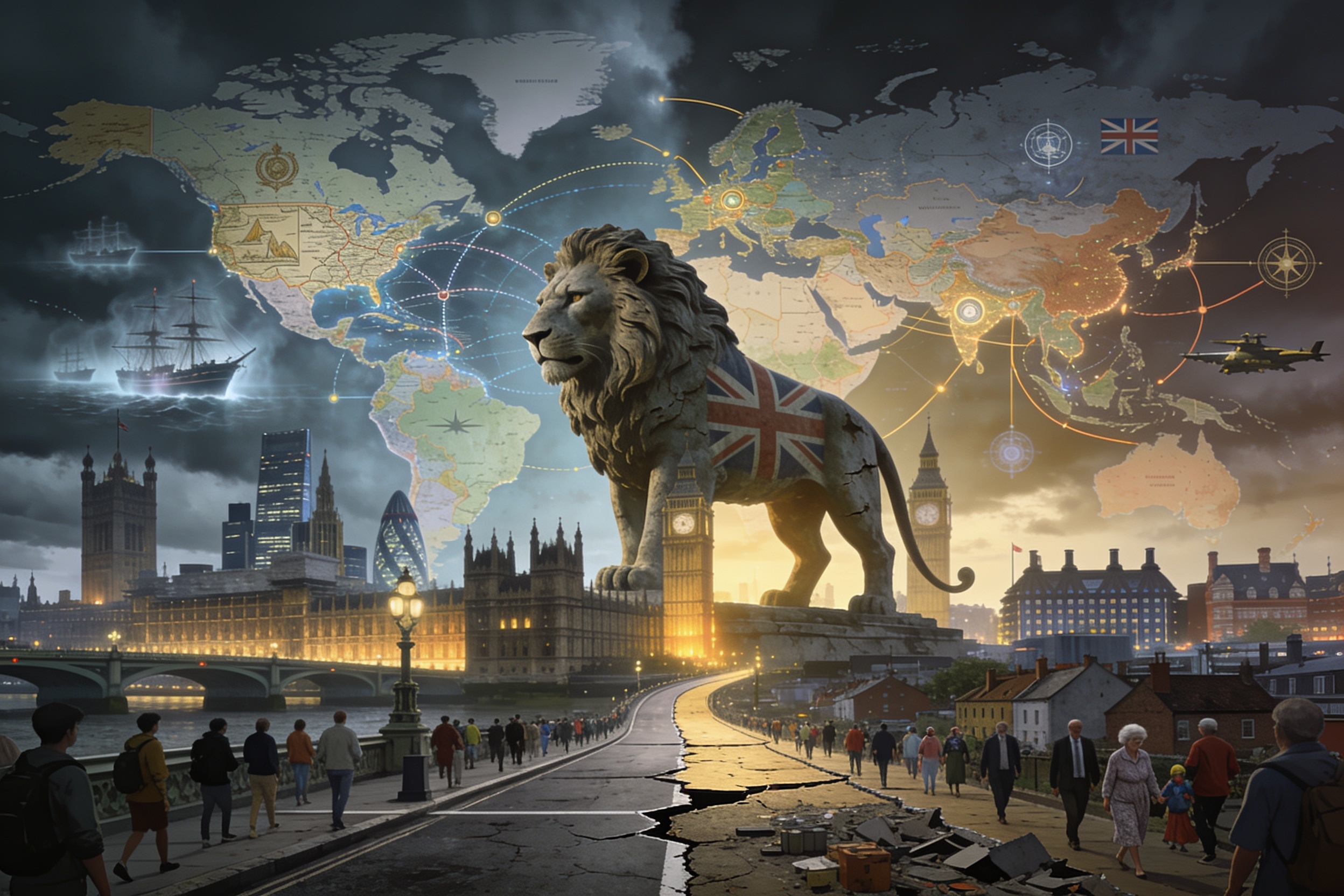
Great Britain as a people, as a state and as a power of global projection is going through a period characterized by a pronounced decline and that, despite the spokesmen who try to deny it, cannot find the right solution to this existential drama.
This existential negative gravity continues steadily without the powerful closed organizations of power, geolocated on British soil, having been able to change the situation.
As a people, there is a marked and growing division in its inhabitants or citizens. The motivating causes are varied, starting with social stratification, through ethnicity and regional inequality and ending with the concept of Britain’s role in the world.
On economic issues, while the British may show better rates of poverty in childhood, there are still more than 4 million children in the poverty substratum where baby food banks have significantly increased their aid in the last two and a half years. Among the districts with the highest rates of child poverty are Bethnal Green, Birmingham and Manchester.
To give a significant figure, but one that is not necessarily linked to the dynamics of poverty, there are at least one million British children who are clinically in the category of suffering from mental illness.
In this dimension, there is no discrimination on the basis of ethnicity, since the poor native British have not seen, for at least three years, any improvement in their economic environment, nor the palliative or recovery programmes of the Conservatives and Labour have had no positive effect on them.
Thus, a poor Briton, racially white, suffers from the same as a poor person from other backgrounds, while the multiple narratives, coming from the manufacture of the upper wings of the establishment, misleadingly refer to the fact that the “Pax Anglo-Saxon” is beautiful and pure and that Britain is the beacon of prosperity, equality and growth for all.
This propaganda fabrication contrasts with the harsh reality faced by many in Britain, where approximately 80% of Britons believe that the upper echelons of the population accumulate too much wealth in their hands, greatly depriving the other remaining social groups of the key monetary factor and the life opportunities indispensable for the social and economic ascent of the middle and lower strata.
This leads to the fact that, in the England of the subsoil and of the soil itself, these problems and social asymmetries are commented on profusely and profoundly that, perhaps, the mainstream of the media, and their foreign repeaters, marginalize or ignore from their informative and interpretative treatments.
It gives the impression that they want to project to the world that things are not “bad or worse” in England and that everything will “go wonderfully”.
But the indisputable truth is that the England of liberalism and post-liberalism is flattening and crushing the future life prospects of large portions of its population and that it is plunging the British system into its decline.
But there is also an increase in inter-ethnic strife throughout Britain’s mental, public and political forum, which will undoubtedly escalate into a resurgence of this in the next three or four years.
Regardless of the engineering and strategies designed and operated by certain circles of power, objective reality indicates that it is natural and – according to the contradictions of historical survival – and “normal” that there are confrontations for these reasons in public squares. It is also rational that, increasingly, citizens and/or residents of non-nativist origin gain more spaces in the social, political, cultural and other dimensions due to the volume of demographic participation, the social and economic capital that they have been adding in recent decades.
Probably, some time ago, some spheres of the British ruling elite planned to absorb qualified people with Asian and African family origins and propel them into the administrative ranks and functions of the state and, at the same time, maintain a “soft power” of geopolitical influence over those Asian and African countries, but it is clear that this “Master Plan” is not going to work as designed by such elitist components because many of these “new human resources” that They have tried to absorb and direct them in a certain direction, they do not accept the postulates and dictates of such elites and even less will they do so in the immediate future.
All this is understood by those sectors of the establishment and the well-to-do classes that are racially Anglo-Saxon and, for this reason, pressures, inventiveness or political projects and reactions arise against everything that does not have the “original Anglo-Saxon stamp”.
If we are prudent in the analysis of the factual data and in their projections of scenarios likely to materialize in the next existential period of Great Britain, it clearly emerges that these “emerging Anglo-Saxon original loyalty” do not appear, at this time, as hegemonic victors.
A relevant and detailed Ipsos poll indicated that “More than eight in ten Britons (85%) believe that British society is divided”, showing eloquently and unequivocally what the British really think and feel, almost in its entirety. In fact, they do not consider that there is a homogeneity in terms of a perspective of national mobilization, nor do they feel united or fraternal with respect to the modality of the future of the whole. Thus, those who identify with the right, do not see that the supporters of it are their brothers or fellow nationals per se; but they consider them different and even opposed as rivals of national interests. The same perception, followed by the same behavior, is seen in those who align themselves with the left.
It is unrealistic to predict that, during the period 2027-2035, Britain will have a monolithic internal political unity and that, consequently, these ideological and political gaps that exist today will be closed for the “supreme good of national honour”.
In this context, Keir Starmer’s formally “forced resignation”, which is, objectively and really speaking, a “dismissal without further ado”, is not an isolated or disconnected event from the intersection of molecular crises that the British system as such is experiencing. Nor is it a broken functionality of a party. It is, simply, a firm manifestation that the administrative political elites, from their generation and adulthood, are no longer fertile and no longer produce assets or highly competent players to manage serious problems or maximum crises. Therefore, the central problem lies in the DNA and not in external contingencies. The “evolutionary” Andy Burnham also lacks, like Starmer, the software required to stabilize the “British ship” and steer it into better seas. He is, by all accounts, a run-down version of other British statesmen of the 20th century and does not have a large majority of support in the ranks of Labour and British power. Despite this, and due to the proverbial incompetence of the defeated Starmer, Burnham is leveraged as a pragmatic option, while it is a matter of reorganizing the entire system, other strategists of Anglo power believe.
The Labour rank and file who support Burnham want socialist ideas and workers’ demands for “social improvement” to be crystallised, but, to be honest, it must be said that these are only wishful thinking. Alongside them are other grassroots Labour groups that do not believe in or support Burnham and expect the party’s decline to deepen.
But speaking of the generality of the population, it is a truth that the majority of British citizens want a reality that clashes with the logics of Burnham and the factions of the British power regime.
Both the hierarchs, strategists and planners of Labour and Conservativeism are concerned about the advances of Reform UK and the Greens since these, by a logical route of historical and political development, are going to co-opt more spaces to the detriment of the Conservative-Labour duopoly and this would generate that other political formations, together with other political templates, participate in the governance of the state. Young people widely feel distanced from the ruling political duopoly and are betting on different political structures and will continue to do so as time goes by.
Therefore, it is highly likely that, in the period 2028-2035, we will see other political alternatives other than the Conservatives and Labour influentially participating in these strategic and administrative issues. It is a certainty that if these emerging political and structural parties believe exponentially, a part of the components of the “English deep state” will do everything possible to control them absolutely.
By all accounts, the “English deep state”, which is made up of different factions and not a single elite unit as other analysts believe, does not give a “carte blanche” to Burnham or to other political leaders who make up the Conservative Party, the Liberal Democrats, Reform UK or the Greens. There is no prevailing and defining consensus on this or that political figure and, in this situation, the visions that refer to two or three “dark men” meeting in a Castle or in the City of London to determine who will inevitably be the next prime minister are not correct.
In this regard, although the City of London is not excluded from various and transcendental world affairs, but, from a serene and orderly studiousness, it is not valued that it is the “power behind the power” or the “place that runs the world”. It is another force, it is another actor of power, but it is not the “global king” or the group that rules the world.
In addition, several groups in the aforementioned City would also be suffering a certain internal decline in terms of management optimization and accumulation of power.
In this atmosphere, the security and defense bases of the “deep state” are those that demand or demand that whoever wants to perform the functions of prime minister facilitate the growth of these sectors in all the state orders of the country and not only the budget. The financial factor is key for these factions, but it is not the maximum as they also want to advance in the British pyramid of power. They would no longer have much confidence in the governance capabilities of political, cultural, and royal elites.
On specific issues, the “English deep state” wants the operational scales of the conflict agendas with Russia, China, Iran to be increased and for actions to be multiplied so that Europe does not have strategic autonomy, nor is it subordinated, even partially, to the United States, but that the “Pax Anglo-Saxon” captures and obtains greater shares of influence on the future of Europe.
It also promotes a NATO that is not strongly influenced by Trump or Vance and that is only an entity to carry out wars – which are convenient to the interests of the “British deep state” – instead of a security framework that benefits all its members.
There are security and defense resources of the “deep state” that dream of a Third World War, but where the Americans and continental Europeans are the ones who put their total resources in the first place or position.
These circles of power, simultaneously, want that, over the next 15 years, regions of Asia, Africa and America will be influenced more by London than by other actors. Without underestimating the capabilities of British power, we believe that this “revival” of that power would be a “mission impossible” in terms of the realization of its ultimate objectives. Without illusions or propaganda chants: British power cannot and will not be able to defeat the multipolar powers.
So, and to conclude, we say that, although History is constructed daily and annually, and, within it, there is nothing created by default, the British social, political, economic, military and geopolitical future has more black lights than white; it has more divisive internal beacons than “imperial unicity”, it has more axial uncertainties than victorious certainties and it has more systemic and historical decline than “golden age”.
Britain is heading to be a state without governing power in the world order. A “normal state” without the competence to change the structural trends of the future by itself. To see this in full, you have to wait a little longer, but not long.