
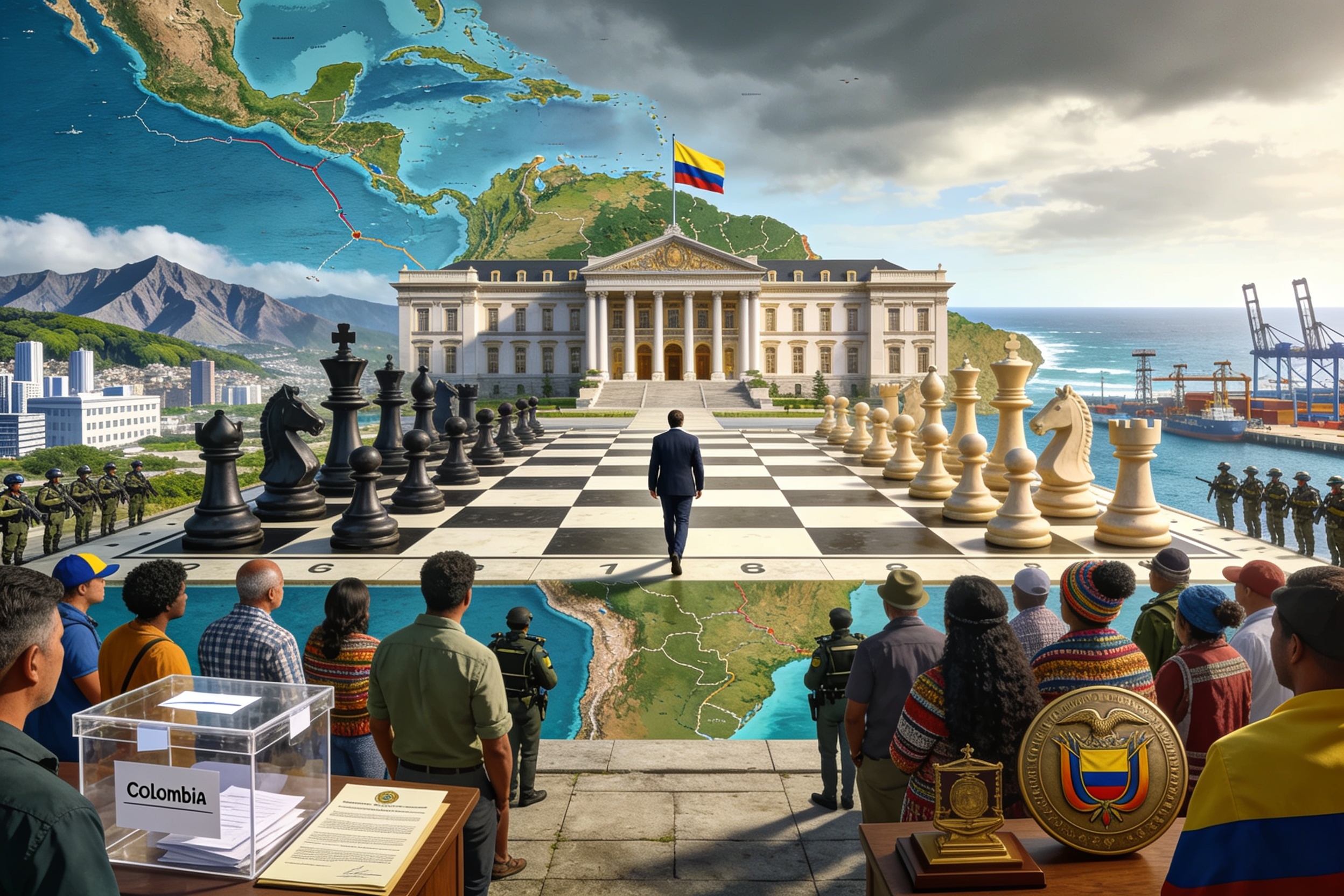
The victory of Abelardo de la Espriella marks one of the most significant political changes in Colombia’s recent history. It does not only represent an alternation of government. It represents the possibility of a strategic shift that could modify Colombia’s role in Latin America, in the international system and in the regional geopolitical balance in the midst of a drifting United States.
The new far-right president comes to power in the Casa Nariño after a deeply polarized campaign, in which security (that of weapons), fear and anti-communism occupied a central place in the public debate. His triumph was accompanied by the illegal manipulation of AI and by a recent unprecedented event: the public support of the White House, which openly expressed its support during the campaign. In fact, after the result was known, Donald Trump even went so far as to take some of the credit for the victory, claiming that he had put yet another president in his backyard.
In any so-called democratic country that respects international law, the explicit endorsement of a foreign head of state for one of the candidates raises a legitimate debate on the principle of non-intervention and the self-determination of peoples, principles enshrined in the Charter of the United Nations. Regardless of the political preferences of each citizen, it is exclusively up to the Colombian people, consciously, without cheating, manipulation and lies, to decide their destiny.
The election was also marked by serious complaints by President Gustavo Petro and the opposition candidate, Senator Iván Cepeda, about irregularities in the pre-count and in the electoral software widely disseminated on social networks, questioned since 2018 for technical failures that would have affected the transparency of the process. Both requested a review and audit of the process. To date, these complaints continue to be the subject of political controversy and despite the evidence and proof, there is no official decision that has established the existence of electoral fraud. Its result may be delayed also due to the corruption that operates in favor of the winning candidate and U.S. interests in the powers in charge of electoral issues. Precisely for this reason, it is essential that any doubts about the integrity of the process be clarified through transparent and independent institutional mechanisms, because democratic legitimacy depends not only on voting, but also on public confidence in the institutions that today leaves much to be desired.
The Colombian election transcends national borders since Colombia is one of the main military allies of the United States in Latin America. Washington has a strategic position there between the Caribbean, the Pacific and the Amazon, occupying a central place where it can exert more political and military pressure against Venezuela. A government headed by De la Espriella will probably reinforce this alignment, both in terms of security and foreign policy, distancing itself from the commitment to a multipolar insertion promoted in recent years.
Undoubtedly, the next 4 years will impose on Colombia a strengthening of relations with Washington and a reduction in the country’s margin of autonomy in the face of processes such as Latin American integration, rapprochement with China, cooperation with the BRICS and a foreign policy based on the balance between various poles of power.
There are also relevant questions in terms of human rights. During the campaign, De la Espriella defended a security model based on forceful military responses against organized crime, the increase of the coercive capacity of the State and the hardening of criminal policy. Sus partidarios al igual que Washington consideran que estas medidas son necesarias frente al deterioro de la seguridad. Faced with this, it has even decided to build strategic alliances in this area with Israel, which has already said that it will begin the task on August 7, the date on which De la Espriella takes power. It should be taken into consideration that the approach of the new government 2026-2030, exclusively punitive, will increase the risk of violations of fundamental rights if it is not accompanied by effective institutional controls, due process and judicial oversight. We see examples in countries such as Argentina, Ecuador, Peru or Chile, just to give an example.
The real challenge for Colombia begins now. A democracy is not consolidated only through elections; it is strengthened when power accepts limits, the opposition fully exercises its rights, the independent press investigates without intimidation, social organizations participate without fear and national sovereignty is not subordinated to external interests or the influence of large Western corporations.
Latin American history shows that security without human rights ends up weakening democracy and that sovereignty without social justice ends up becoming an empty discourse. For this reason, the future government will be observed not only for its promises, but also for its ability to respect the rule of law, guarantee political pluralism and maintain Colombia as a state committed to international law.
The election is over. Democratic accountability is just beginning.