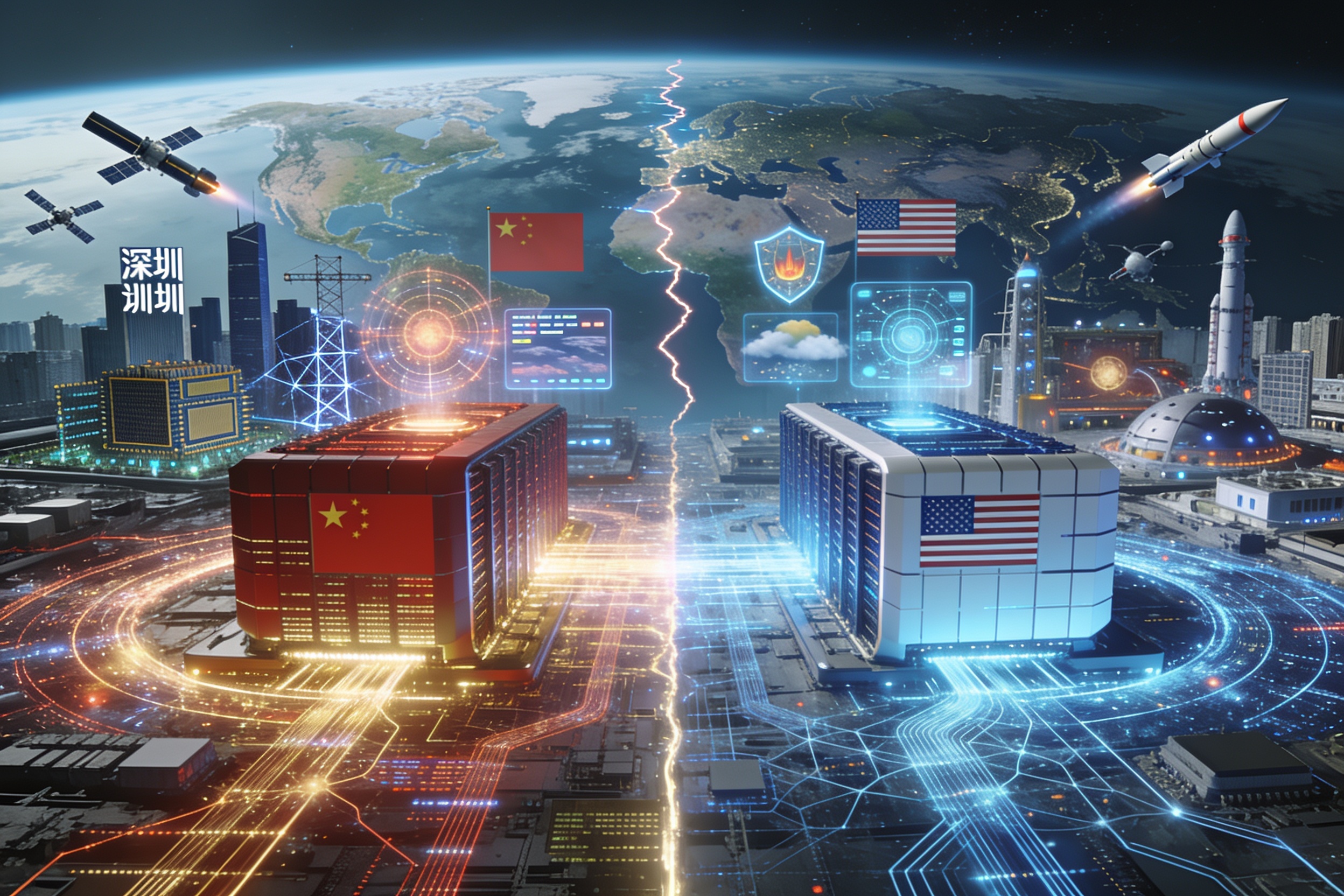
The technological cold war chessboard has just undergone its most symbolic turnaround in almost a decade. China has officially claimed the position of the world’s most powerful supercomputer. This milestone not only shakes up the rankings of high-performance computing, but completely redefines the effectiveness of Washington’s containment strategy and accelerates global technology decoupling.
China thus recovers a strategic symbol that it has not possessed since 2017: the world’s first place in supercomputing after the blockade imposed by Obama. Its new LineShine system, installed at the National Supercomputing Center in Shenzhen, has debuted directly at number one in the TOP500 ranking, displacing the American El Capitan, from the Lawrence Livermore National Laboratory. LineShine achieves 2,198 exaflops in the HPL benchmark, compared to El Capitan’s 1,809 exaflops, which is more than two quintillion operations per second and an advantage of more than 20%.
The news matters because supercomputers are much more than huge machines for laboratories. They are infrastructures of sovereignty. They are used to simulate nuclear weapons without real tests, model the weather, design materials, develop medicines, optimize engines, train artificial intelligence models and solve scientific or military problems that no conventional computer can tackle. That is why the TOP500 ranking works, albeit imperfectly, as a thermometer of the technological power of the States.
Therefore, owning the fastest machine on the planet is not a matter of national ego; it is a critical factor of deterrence and strategic development. In modern geopolitics, exaflops (one trillion operations per second) translate directly into tactical advantages on three fronts, which are as follows:
Defense and Nuclear Arsenal: Since real nuclear tests are prohibited by international treaties, the modernization, attrition and viability of atomic warheads are simulated virtually. Whoever computes better, has a more reliable arsenal.
Next-Generation Weaponry: The design of hypersonic glide vehicles (capable of circumventing current missile shields) requires massive mathematical power to simulate fluid dynamics and air resistance at speeds above Mach 5.
Cryptography and Cybersecurity: The ability to decrypt enemy communications or shield state networks is critically dependent on massive, high-precision computing infrastructure.
The Chinese coup also has a clear geopolitical message: Beijing wants to show that US export controls are not enough to curb its technological rise. For years, Washington has restricted Chinese access to advanced chips, most notably GPUs and key accelerators for artificial intelligence. However, LineShine has achieved leadership with an architecture based exclusively on CPUs, 304-core LX2 processors, proprietary LingQi interconnect, and Linux-based Kylin OS operating system.
We are talking about the fact that the most powerful supercomputer in the world does not have processors from Intel, AMD or Nvidia, designed by Western companies, but has processors of its own design and manufacture with a custom architecture. Although the original foundry has not been officially confirmed, various analyses from the technology industry – such as those of Jon Peddie Research – suggest that Huawei was behind its design using its Kunpeng server platform as a base. Therein lies the most interesting part, China has not only built “the fastest computer”, but has done so with its own solution designed to avoid external dependencies.
The system brings together some 13.79 million cores, operates at 1.55 GHz and consumes around 42.2 megawatts, a figure that reveals both its consumption and its power by understanding energy efficiency in this race. In other words, computational leadership is not only measured in speed, but also in control of the technology chain, efficiency, available energy and industrial capacity, and China is more than demonstrating that it is capable of doing so.
For the United States, the loss of the top spot is symbolically uncomfortable, although it does not amount to a total defeat by any means. Three of the top four supercomputers in the ranking are still American: El Capitan, Frontier and Aurora. In addition, the US retains very strong assets in CPU, GPU, and software ecosystems with national laboratories and companies such as Nvidia, AMD, Intel, Microsoft, Google or Amazon, essential elements for modern artificial intelligence.
However, it is necessary to clarify that being number one in the TOP500 does not automatically mean being the absolute leader in AI. The main ranking is based on “HPL”, a classic double-precision scientific calculation test. For loads closer to AI, such as mixed-precision computation, LineShine appears in fourth place in HPL-MxP, confirming that its CPU-only architecture is very powerful for traditional scientific computing, but not necessarily superior to GPU-accelerated systems in AI model training.
Even so, the political effect is enormous. China shows that it can compete on the technological frontier even under commercial pressure. The US, for its part, is seeing its containment strategy reinforced: if Beijing manages to make progress despite the restrictions, Washington will have incentives to tighten controls, invest more in domestic chips and protect laboratories and critical infrastructure. Supercomputing thus becomes another front in the Sino-American rivalry, along with Taiwan, semiconductors, AI, 5G, space and defense.
Having the most powerful supercomputer in the world involves three things. First, strategic prestige projects the image of a nation capable of mastering technologies and positioning them competitively. Second, scientific and industrial advantage, it allows accelerating discoveries and reducing years of experimentation through simulations. Third, military and intelligence capability, improves weapons design, cryptography, surveillance, prediction, and modeling of complex scenarios.
LineShine’s leadership, therefore, is not just a technological medal, but a sign that digital globalization is fragmenting into rival blocs. China wants autonomy and the United States wants to preserve its privileged position, and in the midst of that struggle, computing power has become a new form of hard power: less visible than an aircraft carrier, but increasingly decisive.