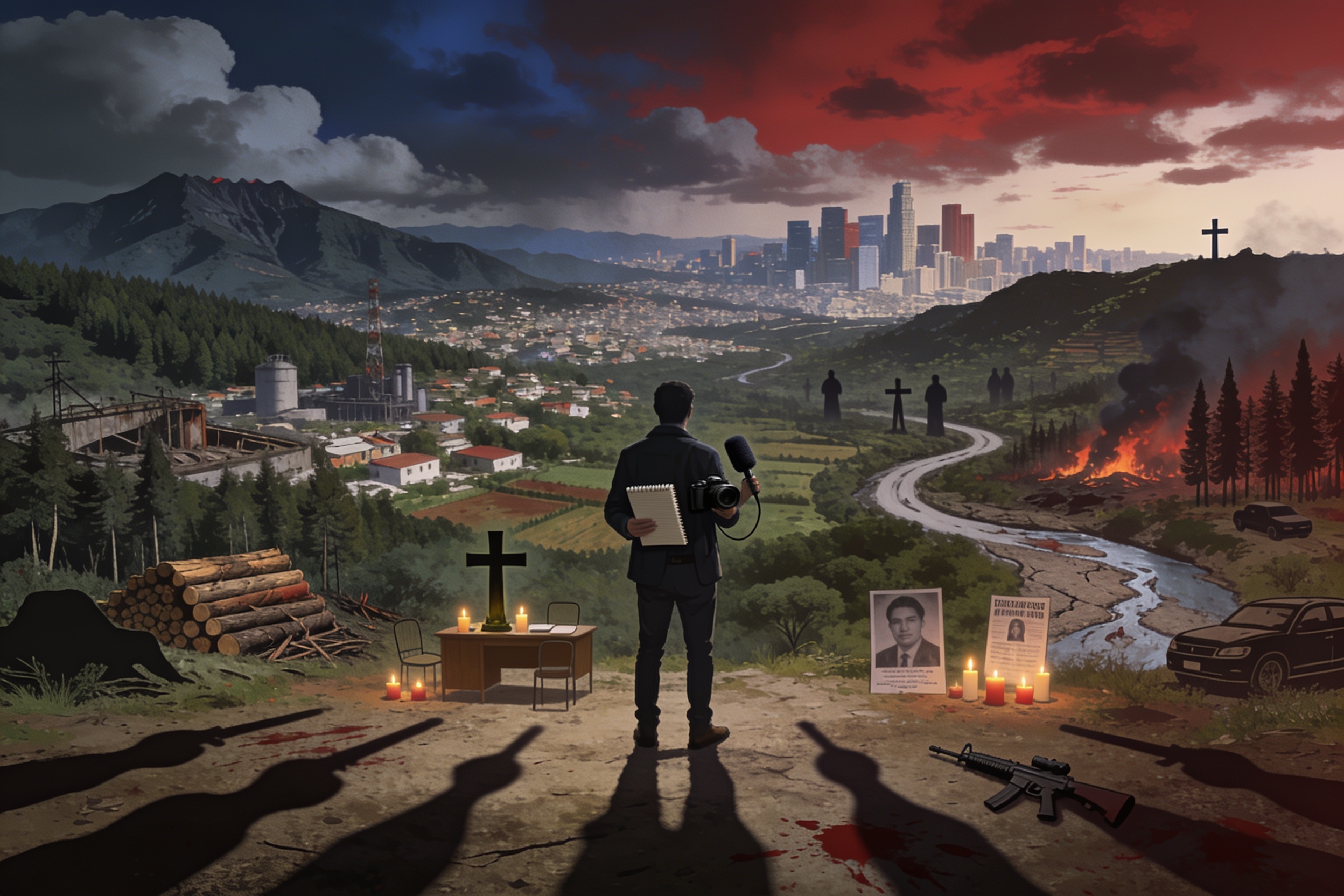
On July 23 of this year, Mexican journalist Francisco Alejandro Leyva was murdered in broad daylight in the state of Oaxaca, adding to the many journalists and environmental activists killed in the country.
It was not just any crime, Francisco Leyva was a recognized critic of politicians and local government officials, also denouncing the operations of organized crime in several regions of Oaxaca. [1] Just twenty days earlier, on July 3, the body of journalist Roxana Guzmán was found in the state of Veracruz, a month earlier an armed group entered the journalist’s house and kidnapped her, all recorded in a video that went viral, generating outrage and a demand to find the journalist. [2]
These murders have caused impact and impotence in society, which through various organizations for freedom of expression have denounced these crimes and have demanded that the government do justice in their cases.
The murders of Alejandro Leyva and Roxana Guzmán are part of a list of crimes against journalists, in the state of Veracruz alone, 34 journalists have been murdered since 2000.
In Mexico there is bloody censorship dictated by cartels and high political figures, who dictate what line journalists must follow, anyone who steps out of this line is a victim of forced disappearance and murder.
But this censorship is not only limited to journalists, but also to environmental activists, defenders of the country’s natural areas, being the case of the activist Homero Gómez defender of the monarch butterfly, one of the most notorious and tragic cases, six years after his murder, he still remains unpunished.
Defending Mexico’s natural territories from clandestine logging, Canadian mining companies and the real estate mafia have led several activists to be kidnapped and killed, speaking out for the defense of the natural heritage of Mexicans can lead to the kidnapping, torture and murder of an activist. [3]
While forests are burned down to build subdivisions for the rich, companies like Coca Cola take water from Chiapas, jungles are cut down to build avocado crops (because gringos need their bowl of guacamole for the Super Bowl), natural heritage is destroyed and those who raise their voices are killed.
Freedom of expression in Mexico is limited by the power of organized crime, a crisis that has remained without the state being able or willing to do anything to stop it.
In 2010, one of the most violent years in the country’s modern history, the state of Tamaulipas experienced an unprecedented crisis of violence, in which journalists were forced to shut up, killed or had to leave for their lives.
In this climate of terror, an anonymous journalist told Reporters Without Borders:
“It’s true, there are five journalists missing for a week, but no one has said anything, only God knows where they are.” [4]
Making it clear how the atmosphere of terror in the press was (and still is) in those years. The situation has not changed.
The years from 2006 to 2012 where President Felipe Calderón governed, unleashed a wave of violence and terror that destroyed all security in the country, a crisis whose consequences are still being suffered.
This red censorship is still maintained, it reaches groups such as the Searching Mothers, who even have to ask permission from criminal groups to search their territories for mass graves where their children may be. [5]
What is the government’s response?
From their morning conferences, both President Claudia Sheibaum and her cabinet express that these crimes will be investigated, but that they are expressions that in the end almost never amount to anything, the perpetrators of the murder of Roxana Guzmán have been arrested, but those who ordered the murder still remain unpunished.
The links between the cartels and different governments are something that is already well known, in the face of a machinery like this. What can a journalist do to protect his life?
Organized crime groups dictate the editorial line to be followed, the journalist then exercises self-censorship on himself, to protect his life and that of his family. Journalistic work is limited, for many journalists it is not worth risking their lives for poor pay and the risk of being disappeared, tortured and killed.
The murder of Alejandro Leyva joins a long series of cases of journalists killed in their duty, under a negligent system and an entire criminal structure that operates at all levels of life in Mexico.
The narco is not only the cartels, it is the entire political-social-economic system that goes beyond local governments, it is a mega structure that reaches high spheres, the narco is the entire unipolar hegemony of the West and in the face of this there is nothing that a journalist or an activist can do.
Sources consulted:
[1] https://www.bbc.com/mundo/articles/cn7ng80mmgko
[2] https://www.bbc.com/mundo/articles/c982r3r3n8yo
[3] https://grupoanimal.mx/explicaciones/defensores-ambientales-asesinados-mexico