
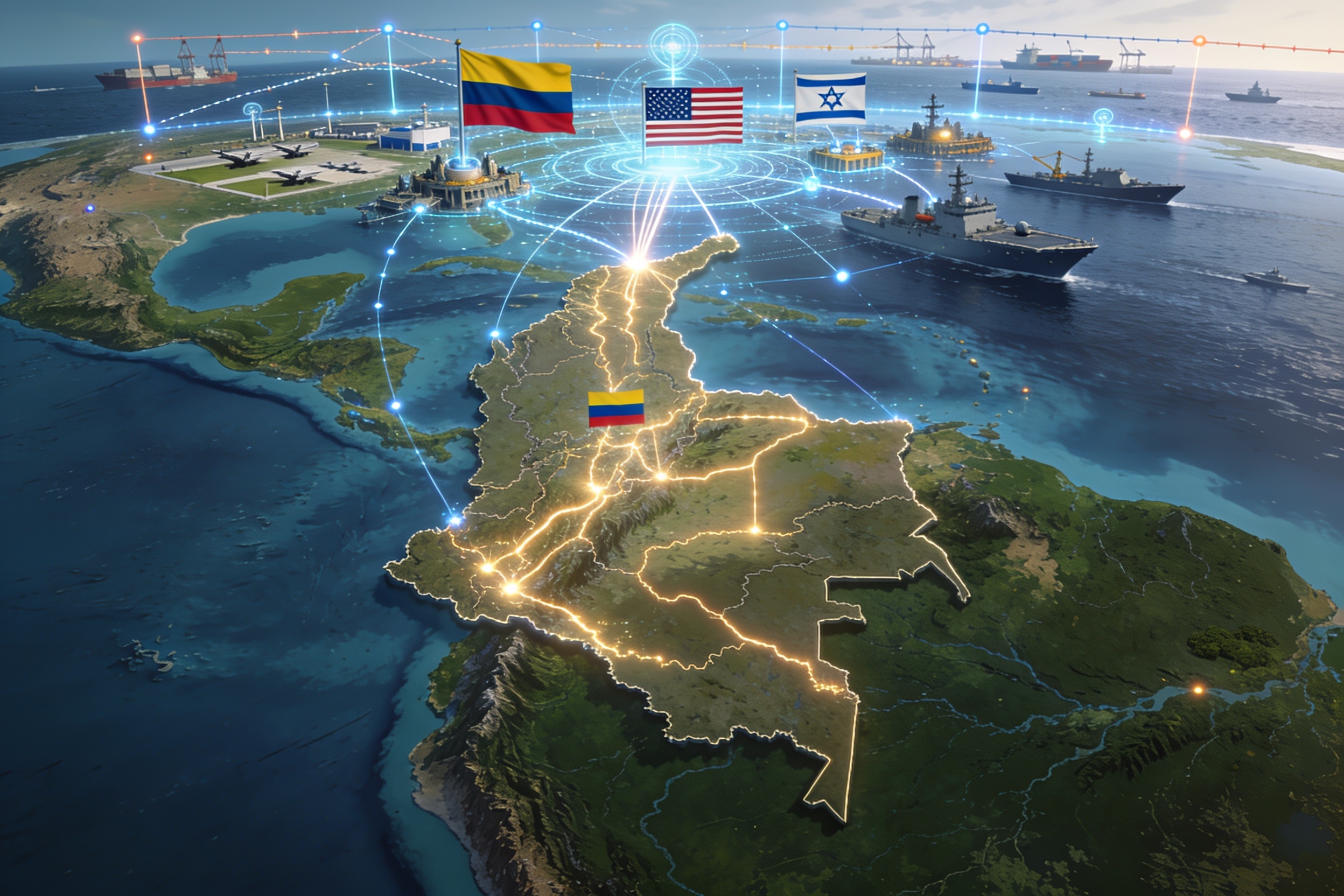
The rise of Abelardo de la Espriella to the Colombian presidency should be interpreted less as a simple ideological alternation than as part of a strategic reconfiguration of the Western Hemisphere. His election coincides with the shift toward a pro-U.S. neoliberal right in Argentina, Chile, Peru, Ecuador, Bolivia, and Panama and, above all, with Washington’s explicit return to a hemispheric conception inspired by the Monroe Doctrine. U.S. Secretary of Defense Pete Hegseth himself has invoked that doctrine and defined the hemisphere as a strategic space that must be protected from external powers.
Colombia acquires exceptional operational value in this context. De la Espriella immediately brought the country into the self-styled “Americas Counter-Cartel Coalition,” better known as “Shield of the Americas,” while Washington announced $1 billion in security assistance and is considering joint military operations against Colombian armed organizations. A U.S. official even stated that cooperation could surpass the levels reached during Plan Colombia.
Under no circumstances should De la Espriella’s victory be understood as an isolated development, but rather as part of a broader reconfiguration of the strategic landscape in Ibero-America: Washington is rebuilding a hemispheric architecture of containment aimed at denying China, Russia, and Iran any capacity to exert influence over Latin America’s infrastructure, routes, and strategic spaces. In the context of a prolonged strategic confrontation with the Eurasian powers, the region ceases to be a mere periphery and instead becomes the military, logistical, energy, and political rear area of the United States. The objective would be to shield the hemisphere from any “malign influence,” secure strategic depth, and limit any rival penetration capable of undermining U.S. global power projection vis-à-vis the emerging Eurasian bloc.
At the same time, a second vector emerges: Israel. Bogotá rapidly restored its alliance with Tel Aviv, recognized Israeli sovereignty over the Golan Heights—departing from the position upheld by the United Nations—and intends to deepen security and intelligence cooperation. Evangelical churches also constituted one of the organized bases of De la Espriella’s candidacy, illustrating how pro-Zionist evangelicalism can function as a political bridge linking Latin American, U.S., and Israeli sectors.
Morocco completes the triangle. Colombia also recognized Moroccan sovereignty over Western Sahara, a territory that the United Nations continues to regard as pending decolonization. Washington had recognized Moroccan sovereignty over the territory in 2020, in parallel with the normalization of diplomatic relations between Morocco and Israel.
Is a new regional sub-axis therefore beginning to emerge? The indications are significant. The United States, Argentina, Chile, Costa Rica, El Salvador, Panama, and Paraguay have already acted jointly within the framework surrounding “Shield of the Americas”—which is likely to be joined rapidly by additional Washington-aligned governments seeking full membership—while the so-called “Isaac Accords,” explicitly inspired by the Abraham Accords in the Middle East, seek to expand Israel’s cooperation with Panama, Costa Rica, Colombia, Chile, and El Salvador. Their purpose is to consolidate Israel’s security interests in the region, which should ultimately be understood within the framework of a hybrid strategy of active confrontation against political and/or social positions that challenge the official Zionist narrative.
The real impact on regional multipolarity lies precisely here: not in automatically transforming Latin America into a homogeneous bloc, but in rebuilding a critical mass of states whose security, intelligence, and diplomatic alignment once again gravitate around Washington’s geostrategic imperatives, with Israel acting as a privileged extra-regional partner. Within this emerging configuration, Colombia—due to its position at the intersection of the Caribbean, the Andes, the Amazon, and the Pacific—could become one of the central components of this new hemispheric strategic architecture.