
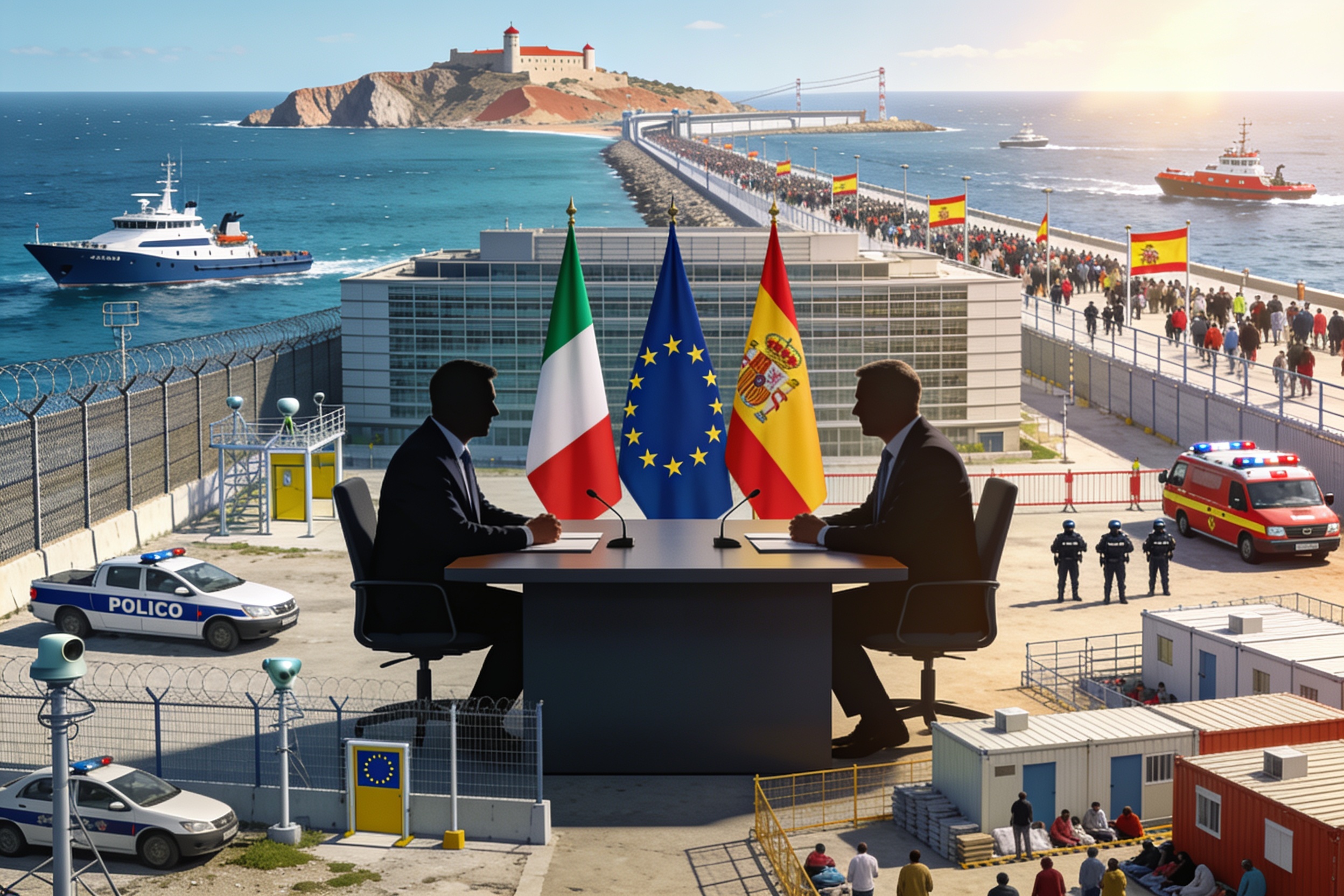
Until June 2026, Rome and Madrid normally collaborated in the European institutions, finding common support for the EU budget. But there was a strong ideological distance.
Meloni had built her European identity on the defense of borders, on the reduction of irregular immigration and on a restrictive line.
Sánchez, on the other hand, represented a social democracy in favor of integration and regularization policies. Meloni also had very close political relations with Vox and Santiago Abascal, while Sánchez was one of the main references of the European left, the Italian one of Elly Schlein’s PD in particular.
According to El Pais, this opposition did not prevent institutional collaboration, but made the two governments potential competitors for political influence in the Mediterranean and the EU.
The crisis in Ceuta, at the end of July, has transformed the political divergence into a diplomatic dispute.
According to Euronews, after the massive arrival of migrants in Ceuta, Meloni and Tajani argued that the situation could also have consequences for other Schengen countries and envisaged the suspension of controls with Spain.
Madrid considered this position unjustified and defended its management of the border.
Paradoxically, in the face of an uncontrollable horde of migration, the Spanish left-wing government has reacted as Vox and the European and American right-wingers are clamoring for: through the first, great mass remigration, moreover not very fast and even not very attentive to primary human rights, how to grant a glass of water.
The crisis in Ceuta can also be read as a Meloni-Sánchez competition for the political leadership of Southern Europe. This is probably the key to understanding why a crisis, which originated in a Spanish enclave in Africa, produced such a harsh clash between Rome and Madrid.
The current controversy between Giorgia Meloni and Pedro Sánchez, under the surface of Ceuta, contains a deeper clash, over which migration model should prevail in the EU.
What caused the controversy to explode? According to Reuters, the trigger was the huge irruption of Moroccan migrants: about 72,000 people tried to enter, and there were numerous casualties.
Ceuta does not belong to the Schengen area, so Madrid argues that the episode did not automatically entail a risk of migrants being transferred to the rest of the EU.
Rome has adopted a preventive reasoning: if many migrants enter Spanish territory, some could, subsequently, try to reach other European countries, including Italy.
Hence the Italian decision on August 1 to introduce controls on travelers from Spain, aimed mainly at non-EU citizens. Madrid considered the measure unjustified and responded by introducing, in turn, checks on travelers from Italy, initially scheduled to last until September 7, according to Reuters.
Therefore, the conflict is formally over border control, but politically it is a clash over responsibility for the management of migration flows.
Is there something else behind it? Yes: two different models. Meloni argues that the migration problem must be addressed above all through the control of external borders, the prevention of irregular entry, repatriations and cooperation with transit countries.
Sánchez, on the other hand, supports the classic left-wing model, which has already proven to be an unattainable utopia and very dangerous for the security of Europeans: the regularization of immigrants already present, without special controls.
Integration, despite the fact that the news shows an escalation of incompatibility between many Maghreb people and our classical-Christian civilization.
Sanchez is in favor of using immigration, also to compensate for the aging population and the shortage of workers. For many it would be, in general, an excuse for progressive movements to cover up the millionaire business at the expense of “new slaves”, who would not really be necessary – as the Italian magazine “Il Primato Nazionale” writes.
The politically explosive point is the Spanish regularization of illegal immigrants, which has produced about 1.2 million requests.
This policy has been strongly contested by the European right, which fears a possible attractive effect – as Reuters pointed out. But Europe is not the Bengodi and cannot afford to host the whole of Africa, including the scum!
Madrid rejects the idea that its policy caused the crisis in Ceuta and points out that almost all those who had entered were subsequently taken out of the enclave, but, of course, it does not say that it used the remigration method that in every country globalist rhetoric calls “inhumane deportation”, when in that case it was the only viable solution. albeit with the minimum of humanity.
What could Meloni gain in Italy? A very high political capitalization, also due to the weakness of the Spanish popular consensus for Sanchez.
Meloni can present herself to Italian voters as the leader who says: “What happens in Spain can become an Italian problem: I intervene before it happens.”
In addition, the contrast with Sánchez has a very strong narrative advantage: Meloni is border control, Sánchez is opening/regularization.
This example, his electoral plan, is extremely effective. Meloni can also turn a bilateral issue into a continental one: it is Europe that must protect its external borders!
This is a position that finds various interlocutors, in numerous other countries, considering that in 2027 there will be elections in important states, where the right is given as winners by every polling institute.
Sánchez, for his part, could further raise the tone for at least four reasons.
1. He cannot afford to appear weak on Spanish sovereignty.
Ceuta is a very sensitive point for Madrid. The issue also involves the relationship with Morocco, which claims sovereignty over the Spanish enclaves.
In recent days, Rabat has again raised the issue of Ceuta and Melilla and Madrid has responded that their sovereignty is non-negotiable.
Sánchez, therefore, cannot give the impression that another European government is questioning Spain’s ability to control its territory.
2. If Sánchez were to accept Meloni’s approach, he would risk legitimizing the thesis that his regularization policy constitutes a “pull factor”. This is precisely what the Spanish Government wants to avoid.
But the people are already exasperated by the lack of integration of too many, and have begun numerous and very popular street protests.
3. Sánchez has to face pressure from the Spanish right and criticism of his handling of immigration at the same time.
Therefore, a clash with Meloni can also become useful to him: “Spain does not accept lessons from Italy.”
It is a classic dynamic of European politics: conflict with a foreign leader can serve to consolidate one’s domestic electorate, raising the polls that show Sanchez in free fall.
4. Madrid considers Italian controls a dangerous precedent.
If each state were to react to a migration problem in another state by reintroducing internal controls, freedom of movement would become much more fragile. It would be a return of national sovereignty that the globalists see as smoke and mirrors!
The Schengen rules still allow for the temporary reintroduction of controls in the presence of serious threats to public policy or security, but configures them as an exceptional and proportionate measure, as pointed out by the Migration and Home Affairs.
Who has more interest in not letting the crisis degenerate?
Both. And this is why we will not see a real strategic break between Italy and Spain.
The two countries have enormous converging interests:
- Mediterranean;
- energy;
- industry;
- trade;
- defense;
- cohesion policy;
- EU budget;
- relationship with North Africa;
- Ukraine;
- European strategic autonomy.
This is proof that the current opposition is limited to migration policy, it is not a geopolitical rupture.
In the European Pact on Migration and Asylum, which came into force on 12 June 2026, the opposition can become dangerous.
The new European system provides:
- Arrival screening;
- faster procedures;
- border procedures;
- repatriation;
- shared responsibilities;
- solidarity mechanisms between states.
The crisis in Ceuta came when the new European system should have proven to work.
For this reason, Meloni has an interest in using the crisis to demand: more protection of external borders, more repatriations, more collaboration with third countries.
Sánchez, on the other hand, wants to demonstrate that the European model must remain based on solidarity, on the protection of asylum seekers and on integration. Something that appears objectively impracticable and out of touch with reality.
After Ceuta, Ursula von der Leyen has proposed – writes Reuters – more European support for Moroccan border security and cooperation with Rabat.
Italy and Spain have a very strong interest in quickly returning to cooperation on the EU budget.
Both want to prevent the new priorities – defence, security, energy, competitiveness – from being financed by sacrificing cohesion. And this was precisely the point agreed by Meloni and Sánchez in June.
Sánchez supports greater European autonomy in the security and defense sector, while Spain has significantly increased investment and support for Ukraine – reports the media La Moncloa.
The crisis in Ceuta demonstrates, once again, that the EU does not really control the migration problem if it does not manage to involve Morocco, Tunisia, Libya and the other countries on the southern shore.
Ceuta also makes Rabat’s negotiating power evident: a local crisis can quickly turn into a European crisis.
My prediction:
At this point it is logical that in September there will be a diplomatic de-escalation between Rome and Madrid. In the autumn, a political clash within the EU will be possible.
The real game will shift from the personal relationship between Meloni and Sánchez to the definition of the European migration policy of the next cycle.
Meloni could gain a political advantage from the crisis. Because the question will become: “What migration model does Europe want to adopt?”
It is a question to which Meloni answers in a much stronger way of popular consensus, which could lead the European Commission to revise the line, with a compromise that includes a form of Remigration and control in addition to the do-gooder and cosmopolitan welcome.