Germany is undergoing a political transformation that can no longer be explained simply as a temporary protest vote. The latest election results show that Alternative für Deutschland (AfD) has become one of the central actors in the German political system, especially in the eastern part of the country.
The turning point came with the federal elections of February 2025. AfD obtained 20.8% of the second votes and secured 152 seats, almost doubling the 10.4% it had obtained in 2021. Since then, its growth has continued.
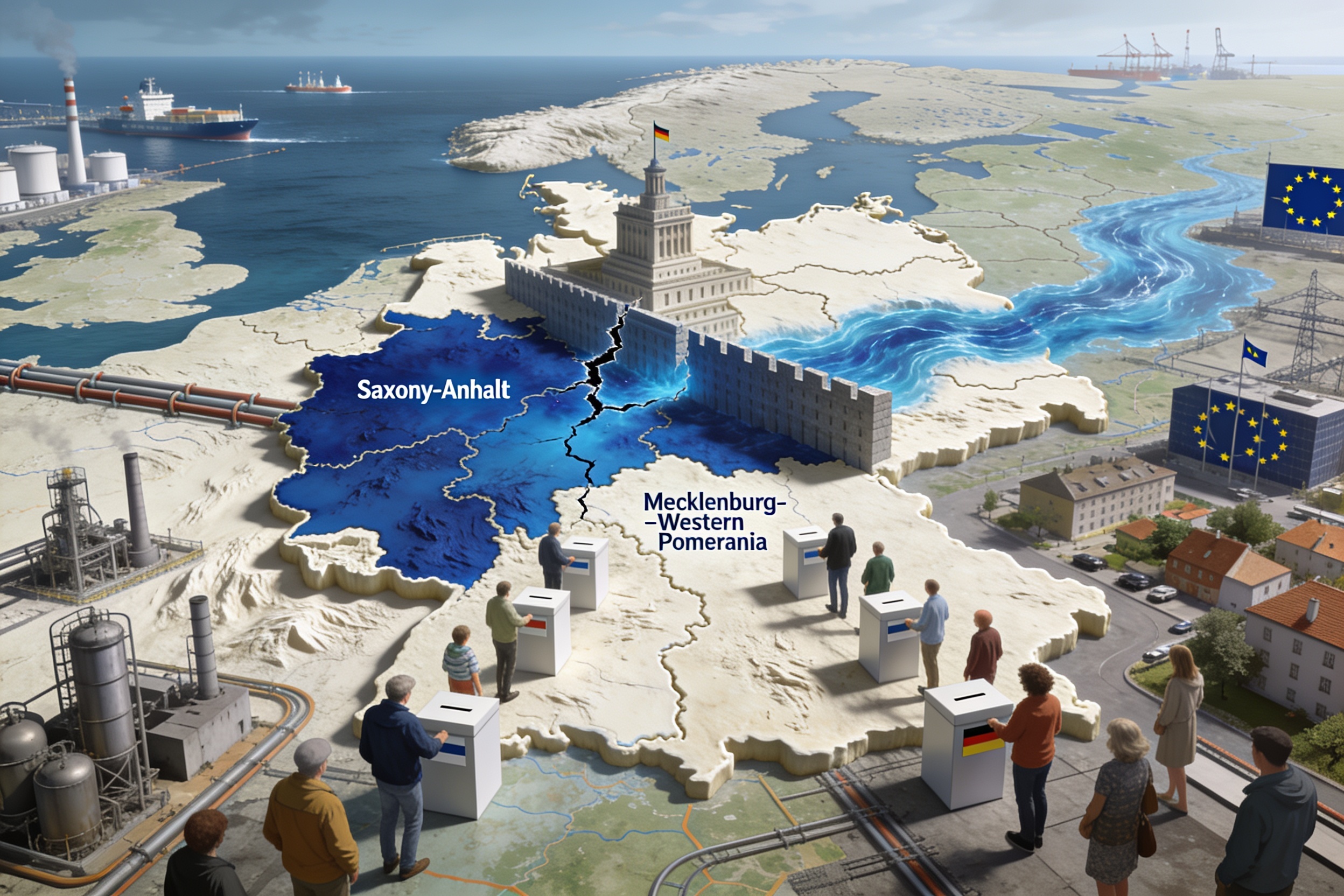
The most striking result came on September 6, 2026, in Saxony-Anhalt: AfD reached 43.8%, compared with 17.2% for the CDU, and obtained 39 of the 83 seats in the Landtag, the regional parliament. It did not achieve an absolute majority, but it more than doubled its share of the vote compared with 2021.
Two weeks later, it won again. In Mecklenburg-Western Pomerania, on September 20, AfD provisionally reached 38.2%, compared with 35.5% for the SPD. It also made significant gains in Berlin, where it received 16.3% of the vote, 7.2 percentage points more than in the previous election.
From a sovereigntist perspective, it would be far too simplistic to reduce these results solely to radicalization or xenophobia. Post-election studies in Saxony-Anhalt indicate that issues such as social security, the economy, and peace in Europe played an important role in voters’ decisions.
This is probably where the fundamental problem of contemporary German politics lies. A growing segment of the electorate is questioning the decisions taken over recent decades regarding energy, immigration, European integration, industrial policy, and relations with Russia. AfD has managed to translate this discontent into a political platform based on greater national sovereignty, stricter migration restrictions, and a foreign policy considerably different from the one pursued by Berlin.
This last point, in particular, is among the most controversial. AfD’s leadership has defended the restoration of economic relations with Russia and the facilitation of renewed Russian energy supplies, while its opponents argue that this would recreate a strategic dependence on Moscow.
At the same time, the so-called Brandmauer, or “firewall,” remains in force, whereby the main political parties refuse to govern in coalition with AfD. This means that finishing first in an election does not necessarily guarantee the ability to govern. After the September elections, this mechanism is once again the subject of debate within Germany.
For this reason, the AfD phenomenon goes beyond the party itself. What we are witnessing is a crisis of representation within Germany’s traditional political center. The results in Saxony-Anhalt, Mecklenburg-Western Pomerania, and Berlin point to an increasingly fragmented electorate and a coalition system that is becoming progressively more difficult to manage.
The decisive question for Germany now is whether AfD will be able to transform its growing electoral strength into effective governing power, or whether it will remain a powerful opposition force institutionally blocked by the other parties. This tension could become one of the major defining features of German politics in the coming years.