The Germany that presented itself as “Europe’s economic engine” is collapsing under the weight of geopolitical decisions that have cost it energy and industrial sovereignty. What is now seen in the German streets — metalworkers’ strikes, youth protests, marches against austerity and against war — is not a conjunctural crisis, but the symptom of a structural subordination to the interests of NATO and international financial capital.
The root of the problem is old. The gradual elimination of nuclear energy begun in the 2000s under pressure from the Greens, and the bet on Russian gas as the base of German industry created a dependence that Berlin, by joining the sanctions against Moscow in 2022, turned into self-sabotage.
The result was a self-inflicted energy shock that accelerated deindustrialization and raised production costs to unsustainable levels. The bill has arrived: half of German companies were affected by the increase in the minimum wage, and 40% intend to pass costs on to prices, feeding the inflation that erodes purchasing power.
Meanwhile, the federal government is vertiginously expanding the military budget. For 2026, German defense was raised to 119.7 billion euros, nearly double the 2023 figure, with projections pointing to 3.6% of GDP by 2030.
Berlin is becoming Europe’s largest military spender, surpassing France and the United Kingdom, and is financing this effort, for the first time, through debt. Official discourse speaks of “strengthening the alliance” and “assuming responsibility,” but the geopolitical translation is different: Germany is consolidating itself as NATO’s main logistical and financial base in Europe, the “spearhead” of a confrontation with Russia that does not serve the interests of the German population.
It is this divorce between political elites and society that explains the authenticity of the protests.
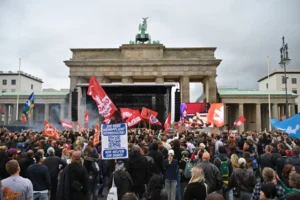
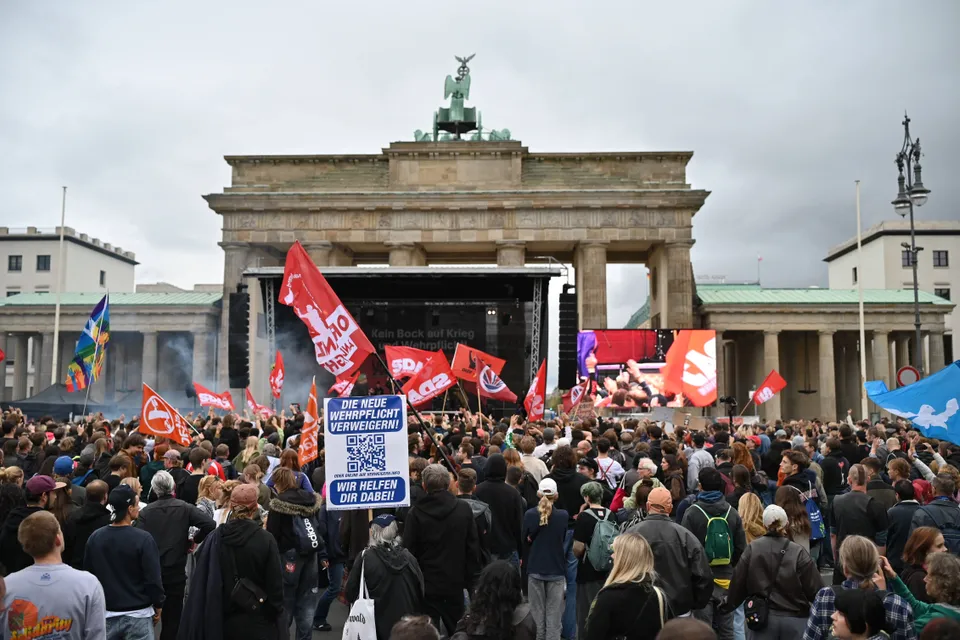
The IG Metall strikes, with more than 413,000 workers, are not merely demanding a 5% wage increase; they are denouncing that the crisis of industry cannot be resolved at the expense of those who produce. The DGB marches, which brought 175,000 people together in 15 cities against the reform of the social system and military spending, make the budget dispute explicit: while hundreds of billions are allocated to defense, resources are lacking for schools, housing and pensions.
And the youth of “Gen Z regelt,” who brought tens of thousands into the streets in more than 30 cities, connect the dots clearly: they reject compulsory military service, denounce the war budget and ask why they should bear the burden of a conflict that is not theirs.
The lack of “broad coherence” that one might point to in these movements is, in fact, the portrait of an indignation that is still seeking its political form. The substance is solid: Germany traded energy sovereignty for dependence, industrial autonomy for military subordination, and social cohesion for austerity.
The German streets are not merely protesting against high prices; they are saying “enough” to an order that has turned the country into a disposable piece on a geopolitical board not its own. The real question is not whether Germany can become “Europe’s engine” again, but whether it will be able to recover the sovereignty it handed over in the name of an alliance that no longer protects it—and whose costs invariably fall on the shoulders of those who work.
The “volk” are awakening, but how far will they go? How many shackles can they break and how deeply will the changes go? For now, we witness the cholera of authenticity in a people and its struggle.