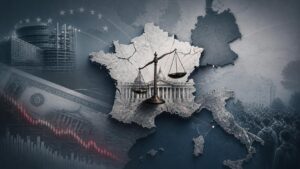

The Judiciary Committee of the US House of Representatives has drafted a relentless indictment against the European Commission, guilty of orchestrating a “ten-year campaign” to censor political debate globally, including on American soil. The voluminous report – consisting of one hundred and sixty pages – bears a title that leaves no room for doubt: The threat of foreign censorship.
The conclusion of the document appears clear: The European Union over the past decade “has successfully lobbied major social media platforms to change their global content moderation rules, directly harming Americans’ freedom of expression online in the United States.” The aforementioned report states, in particular, that European Commission officials have held over a hundred “closed-door meetings” with those responsible for social platforms since 2020 “in which regulators have had the opportunity to pressure platforms to censor content more vigorously”.
Although often framed as a campaign to combat so-called ‘hate speech’ or ‘disinformation’, the European Commission has worked to censor truthful information and political discourse on some of the most important political debates in recent history, including the Covid-19 pandemic, mass migration and transgender issues. The fact is that these are not mere apodictic statements. The report of the US legislators documents in detail and punctually substantiates with precise facts what is denounced in the same document. Accusations of electoral interference are not spared either.
The report, in fact, identifies specific cases in which European Commission officials would have met with the operators of social platforms before the elections in the Netherlands (2023, 2025), France (2024), Germany (2024), Poland (2023), Spain (2023), Belgium (2024) and Ireland (2024, 2025). According to the Judiciary Committee of the US House of Representatives, these European policies end up influencing social platforms internationally, leading them to apply restrictive standards in the United States as well. The report highlights how this constitutes a form of indirect “foreign censorship”, contrary to the First Amendment of the US constitution. In particular, two European regulations are targeted: the GDPR (General Data Protection Regulation – EU Regulation – EU Regulation – 679), on the protection of personal data of natural persons, and the DSA (Digital Services Act – EU Regulation – EU Regulation – 2022/2065), on the regulation of online intermediary services.
The report of the US Judiciary Committee highlights, in fact, the role that these two European regulations play in promoting the preventive removal of content, and concludes that such European regulatory pressure represents a threat to Americans’ freedom of expression, threats that require a political and legislative response from the United States. The language used in the US Judiciary Committee’s report is decidedly free of diplomatic hypocrisy:
“The European Commission has successfully pressured social media platforms to censor truthful information in the United States; European Commission targets US political content for censorship; the European Commission disproportionately targets conservative content and interferes in elections across Europe; the European Commission’s regulatory initiatives, defined as “voluntary” and “consensus-based”, are neither voluntary nor consensus-based”.
Because “the European Commission’s ongoing initiatives indicate that it remains committed to censorship and aims to export its censorship measures to other countries,” the U.S. House of Representatives Judiciary Committee states in the report that it will “continue its investigation of foreign censorship laws, regulations, and orders and countering this existential risk to a fundamental American right: the right to freedom of expression”.
Last year at the Munich Security Conference, US Vice President James David Vance appeared as the whipping boy of Europe, when he launched into a real reprimand that to many appeared excessive and out of place. Especially when he uttered these words: “The threat that worries me most about Europe is not Russia, it is not China, it is not any other external actor. I am worried about the threat from within.”
Evidently, Europeans did not understand that those words were not dictated by a simple rhetorical emphasis. They were a serious and deep concern on the other side of the ocean.