Some countries are sinking with a bang and France is doing so with the thud of a bobbin against the skull of a teenager. The self-proclaimed homeland of “human rights” is going through a crisis that no longer disguises the republican rhetoric, revealing the existence of a crisis, that of the Elysée regime and the corporations that run it behind it.
It all started, as so often, at the petrol pump. Diesel reached €2.41 per litre in September 2026, a direct consequence of the geopolitical storm that the West itself ignited: the Strait of Hormuz, the Gulf refineries and the war of attrition against Russia. The popular classes pay at the petrol station, as is customary in the current international order, the price of a Western imperial diplomacy that they did not choose. And when they demand protection such as, for example, lowering VAT and blocking prices, the think tank Terra Nova disqualifies both measures as “fictitious protection”.
In other words, and so that the people understand, the corset of European law, with its 15% VAT floor, is worth more than the plate of food of a worker in Lens. This is how popular sovereignty is dissolved within the market.
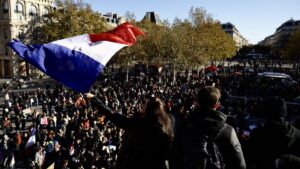
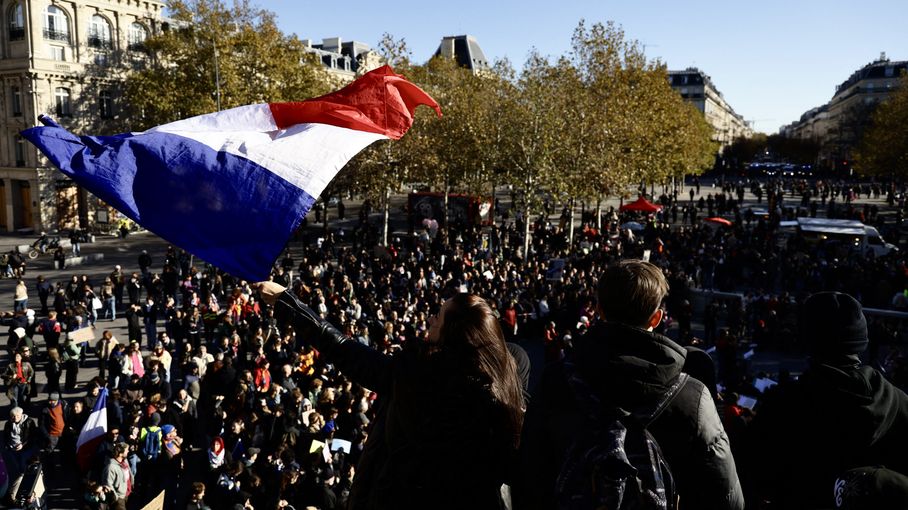
Since mid-September, high schools and universities have taken to the streets to demand something as basic as a decent education, territorial equality and humane schedules.
Macron responded with a repression that the UN Special Procedures, despite the politicisation of this body, described as “unacceptable and unjustifiable“. And it is that keeping silent in the face of such obvious violations of human rights was already impossible: more than 210 underage students were injured, their jaws shattered by grenades thrown at their faces; a 15-year-old boy lost a hand and several others lost an eye to LBD gunfire.
This is the image of a France that, like other Western countries, takes off its mask and shows what it always was: when it finds itself in the midst of a crisis, it turns to fascism to sustain the system that has made the world a place marked by structural inequality, the violence of colonialism, extractivism and persistent humanitarian crises in the Global South.
The French state repression of 2026 is comparable to that suffered by the Latin American peoples under bloody dictatorships imposed by the US during the twentieth century and so far in the twenty-first: 6,877 arrests since September 21, 86% of them minors, and almost 2,000 arrests in a single day, a figure higher than that of the height of the yellow vests.
Faced with such worrying and dramatic figures, the Minister of the Interior, Laurent Nuñez, ordered intervention “without a slogan of containment” and Emmanuel Macron took the leap that all Bonapartism ends up taking, banning “illegitimate” demonstrations, those that are not called by domesticated unions.
The right of assembly was thus and until now subject to the permission of the prince, the one who believes himself to be Napoleon. It is clear and the student union denounces it without hesitation: Macron is “spitting on the values of the republic he claims to defend” and completely, to defend those who have him as a puppet in French power from Paris.
But there is something darker than legal repression and that is the double standards used by the authorities to measure what is happening in France. By way of example, on October 24, fascist militias attacked processions in at least sixteen cities while police and gendarmes looked the other way or let the aggressors go.
The Attac association thus formulates the question that should resonate in every human rights court: if the police protect the fascist militias, who protects the demonstrators? History is the one who answers it by stating that the repressive apparatus that Macron fattened for a decade is the inheritance that he will hand over in 2027 to the extreme right that he claims to fight.
Macronism is thus defined as the battering ram of fascism and in the face of this, in the field of human rights we must react. That is why the proposal of the International Association for Human Rights and Social Development (AIDHDES) has been working for some months is interesting, that of creating an Annual Forum on the Decolonization of Human Rights, to rethink them without double standards when measuring the violations that threaten them in any part of the world.
The same president who covers the fascists in Israel, complicit in the siege of Gaza, applies on his territory the colonial logic that France has always reserved for its peripheries: from the Sahel to New Caledonia, from Algeria to the high schools of Seine-Saint-Denis, the republic only knows the grammar of the armed monopoly. That is the geopolitical perspective of what is happening in France. What Orient XXI documents in Tel Aviv and Attac in Montpellier is the machinery of French imperialism folding in on itself.
It must be borne in mind that, if we are talking about fundamental rights, the state that mutilates its minors, criminalises protest, tolerates neo-Nazi militias and externalises its violence in Palestine, renounces, as it has done so far, all moral legitimacy to pontificate on human rights. The international community must stop treating France as an exception in this sense and start treating it for what it is: a case of urgent examination.
And yet, the epic is not in the palaces but rather in the girls and boys who return to the blockade with their arms in a cast, in the teachers sitting in front of the CRS, in a youth that understood what the Brazilian pedagogue Paulo Freire taught: emancipatory education is conquered in the street, not begged in the Elysée. France thus looks at itself in the mirror of its colonial history and the people, once again, write the next page.