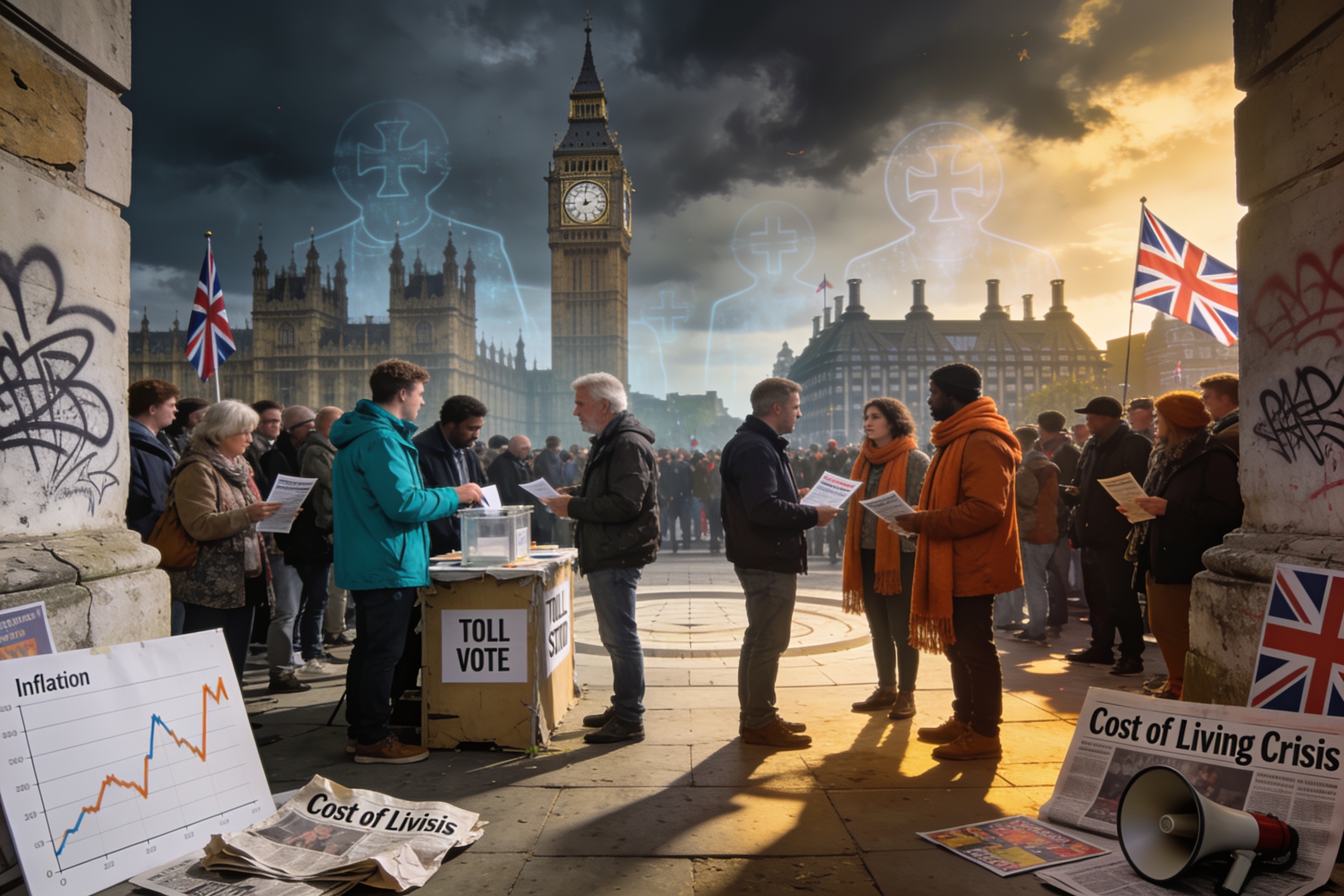
We can look at the British domestic political crisis, dividing it into three key elements: The relative decline of British power in the international system and the possibility of the emergence in the United Kingdom of an authentically sovereignist and multipolar political culture is similar to what already happened in the United States in 2025, when Americans placed their trust in Donald Trump, as an expression of political novelty, according to MAGA sovereignism.
1. Great Britain is experiencing a systemic crisis
Many observers believe that the United Kingdom is going through a phase of structural decline, which did not start with Keir Starmer’s government, but has its roots in deeper phenomena:
Brexit and, above all, its economic and institutional consequences, was it really the best and most suitable choice for the characteristics of England in the Third Millennium?
Many British and European economists write of a stagnation of productivity, in the face of an unexpected growth in territorial inequalities, which are adding in a worrying way to the first major historical crisis of the traditional two-party system.
Identity tensions, linked to immigration and multiculturalism are being expressed, even with mass demonstrations. The recent murder in Southampton has sharpened the feeling of exasperation from incompatibility with those who give an opposite meaning to the sacredness of life and criminal action, as if it were justifiable because it was the daughter of different “cultures”.
But the invasion of social incompatibility, which is the result of foolish policies with the head in Brussels and the wallets of the big international speculators, including George Soros, cannot be justified. But it is globalization itself, dominated by the Angular sphere through a turbo-capitalist financial and commercial unipolarity, that has proved perverse in that it involves the import of cheap labor from poor countries. And with it, inevitably, also embarks the great delinquent scum of Africa, who take advantage of unscrupulous smugglers to find the markets of the underworld and rich drug users wide open. New slaves and many criminals are the fruits of the dominant social chaos, because globalism is the natural child of globalization.
Alongside this, which is a tragedy for all the States of the Union, where, in fact, the people vote by a majority for the identitarian right, we observe centrifugal forces in Scotland and Northern Ireland. In this regard, some scholars speak of an “axial crisis” in the British model established after 1945 and reformulated during Margaret Thatcher’s years in office.
However, to speak of the imminent collapse of the British state would be excessive. The UK still maintains: one of the world’s leading economies; In this sense, some scholars speak of an “axial crisis” of the British model built after 1945 and reformulated in the years of Margaret Thatcher.
However, to speak of the imminent collapse of the British state would be excessive.
The UK still maintains: one of the world’s leading economies; autonomous nuclear capacity; permanent seat on the United Nations Security Council; an extensive diplomatic network; intelligence services among the most influential in the world and the well-known City of London is still able to exercise its power anywhere.
2. Political violence and ethnic sectarianism are worsening in severity
In recent years, there has been an increase in political and community tensions.
Demonstrations related to the Gaza war, unrest in some British cities, tensions between ethnic or religious groups and growing online radicalisation have shown a more intense polarisation than in the past. These elements also demonstrate, despite the fact that the Kingdom is accustomed to the coexistence determined by the colonies, that the forced coexistence of incompatibles causes the devastation of every order.
However, it is necessary to distinguish between: serious but limited episodes and a real national destabilization. To date, England is still far from scenarios similar to the ethnic-political conflicts that have characterized other regions of the world.
This does not mean that the growth of distrust in institutions may increase the risk of social and political clashes in the coming years. And it applies to the whole continent.
3. Multipolar proponents, who are identitarian and often traditionalist, observe these British phenomena as part of a larger phenomenon:
It is the downsizing of the unipolar order, dominated by the United States. They also favor the rise of China, India and other regional powers. Note a growing strategic autonomy of many countries of the Global South, as a new factor underestimated by the globalists, because they are accustomed to the preface of their mineral and oil wealth.
In this reading, the United Kingdom would represent one of the main powers of the Atlantic order that is losing relative weight. From this perspective, the British internal crisis is interpreted as a symptom of the decline of the entire Western system, built after the Cold War, which many media do not want to talk about.
It should be remembered, however, that this interpretation is disputed by other scholars, according to whom the West still retains enormous technological, financial and military advantages. In an objective overall view, we cannot give up for dead those who nevertheless maintain vitality and global influence, still unchallengeable to the end.
4. These phenomena will weaken Britain’s ability to project power abroad Perhaps to a limited extent, in the short term.
Domestic priorities tend to consume financial resources, political capital, and government attention. This can reduce the public’s willingness to take on costly external military operations.
However, the United Kingdom continues to be the privileged partner of the United States, one of the most important members of NATO, a nuclear power and a key player in Western intelligence networks. For this reason, it is unlikely that London will give up its international role in the near future.
It is more realistic to expect a gradual reduction in capabilities compared to the standards of the imperial past and even compared to the post-Cold War period.
5. A British multipolar sovereigntist platform may be born, but Farage does not seem the most suitable figure to play the role of leader, in the medium and long term.
For personal and political characteristics that do not give authentic reliability. A distinction must be made between: Multipolar sovereignism, which would be a current that it defends national independence, rejects unipolarity, seeks balanced relations with multiple poles of power and limits military interventionism.
Neo-imperial nationalism, on the other hand, would be a current that recovers British imperial symbols, maintains a strongly Atlanticist vision, considers the United Kingdom a global power called to lead the West.
In the British context, the second option now appears more entrenched and will isolate Farage, if he does not adapt. Even many forces critical of the establishment do not necessarily question NATO, the special relationship with Washington, the idea of “Global Britain”.
Nigel Farage and the UK Reform Party tend to place themselves, more easily, in the category of Anglo-Saxon nationalism, than in that of Eurasian multipolarity because it is more comfortable and falsely revolutionary.
6. If one thinks in realistic rather than ideological terms, as all independent journalists should always do
We can observe: the continuation of the crisis of traditional bipartisanship, which involves the high probability of growth of Reform UK, which does not want to completely change the status quo, but only makes populist propaganda that attracts many discouraged British people or tired of too many troubles attributable to past policies, and of Starmer, who is very low in his approval.
A relative reduction in British global influence maintains a high probability as the rapid collapse of British power has a low probability. The birth of a true and strong British multipolar sovereignist movement has a low or medium-low probability.
The affirmation of a national-conservative right, but still linked to the Anglo-Saxon and Atlantic universe, has a medium-high probability of being realized. In short, the United Kingdom seems to be heading towards a phase of political turbulence and relative decline in its international influence.
However, at least in the foreseeable future, it is more likely that forms of British nationalism compatible with Atlanticism will emerge than a genuine multipolar sovereignism capable of breaking with the British geopolitical tradition of the last two centuries.