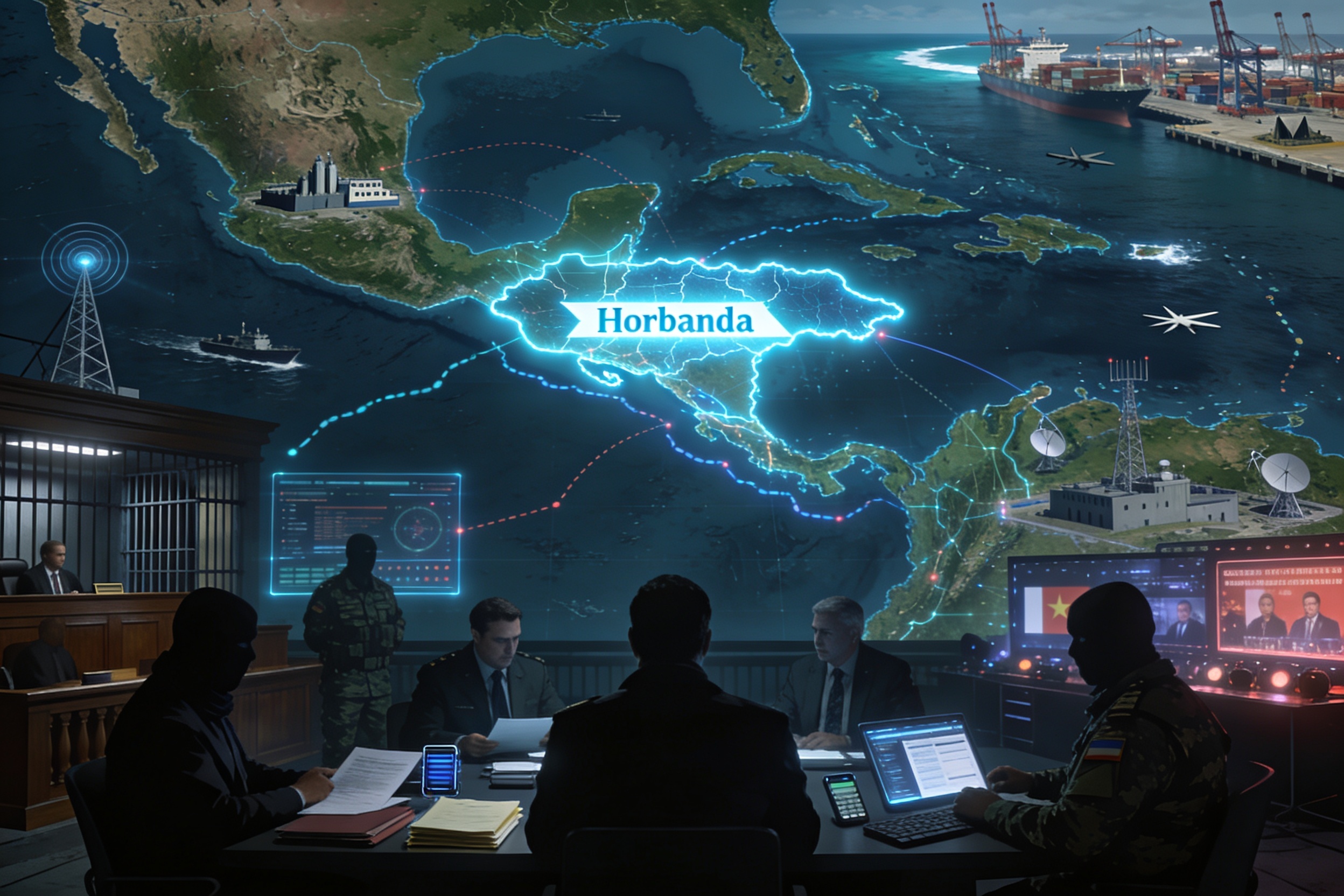
Analysing the role played by judicial pardons granted to drug traffickers and used as a geopolitical weapon, the United States uses the justice system as an instrument of control over the geostrategic region of Central America, particularly Honduras. Some believe you are a friend of the United States, but in reality this is not the case. In the past, Honduras was always a buffer state, with its military bases—such as Palmerola, the most important in the entire region—serving this purpose; nothing new.
The methodological analysis proceeds through the theory of peripheral realism. The great hegemon does not allow countries such as Honduras or the rest of the nations in Central America to engage in exchanges with the powers of the Global South, specifically with China. Honduragate is a plan well orchestrated by the hawks of the United States, or as it might be called, the (Deep State); it is a scheme to boycott or sabotage the governments of our Latin America, with particular emphasis on the left or 21st-century socialism; the Libre government and former President Xiomara Castro, as well as Colombia, Mexico and Brazil, are tacitly involved. More explicitly, it is a problem of the geographical centre of dominance in the hemisphere.
As for the methodological aspect, small countries such as Honduras, according to the theory of peripheral realism, are condemned to be subjected to the political will of the centre; that is to say, they do whatever the United States wants, and the small republics have no choice but to accept the slavery of hegemony. According to Carlos Escudé, a peripheral state such as Honduras must yield, come what may; and if there were a project for popular sovereignty, it would have to yield and become a vassal state, rather than risk becoming a pariah state. “The autonomy of a peripheral state is not measured by its capacity to confront the hegemonic power, but by its capacity to avoid the costs of that confrontation without sacrificing its development interests” . (Escudé, 1992, p. 38).
And that, for Latin American countries, on the one hand, the foreign policy of the United States is imposed without question as a sort of religious creed, with politicians on both the right and the left having no room for manoeuvre in the face of it. Secondly, the lack of career diplomats is staggering; they see no alternative but to follow US propaganda. Sometimes the left, at least rhetorically, responds to ‘dollar diplomacy’ in the face of the pirate empire or the 21st-century privateer style. The dilemma of this theory is that the political and economic sovereignty of a small country is left with no alternative; when in reality the entire Global South exists, offering the possibility of imagining other alternative worlds.
The work consists of three parts:
The theory of the geopolitical pivot
Peripheral realism
The theory of Lawfare (judicial warfare or the use of law and justice as a political instrument, diverted from its original purpose).
Actor Geopolitical interest or geostrategy
The United States under Donald Trump and Trumpism, or more specifically the Donron doctrine. Regaining power or geopolitical control over Chinese influence in Central America
China Agreements with countries in the region as a means of counterbalancing the United States
Israel Diplomatic support and propaganda, the use of military support and technology, and financial contributions towards pardons as an instrument of justice.
The theory of the geopolitical pivot
Peripheral realism
The theory of Lawfare (judicial warfare)
1. Theory of the geopolitical pivot
This concept is used not only in geopolitics but also in the world of sport; the pivot is a fundamental element in organising and directing every move. It was the American politician and diplomat Halford Mackinder (1904) who coined the term, which can be defined as the fulcrum of a social structure in politics; one cannot afford to do without a pivot in international relations. It is similar to having a fulcrum; thus, you can move everything within your sphere of influence with a single move. For the United States, Honduras is a kind of pivot; it is a chess piece or the centre of the geopolitical or geostrategic manoeuvre to control the sphere of influence in Central America and the rest of the continent. And its interest in everything to do with Trump and his entire foreign policy, the ‘Trumpist doctrine’ or ‘neo-Monroeism’ or ‘Donron’. As a strip of land close to, or a periphery very close to, the sphere of influence of the hegemonic power.
The Rimland is attributed here to the Dutch-born politician and diplomat Nicholas Spykman, who gave theoretical form to the idea of the Rimland, which in geography can be defined as a coastal and maritime arc or the coastal zone. Control of territories over which influence can be exerted; Spykman’s classic examples include Eurasia, Europe, the Middle East, India and China. This idea, contrary to Halford Mackinder’s ‘Heart of Eurasia’, in 1904. Spykman, who criticised Halford Mackinder’s theory, does not consider the idea of the heart of Eurasia, but rather its neighbouring parts or coastal zones, as the theorist would say, or transit points—a sort of bridge. “Whoever controls the Rimland dominates Eurasia; whoever dominates Eurasia will control the destinies of the world”. (Mackinder: p. 43). (Spykman, 2008, p. 43).
Considering the pivot theory, both the concept of the Rimland and that of the Heartland can be applied to the specific case of Honduras; it can be regarded as both the heart of Central America and a strategic foothold, thereby enabling control over South America.
The Honduran coastal areas are regarded by the United States as its own territory. Honduran territory is bordered by two oceans: the Atlantic Ocean to the north and the Pacific Ocean to the south; yet, according to the logic of the pirate empire, these seas are its own (Mare Nostrum). According to this theory, geography can bring you glory, though it can also bring defeat or even hell itself. Similarly, possessing natural resources such as oil, natural gas, zinc, copper, cobalt and lithium can place you within an area of strategic interest—the Rimland or Herland—a pivot for the 21st-century pirate empire.
This stance in US foreign policy is permanent and constant; it does not and will not change, regardless of who is in the White House. It is part of imperial geostrategy; for Nicholas Spykman: “the geographical location of a state is its basic position; it is the framework within which that state must operate”. (Spykman: p. 7) Honduras is considered a buffer zone, and the United States cannot allow an emerging power to exert influence in the area; here, the People’s Republic of China must be clearly emphasised. (See and read with careful analysis) the specific case of the Panama Canal, where Donald Trump pressured the Panamanian government to cancel an agreement with China. The hegemonic power seeks to control these coastal zones, as it regards them as vital to its own security at the expense of the security of others.
According to Spykman, in the realm of political strategy, it is a matter of imposing the will of the strongest, and the weak have no choice but to submit. There are few cases of resistance; perhaps the most emblematic of all in our region is Cuba. “In the realm of geopolitics, security means that control of one’s adjacent territory must not fall into the hands of a hostile or potentially hostile power”. (Spykman: p. 58). This must be the unquestionable imposition of power by the great hegemon; the case of the United States, despite all its forms of warfare against the Caribbean republic, is paradigmatic. Another equally exemplary case was in Central Asia, in Vietnam, where it suffered a strategic defeat, failing to defeat the guerrillas and prevent communism from coming to power. But beyond that, the history of US invasions is rife with infamy, such as, for example, the invasion of Grenada. Assassinations, coups d’état, ‘rescue operations’ – during the Cold War, it was the fight against communism. Today it is the fight against terrorism or drug trafficking, two siblings of Anglo-Zionist creation, which constitute the endless war of the 21st century.
The pivot theory, which was also developed by Nicholas Spykman, who was the greatest critic of that fundamental thesis of US foreign policy. In his 1904 essay, ‘The Geographical Pivot of History’, he argued that, when discussing the foreign policy of the pirate empire, the cornerstone is geography. “International politics is the product of geographical forces (…). There are regions that act as pivots in the balance of world power”. (Mackinder, 1904, p. 422). In this particular case, the United States is fighting for control of Honduras not so much in an ideological struggle, but in a war against the Latin American left and against the 21st-century socialism of the Partido Libre.
As an example of this, we can cite the interference of the US government in telling people who to vote for and who not to vote for. As a precedent, in 2017, the US embassy directly stated who the president-elect of Honduras was.
2. The theory of peripheral realism
This theory is like a twin sister to the thesis of the periphery, semi-periphery and the centre, but applied to geopolitics; it was developed by the thinker Carlos Escudé. In the fundamentals of Honduras’s foreign policy, to use the analyst’s language, Honduras has no foreign policy; to put it bluntly, the United States decides everything here. A peripheral state cannot possibly resist the hegemonic power; attempting to do so could be suicidal. “The autonomy of a peripheral state is not measured by its capacity to confront the hegemonic power, but by its capacity to avoid the costs of that confrontation without sacrificing its development interests”. (Escudé: p. 38). Here, the idea of autonomy is equivalent to the sovereignty of the Honduran people; not even in Central America—perhaps the case of Nicaragua has more self-determination than the rest of the countries in the region—does this nation contradict this argument of peripheral realism.
Another possible interpretation of Escudé’s hypothesis is the theory of a nation’s political neutrality. In the specific case of Honduras, which is not a peripheral country according to that doctrine, it would have to be semi-peripheral and neutral—but that is not even a dream. Honduran politicians do not think like Hondurans but like gringos; it seems like an aporia. Moreover, with the advent of neoliberalism, small states such as Honduras effectively relinquished their political and economic sovereignty by implementing the economic policies of the World Bank (WB) and the International Monetary Fund (IMF). In theory (or according to Yuré), Honduras is a country with autonomy or sovereignty, but in practice or de facto, reality tells a different story.
This notion of sovereignty used by the politicians of Honduras-Gate is completely devoid of substance; it is propaganda of the lowest order. Or they allude to a form of nationalism that is nothing but a scam, with the elite mentioned in the audio recordings; these people, rather than politicians, bear a striking resemblance to an organised crime syndicate; they do not look like a political party. According to Escudé, one cannot compare the State to a person: “The State is not a person of honour; it is an instrument that must serve the welfare of its citizens. Sovereignty is not an end in itself, but a resource to be administered”. (Escudé: p. 112). The State is a fictitious entity invented by human beings for the social welfare of individuals or the people, in pursuit of social justice or the common good. But if the State becomes an instrument of the social elites for the welfare of a small power-holding group, the ideal of the State degenerates. Therefore, sovereignty belongs to the people; otherwise, sovereignty is merely a means to achieve the common good. The neoliberal state has become an organisation administered to serve the mafia-like elite. A state that plunders the people and serves a handful of outlaws; here, sovereignty or autonomy is ultimately compromised.
The international system, as defined by Western states, claims to be based on rules, but what rules are these? Where are they written? Who knows them? Anyone who dares to challenge these rules will have them applied without hesitation: “In a hierarchical international system, states that do not have the power to dictate the rules of the game must have the intelligence not to be among the first to violate them, unless the benefits far outweigh the punishment”. (Escudé: p. 156). There are countries that are medium or small powers or have the capacity for negotiation or diplomacy; others function as a kind of bloc of countries to protect their interests—examples of this are the European Union, the countries of South-East Asia, or the countries of the Global South. In war, for example, whoever loses the conflict is not in a position to impose their own rules, but must, on the contrary, accept the winner’s rules.
3. The Lawfare theory and the instrumentalisation of justice
Lawfare is a term of Anglo-Saxon origin, composed of ‘law’ and ‘warfare’; therefore, it can be interpreted as ‘legal warfare’ or the distortion of the law for the benefit of one’s allies and the destruction of political enemies. Lawfare is the destruction of the adversary by using the law as a weapon of war to annihilate the opponent. The evidence—which determines the innocence or guilt of an accused person—no longer matters. The point of this theory is that the law is politicised to favour one’s cronies; for example, in the specific case at hand here, Donald Trump pardons a criminal and drug trafficker who had been sentenced to 45 years in prison by a court in New York, with the President of the United States claiming that Juan Orlando Hernández had been the victim of a conspiracy by former President Joe Biden. It is a Machiavellian maxim: “For my enemies, I applied the law; for my friends, everything.”
In the United States, the person who popularised this concept was General Charles Dunlap; whilst he cannot be credited with coining the term, he did formulate a definition that is well known in military and political circles, as well as in international relations. “Lawfare is a method of warfare in which the law is used as a means to achieve military (or political) objectives that would otherwise require the use of conventional armed force”. (Charles Dunlap, 2001. According to Dunlap, this is a procedure whereby, by imposing the rules of the game of chess, one can use the law as a weapon and achieve an end through the power of one’s will; and not precisely to use the law to do good and achieve justice, but rather to commit an act of injustice. Donald Trump abuses the institution of pardon to pardon offenders or criminals, and commits an act of injustice by releasing the former president of Honduras; this is an outrage against the people of Honduras and also against the people of the United States.
According to the Dictionary of the Royal Academy, ‘lawfare’ can be applied to the military sphere as an instrument of war to annihilate the adversary. “is the use of legal proceedings for the purposes of political persecution, discrediting or destroying the public image and disqualifying the political adversary”. (RAE, 2020). For example, the President of the United States uses the instrument of a pardon for a proven convicted criminal—not on the basis of false accusations but of empirical evidence—who was convicted and found guilty by a jury in the District of Columbia. What becomes of the credibility of the judge who presented the evidence and all the proof? What can one think of the credibility of the US judicial system? Where has the role of the DEA gone in the famous fight against drug trafficking? This is at least somewhat suspicious.
3.1. Honduras-Gate
The audio recordings revealed by Canal Red and La Base expose the intention behind a macabre plan by Juan Orlando Hernández, featuring the voices of well-known figures in Honduran politics, such as the current Speaker of Congress, Tonny Zambrano, María Antonieta Mejía, and the President of Honduras himself. The recordings also refer to the President of Argentina, who is financing the plan with a large sum of dollars. The price for Juan Orlando’s release is a group of rabbis. If this isn’t a conspiracy theory, far from it—it’s real and there is evidence of it all. The audio recordings are not fake (the hitman press); nor, as National Party activists here claim, are the recordings produced using Artificial Intelligence (AI)—the people who leaked the information have provided all the physical evidence. Having listened to all the material revealed by the journalists, there is no hesitation in describing all this as a ‘politics of death’ programme (necrophilia); in academic circles, it is called necropolitics.
The main objective of Honduras-Gate is to attack the presidents of Mexico and the Colombian government; the language is clear and the purpose evident: it is an anti-left-wing plan. They have revived the anti-communist doctrine or, at best, it is a Plan Condor 2.0. During the Cold War, their struggle was against communism, but today communism no longer exists. The rhetoric of the Trump administration goes directly against the left-wing project in Latin America; according to the recordings, its aim is to attack through psychological warfare, propaganda and publicity to go for the jugular of the Mexican government and Gustavo Petro. They are being attacked because they are left-wing, or for that matter. One of the things the United States and Donald Trump cannot forgive is that these governments do not wish to submit to the foreign policy of the empire of piracy. To undermine the autonomy, self-determination or sovereignty of Mexico, they have now invented the fight against drug trafficking.
Because we argue that Honduras-Gate is a secret political plan of death (necropolitics), one of the aims of which is to seek to eliminate the political opposition in Honduras, first through ‘lawfare’ – a judicial war against the political adversary – in this specific case against the councillor Marlon Ochoa, for whom two things are demanded: either prison or death. A recording released on 27 March by Diario Red shows the convicted criminal and former president of Honduras calling for Ochoa’s head.