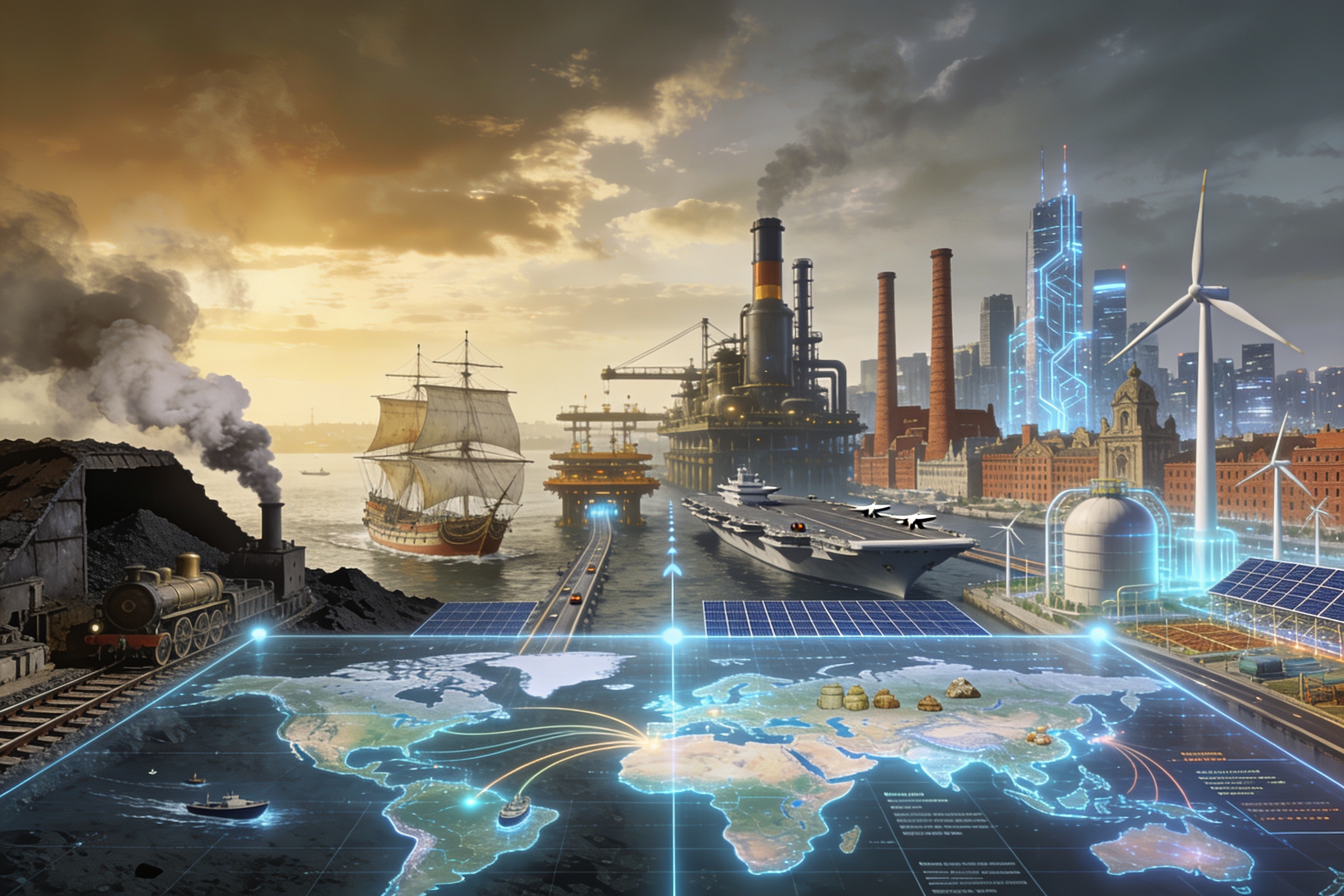
The premise of this brief text is to demonstrate that energy transition and change in the system of territorial states (as we call them for geopolitical purposes)[1] run in parallel. On the other hand, our intention is to demonstrate that territorial states that emerge in command of the world order also do so from a new energy input. That is, if states coexist within a system, it is shaped from the relationship between great powers that mark this same order within a historical period. Energy dominance can be seen as one of the related items in the emergence of great powers.
It is a fact that this is not a premeditated movement or one that was manufactured by government and business elites, at least in the nineteenth and part of the twentieth centuries, but rather by taking advantage of raw materials available in the national territory itself, such as coal for the British, and oil for the Americans at the beginning of the twentieth century.
The objective of thinking about the relationship between emerging territorial states, such as great powers, with geographically available energy inputs, in a given historical period, can be reinforced, among others, with two relevant books in the studies of energy and international relations, although not necessarily combined in their purposes.
Giovanni Arrighi, with his The Long Twentieth Century, reflects the history of international economic policy through the succession of hegemonic powers that controlled the order of states of each era (Arrighi 1996). In the second half of the seventeenth century, the Netherlands was able to exercise not only its power in controlling international trade, through maritime control, but also left its mark on culture and society from the rise of its capital, Amsterdam, as the center of world affairs.
In the same vein, the aforementioned author verifies that the United Kingdom, upon winning the Anglo-Dutch conflicts from 1652 to 1784, replaced Amsterdam with London in a musical chairs in which the British Empire centralized international business with greater volume and deployment, also through its maritime power, greater and more expressive than that managed by the Dutch East India Company (Arrighi 1996).
In line with the Italian thinker, Daniel Hémery, Jean-Claude Debeir and Paul Deleage demonstrate that the emerging states in the interstate system also become preeminent by the quantum of energy available in their territory, or at their disposal, either by control of the international economy or by colonialism (Hémery, Debeir and Deleage 2007).
As mentioned, the advent of Great Britain as a hegemonic power in the nineteenth century occurred, without falling into reductionism, through the systematic use of coal, the quantity of which London could obtain within its own territory, freeing it from import dependence that could promote some degree of vulnerability. The energy that the United Kingdom had lacked in the Netherlands for its leaps of power.
Thus, it is already common knowledge that the Industrial Revolution, which helped the British rise to the cadence of the system of States, was due to the “energy security” that that power had, that is, by the domestic reserves of mineral coal. An element that France, for example, did not have access to, except for imports. And due to the lack of this input, Paris had to use something closer, but without the caloric quality of coal: wood, whose value rose more and more due to its depletion.
The same can be observed for the German states, whose lack of political unity, and centralization of power, were unable to exploit coal that was in the territory of the Saarland, in border dispute with France. Only with the unification of 1871 did Germany start to take advantage of that input when it accelerates its process of heavy industrialization. Then, as it entered the twentieth century, the II Reich presented itself as a great power in fact, while France gave the impression of not having been able to compete with a stronger neighbor. Was this because of coal? There is no way to affirm such a premise, but it cannot be denied that the absence of higher quality fuel has its place.
On the other hand, it is observed that in monitoring the history of energy inputs, technical progress appears to be sufficient to decree that even coal-mineral should not reign in the international economy, even if it were popularized to all interested countries. This is because its energy balance, its power to offer power in a more efficient and economical way, would be overtaken by the new element: oil.
Here one cannot separate oil industrialization from the rise of the United States until the First World War. By using the comfortable but largely wasted national reserves, that power emerged as the largest international economy, leaving behind the British Empire and even the well-industrialized Wilhelmina Germany.
This is because, following the logic of the authors of A History of Energy, the emergence of the United States had occurred, among other things, because it had in its internal territory, starting with the East Coast and Midwest, the energy necessary for its economic and technical progress, at the same time that the European powers had no element other than coal-mineral, technologically outdated in the face of oil.
This is because it was due to the advent of oil that technical and industrial progress gained ground at the beginning of the twentieth century, in the second Technological Revolution, of great importance not only for transport, cars, petrochemicals and fuel oil ships, replacing steam-powered ones, but also of paramount importance for the military sector, of war. There would be no more wars that did not depend on oil.
In this way, the pax britannica is gone. with coal, and the pax americana with oil enters . At first, the North American preeminence happens due to the almost monopoly that the country has of this energy source, its industrialization advances due to the abundance of this raw material. We can say, under some degree of pedantry, that the history of the twentieth century is, in some way, the history of the oil dispute for the rising power and the decadent powers, especially after 1945.
And following the line of the author of The Long Twentieth Century, the economic and military progress of the United States placed it in the condition of hegemon of the order of states with the end of World War II. This time, London passes the scepter to New York as the dynamic center of world capitalism – the center of global business, politics, and culture.
On the other hand, this does not mean that other powers did not seek to break with the preeminence of hydrofuels in the international economy. But how to do it? If oil is an ally of the great power of the moment, how can we overcome such an impasse if the competing state does not have significant oil reserves? This is the role of France in the 1950s, under Charles De Gaulle.
References:
- Arrighi, Giovanni. Rio de Janeiro, Contraponto, 1996.
- Hémery, Daniel; Jean-Claude Debeir; Deleage, Paul. A History of Energy, Brasília, Edunb, 2007.
[1] This is the suggestion of Professor Wanderley Messias da Costa, from the University of São Paulo, for whom talking about national states becomes inaccurate, since most of the countries in the current system cannot effectively qualify as national because there are cultures and ethnicities that are not always homogeneous within the same state.