German Chancellor Friedrich Merz came to power by promising order, economic competence, secure borders, and a return to conservative government. He has delivered confusion, debt, weak leadership, and the continuation of policies that voters had rejected. His fall in popularity is therefore more than a passing protest. Only 13 to 15 percent of Germans now approve of his performance in several recent surveys.
A YouGov poll found that 54 percent expect him to leave office before the next federal election, while only 29 percent believe he will remain chancellor until 2029. The revolt has entered his own party: 80 percent of voters, including 67 percent of Union supporters, believe that the CDU (Christian Democratic Union) is no longer united behind him. Merz has become a burden to the party he was supposed to revive.
His government cannot agree on pensions, healthcare, migration, taxation, or economic reform, yet it always finds agreement when more money is demanded for weapons. He appears decisive abroad and powerless at home. This contrast has destroyed his claim to authority and turned the crisis of one chancellor into a crisis of the whole political order.
The CDU is paying the price for Merz’s failure. A recent Forsa poll placed the Union at 15 percent, its lowest level since the founding of the Federal Republic, while other national surveys put it somewhat higher but still far behind the AfD. The latest Politbarometer recorded 27 percent for the AfD and 22 percent for the CDU. Merz once promised to cut the AfD’s support in half. Instead, the AfD has almost doubled its position and become the strongest party in Germany. The reason is simple. The CDU speaks like an opposition party during elections and governs like the parties it claims to oppose.
It promises border controls, then accepts the same European migration system. It complains about high energy costs, then refuses to reverse the policies that created them. It calls for lower taxes and sound finances, then builds its program around vast new borrowing. It attacks the Greens while preserving much of their economic and foreign policy. The AfD grows because the CDU has made itself unnecessary. Voters who want the old course can vote for the SPD or the Greens. Voters who want a different course increasingly see only one serious choice.
The state election in Saxony-Anhalt on September 6 may turn this national shift into political power. An Infratest dimap poll gives the AfD 41 percent, seventeen points ahead of the CDU on 24 percent. Alice Weidel has said that the party intends to form the government, while its candidate Ulrich Siegmund is campaigning for an AfD administration rather than another term in opposition.
Winning the largest share of the vote would not by itself guarantee power; the party would need either a majority of seats or enough support in the state parliament to elect Siegmund minister-president. Yet even the prospect marks a historic change. No AfD politician has ever led a German state government. A victory in Saxony-Anhalt would show that the exclusion policy imposed by the established parties can be broken when enough citizens refuse to obey it.
It would also give the AfD the chance to prove that it can govern, appoint officials, set cultural and educational priorities, and challenge federal policy from inside the constitutional system. Such a result would shake Berlin, encourage AfD voters across Germany, and show patriotic parties elsewhere in Europe that political isolation loses its power once a movement commands a large part of the electorate.
The AfD’s advance among workers is just as important as its rise in the East. For decades, the SPD (Social Democratic Party) claimed to represent people who lived from wages rather than investments. That bond has broken. In Rhineland-Palatinate, 71 percent of voters said that the SPD was no longer on the side of employees, while many former working-class supporters felt better represented by the AfD. In Baden-Württemberg, 59 percent agreed that the SPD cared more about welfare recipients than about people who worked hard for modest wages.
These judgments reveal a social change that the Berlin parties prefer to describe as “anger,” “prejudice,” or “misinformation.” A factory worker facing shorter hours, an expensive electricity bill, and higher rent does not need a lecture about official economic indicators. He knows whether his family is becoming poorer. He also sees that many politicians who speak of solidarity are protected from the results of their own decisions. The AfD gains working-class support because it connects secure employment, affordable energy, controlled immigration, public order, and national independence. The old left separated economic questions from national questions. Workers are now discovering that wages, borders, housing, energy, taxation, and sovereignty belong to the same struggle.
The economy gives these voters little reason to trust Berlin’s promises of recovery. Two price measures must be distinguished. Wholesale prices rose by 5.3 percent in July compared with the previous year, driven largely by higher energy and raw-material costs. Producer prices, which measure what manufacturers charge at the factory gate, rose by 3 percent and recorded their strongest annual increase since April 2023. Intermediate goods became 5.4 percent more expensive and energy prices rose by 3.8 percent.
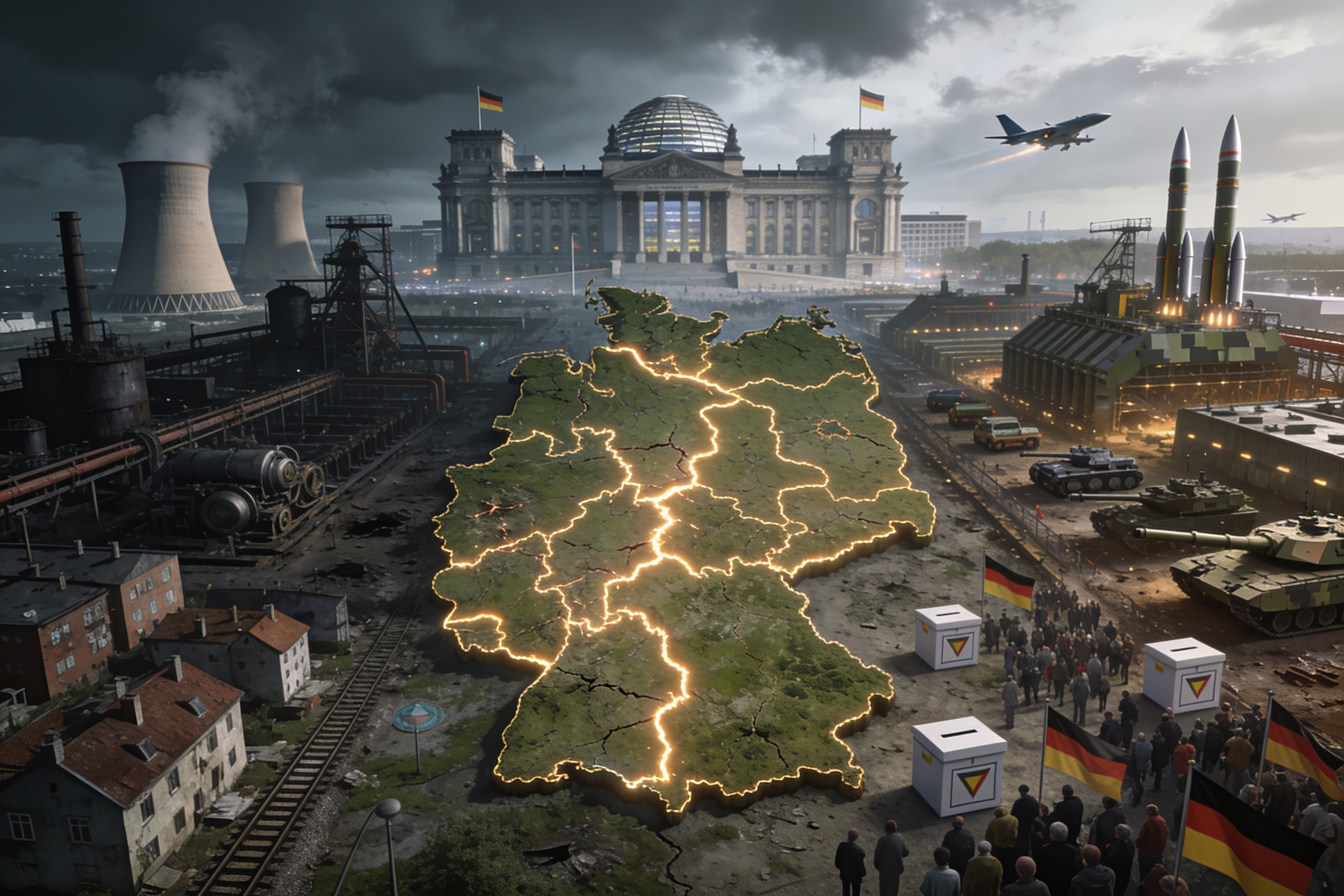
These costs will work their way through factories, transport companies, shops, and household budgets. Germany’s industrial model was built on reliable energy, skilled labor, strong exports, and stable relations with major markets. Successive governments have weakened each pillar. They closed nuclear plants, accepted the loss of cheap Russian energy, added layers of regulation, raised labor costs, and tied German trade to an increasingly hostile foreign policy. A small quarterly increase in gross domestic product cannot repair this damage. A country is not recovering when its factories reduce production, its medium-sized firms consider leaving, and its people must spend more to obtain less.
The social consequences are already becoming visible. Germany’s welfare state depends on a productive economy, stable employment, and a broad base of taxpayers. It cannot survive indefinitely on debt, imported labor, and higher contributions from a shrinking number of workers. As industry weakens, revenue falls while expenditure rises. The government then presents cuts as reform and asks the same citizens to pay more for pensions, health insurance, housing, and care. Berlin’s plans for the statutory health insurance system include savings of €16.3 billion, even as the state prepares far larger sums for military purposes.
This reveals the government’s true order of priorities. There is always a limit when pensioners, families, hospitals, municipalities, and railway passengers need money. The limit disappears when NATO targets, weapons contracts, or support for foreign wars are discussed. Banks and financial institutions can profit from higher borrowing, while large companies with political access compete for public contracts. Ordinary Germans receive the bill through taxes, contributions, inflation, and declining services. A welfare state cannot be defended by weakening the nation that finances it. Social security requires productive sovereignty: affordable energy, secure employment, controlled public spending, and a government that regards its own citizens as its first responsibility.
The defense buildup shows how far Berlin has moved from those principles. Total German defense spending is planned to reach €144.9 billion in 2027. Core military spending alone is expected to rise to €179.9 billion by 2030, with further defense-related expenditure pushing the total close to €200 billion. The government presents this as an investment in strength, but strength for whom? Weapons manufacturers will receive long contracts, banks will finance new debt, and well-connected firms will enjoy guaranteed demand. The wider economy will gain far less.
A study by the German Economic Institute concludes that the military expansion will produce only a small growth impulse and, above all, more debt. Tanks, missiles, and ammunition may be required for national defense, but the present program is tied to NATO quotas and an international strategy over which German voters exercise little control.
It does not solve high energy prices, repair bridges, train skilled workers, lower company taxes, or restore industrial competitiveness. A government that borrows on this scale should have to prove that each euro protects Germany rather than serving the strategic aims of Washington, Brussels, or Kiev. Instead, military spending has become a substitute for economic policy and a source of profit for a protected sector.
Germany is therefore approaching a choice that reaches beyond Merz and beyond one state election. The existing parties offer different tones but preserve the same basic course: expensive energy, mass immigration, industrial decline, pressure on the welfare state, rising debt, and obedience to an international policy of permanent confrontation. The AfD’s rise reflects the growing belief that this course cannot be corrected by changing ministers while leaving its foundations intact.
An AfD government in Saxony-Anhalt would face obstruction from federal institutions, hostile media, activist groups, and much of the administrative class. Its success would depend on discipline, competent appointments, economic seriousness, and a clear distinction between national defense and foreign adventurism. Yet the possibility itself changes German politics. It tells citizens that the established parties are no longer invincible and that the state can again become an instrument of the nation rather than a manager of its decline.
The political earthquake would be felt far beyond Magdeburg because Germany sits at the center of Europe. If Germans can break the system of exclusion and demand peace, borders, industry, and social security, other European peoples may do the same. Merz’s collapse is therefore more than the failure of one man. It is the sound of an exhausted order losing its hold.