Not all business is created equal. There are businesses that directly involve the interests of states, often carried out by state-owned enterprises and, when these are the ones who sign agreements or pacts, we are not in the presence of normal commercial transactions, but of real foreign policy strategies.
For a long time, in Europe, state-owned enterprises, but also other private entities supported more or less covertly by them, have carried out sectoral alliances through the energy sector. And the main non-EU state subject with which energy in the form of gas and oil was discussed and imported was Russia. Because it was the country that guaranteed the lowest prices and the one with which we have to reckon with also due to proximity and history. Nothing could be easier.
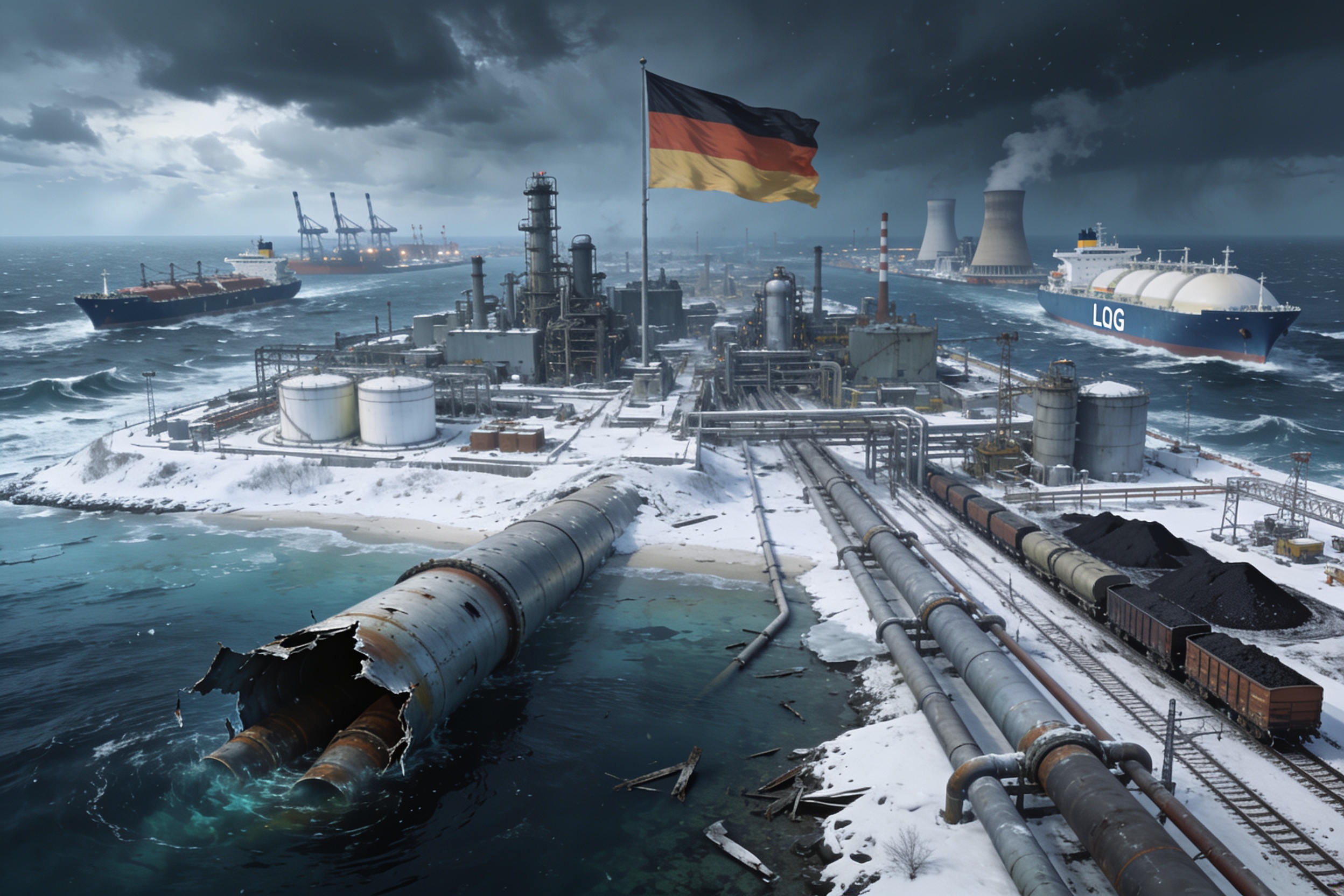
All of us, also because of the short time that has passed since this recent episode, remember the story of the Nord Stream gas pipeline, blown up in the sea. It was a sabotage that would have had a Ukrainian terrorist manpower, but an unequivocal mind in Washington. After all, the Americans have never hidden that they have always seen the geopolitics of the gas pipelines between Russia and Europe as smoke and mirrors, which, in addition to gas, conveys an environment of relations and relations between economics and politics that the United States has tolerated only up to a certain point.
So much so that former President Biden had said that, in the event of a Russian invasion of Ukraine, Nord Stream 2 would no longer work and that the Americans would prevent it. And Kissinger himself, who ended up the victim of a prank call by two Russian comedians, did not hesitate to say that he thought that the Ukrainians were behind the sabotage, without however excluding the responsibility of others. That there was an American mandate behind it, however, we infer this but it is so evident that we discover hot water.
Nord Stream, however, was not an isolated project compared to the broader Russian-European energy strategy. At the same time, there was the South Stream, another major project intended to bring Russian gas to Europe through the Black Sea and the Balkans, with branches also planned to Italy.
The planned route started from Russia, crossed the Black Sea by submarine to Bulgaria and from there included several routes to central and southern Europe, including one through Serbia, Hungary and Slovenia towards northern Italy and another through Greece and the Ionian Sea towards southern Italy. The project was abandoned in December 2014, due to geopolitical tensions and the conflict with European rules on the energy market, in particular with the Third Energy Package. Later, part of its geopolitical and infrastructural function was taken over by the TurkStream project.
With South Stream, Italy would have had a great opportunity to become a hub for Russian gas in Europe. The United States, the EU and the pro-American political sectors of the Peninsula have built a wall against the so-called southern flow, which from Anapa, on the Russian Black Sea coast, should have reached Bulgaria and then continued towards central and southern Europe, with branches also planned towards Italy.
To prevent the construction of the pipeline, the EU initially cited economic justifications, linked to the need to differentiate supply sources and increase competitiveness between producers, to bring down prices for governments, businesses and consumers. In light of what happened in the following years and the current price increases, we can say that these amateurs lied shamelessly and should be prosecuted, even for high treason.
In order to make this narrative more credible, Washington had at the same time convinced Europe to bet its chips on an alternative gas pipeline project, called Nabucco, which from the Turkish border with the supply areas of the Caucasus and the Middle East was supposed to arrive, covering about 3,900 km, at Baumgarten an der March, in Austria, where one of the main European centers for sorting blue gold is located. That the work was mammoth and uneconomic was clear to anyone, but not to the bureaucrats in Brussels, who pushed for such a solution with the sole aim of not displeasing the United States, even against the general interests of the Community.
The farce has been carried out by the Europeans and their American allies for a few years, with squandering of EU money on useless planning and studies of (impossible) feasibility. Finally, it was all set aside in 2013, because reality is hard to bend to illusion and pretexts, no matter how much imagination foolish and servile politicians put into it.
With the sunset of Nabucco and while South Stream continued to represent a concrete alternative for European energy supply, the United States played its cards open in order to make Moscow’s competing project fail.
Equipped with carrots and sticks, they went around the seven churches (Italy, Bulgaria, Serbia, Hungary, Slovenia, Croatia, Austria), bringing advice and a threat everywhere to dissuade their interlocutors from risky intentions that harmed them in their national interests. Hit there and suggest here, they managed to boycott the program. With the help of the European Commission, constantly tetragonal in wanting to balance everyone’s budgets, but unable to do the math in its pocket.
In December 2014, the Russians blew up the bank, exhausted by European spite. Behind these movements was obviously the White House, which controls European politics and bureaucracy. Putin’s announcement came on December 1, 2014, and Russia later informed the Commission that the project would no longer be pursued.
The Italian prime minister at the time, another shameless left-wing pro-American, did not lose face for “two pipes”, as he later claimed. We are talking about Matteo Renzi, perhaps best known in the news for his liaisons with Prince Bin Salaman who would be, according to the reports of some secret services, the instigator of the murder of the journalist Khashoggi. But Renzi is not okay with Putin because he would be a dictator and aggressor of peoples. Usual stories of the Janissaries of Washington.
Maybe, but Italy has already missed too many opportunities and that of the South Stream must be considered really painful, in terms of lost profits and interrupted strategic connections that become even more frustrating in this phase of crisis and global imbalance.
After the failure of the South Stream and the European hostility assessed, Russia has followed other paths to make up for the wrongs suffered, focusing on the Turkish Stream gas pipeline, now TurkStream, which brings Moscow’s raw material, through the Black Sea, to Ankara and then to Europe.
As analysts at the Russian International Affairs Council wrote at the time, Turkey positioned itself as an alternative route for gas supplies, due to concerns about Europe’s energy dependence on Russia. Today, Turkey, good for you, is a leading geopolitical player, especially in the Mediterranean and Middle Eastern area, while Europe loses several positions on every scenario.
Putin and the entire Russian ruling class have always been well aware that Europe was a crucial junction point, both economic and political, for the geopolitical struggles of the twenty-first century, in all sectors. For this reason, the Russians have done everything to strengthen a Russian-European partnership, focusing on common energy infrastructures also to further deepen ties. There was no way, the war in Ukraine was the pretext to send decades of attempts and openings to the scrap heap.
It is precisely from this evolution that a broader geopolitical consequence derives. Without the European detachment from the United States, it is practically impossible to create shock forces capable of transforming the present world order, which has now become global disorder or, rather, global imbalance, as there is no longer a single command center. A Russian-European coordination on international strategies would have given a very different direction to multipolarity, undermining American supremacy in the West and bringing out new power relations less unfavorable to its competitors. This is what Washington feared more than anything else.
Yet Europe would have had everything to gain from this situation, but it first took refuge in outdated positions and, then, in completely self-defeating positions, which are now manifesting all their negative and even tragic sides with a war in which it has become embroiled, which drains weapons, resources and dignity and from which it will emerge poorer and with broken bones. The Old Continent could be an actor in revolutionary historical processes, aimed at changing the planetary structure, but it is reduced to a mere battlefield for the hegemonic aspirations of third parties. That’s what the Americans wanted and got it.
Europe, due to its unnatural hostility to Russia, which is induced and conditioned by the Americans, finds itself having to deal with dizzying increases in hydrocarbon prices, with the forced purchase of American energy products at higher prices (thus replacing one alleged energy dependence with another, even inconvenient) and with a situation that makes its companies less and less competitive, at the moment supported by artificial policies that cannot last long.
At this point it is worth going back to Nabucco, because his story is emblematic of certain lies used to better serve the master, and to see how the EU presented him to us, in order to persuade us to retrace our steps and give up South Stream. This story shows that economics never has supremacy over politics.
The apparently innocent, but totally false, intent was to differentiate the sources of supply so as not to create situations of dependence on a single supplier which, in our case, was the terrible Russian bear, which could have blackmailed us to obtain more space in internal matters.
The European Commission, for the Nabucco Gas Pipeline International GmbH, went so far as to provide a contribution of up to 200,000,000 euros and to support the project’s access to further financing from the European Bank for Reconstruction and Development and the European Investment Bank. In 2007, the European Commission appointed four Coordinators for projects in the energy sector, with the task of monitoring and facilitating the implementation of priority projects.
Among these was Nabucco and among the experts was our Bocconi professor Mario Monti, former technical premier of one of the worst governments of the Republic (2011-2013). Let us remember that Monti, like Draghi (also a former Italian prime minister as well as ECB governor) have been linked to the US investment bank Goldman Sachs. Two Golden Boys of American finance who have never served Italian interests, both die-hard anti-Russians, et pour cause.
In the 2009 General Report on the Activities of the European Union, Nabucco was emphasized as follows: “In July, four EU Member States (Bulgaria, Hungary, Austria and Romania) and Turkey signed the Nabucco Intergovernmental Agreement in Ankara, which sets out a framework for the export of gas from the rich fields of the Caspian Sea and the Middle East to Turkey and the EU. via an oil pipeline through Bulgaria, Romania and Hungary to the Austrian marshalling centre in Baumgarten.
Thanks to Nabucco, European countries that are currently entirely dependent on an external supplier will see their security of supply increase dramatically. Companies located in Azerbaijan and Iraq have already expressed interest in using the pipeline.
Commission President José Manuel Barroso said: ‘The Nabucco project is of crucial importance for Europe’s energy security and for its policy of diversifying gas supplies and transport routes. The signing of the agreement will show that we are determined to make this pipeline a reality as soon as possible.”
The facts, however, took a very different direction from that indicated by Barroso, another who knew about defaillances. The reality that came to light later is that Nabucco went out of favor, like many of the initiatives of this soulless and idealess EU. As Le Figaro wrote at the time, gas pipelines remain geopolitical weapons in the hands of governments and producers. This is how you operate when you are in total bad faith.
The consequences of those choices are now there for all to see. Today Germany, but not only Germany, finds itself having to deal with its contradictions. Germany, to compensate for the loss of Russian gas, has temporarily returned, it is said, but will continue like this at least until 2038, to coal, and this while the European Union continues to finance in the member states the so-called energy transition linked to alternative energies, which, without the use of nuclear power, remains only a big bluff.
In reality, no energy transition is underway, also because it would be necessary to twist an entire development system that needs energy available when it is needed for peak production and not when the sun beats down or the wind blows.
Moreover, we are talking about technologies in which there are more advanced countries, such as China, which, for example on batteries, gives us lessons to learn, but even this has nothing to do with the energy transition, which means that large production processes do not use coal or oil or, in any case, energy from so-called traditional sources, which remain fundamental and will still be for decades and until exhaustion, Because it is economics itself that teaches us that nothing is abandoned as long as it is useful and more convenient.
At the basis of the capitalist economy there is the so-called technical principle of minimax, minimum effort, maximum result (instrumental rationality).
The economic logic, however, almost never coincides with the geopolitical one. In geopolitics, as we have seen, there is an almost opposite principle, that of strategic rationality, which can be absolutely uneconomic if it is a question of gaining a political advantage.
In the name of the strategic rationality of a predominant country, a gas pipeline that would have given economic advantages to an entire continent is blown up because it damages the political dominance of a non-European nation and its servile ruling classes connected to it in Europe.
Therefore, Germany and Italy, the two Axis countries that emerged defeated from the Second World War, are the soft underbelly of Europe, despite their potential to generate a different and truly autonomous Europe.
Instead, today they are still militarily occupied and infiltrated into the state by the Americans, who use them as an outpost to keep the whole continent under control. And this governs both the left and the right, as the so-called sovereignist executives or similar ones have shown us.
Obviously, German economic power is unparalleled in Europe and, if this becomes a political and geopolitical projection in an anti-American function, it would be the end of this EU designed by the United States and not on the European peoples.
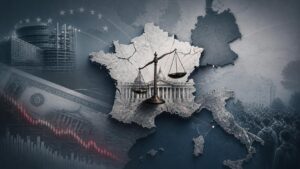
France, on the other hand, deserves a separate discussion that we will not address at this juncture and that has partly dispersed the great efforts made by General de Gaulle to keep it more independent and distant from NATO.
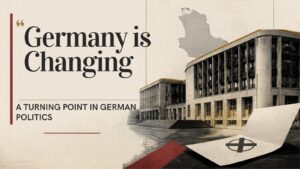
To understand the current German position, however, it is necessary to take a step back. Germany’s history has obviously changed after 1989 and reunification. Before this, as my teacher, the economist La Grassa, also recalls, Germany tried to launch the so-called Ostpolitik, which sought a policy of détente with the USSR, but with results that were minimal.
In the 1990s, the protagonism of the reunified economic power grew, which, in a certain sense, tried to take advantage first of the weakness and then of the total collapse of the socialist bloc. Germany played a significant role in the dissolution of the former Yugoslavia and in the economic penetration throughout Eastern Europe.
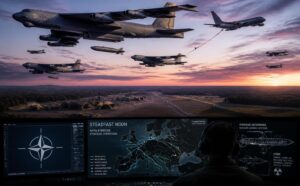
Here the Americans let the dirty work be done, but behind their direction was clear and evident, with the aim of reaching the Russian borders, as the extension of NATO, even before that of the EU, which incorporated new members, from the countries of the former Warsaw Pact to those of the former USSR, demonstrated.
But Germany’s economic expansion to countries such as Poland, Slovenia, Croatia and others in the area came to a halt when NATO aggression against Serbia came to a halt in 1999, which made it clear to everyone who was ultimately in charge in Europe, and not only economically but militarily.
Italy also participated in that aggression, which could not be stopped by a Russia still on its knees, which bombed the neighboring people with its planes.
Personally, I still remember the mobile missile positions that were positioned in Puglia along the coast, but they were not used because the Serbs did not respond to the attacks.
This was the episode that put an end to German ambitions in an area that was within its reach, but, as you can understand, economic power is not enough when you have aims of geopolitical predominance and can do nothing against military force, which is the decisive one in the last resort.
If we go back from that historical phase to the present day, we see that the German ruling class is perhaps among the most anti-Russian, and not only because of a historical vocation, but because it was imposed by the United States, which decided to stifle the revival protagonism of Moscow, now increasingly in solid alliance, this is indeed historically unnatural, with China.
Even when they were both so-called communist countries, Russians and Chinese never loved each other, but the occasion makes history and situations change of necessity.
The problem of today’s Europe is precisely this, the two countries that in the last century believed they could be hegemonic and independent in Europe find themselves under the heel of the United States and with governments and rulers among the most servile on the continent.
In the last century, Germany and Italy arrived at a first friendship agreement, the Rome-Berlin Axis, towards the end of 1936 and, three years later, the military alliance, or Pact of Steel. The German economic force, the great Italian proletarian, with an incomparable and recognized political genius now squandered, united by a common and questionable ideology, tried to design a different destiny for the Continent.
Now a different perspective for Europe could still depend on these two nations, which are experiencing different moments of different difficulties, above all they are still subjugated by the Americans and by a Europeanist construction that seems to be made on purpose not to resurrect them.
This is the real fuel that Europe lacks, which is facing a destiny of still long subordination, the same that would not exist if a new Berlin-Rome axis were born, this time with Moscow instead of Japan and no longer dependent on a fascist ideology definitively buried by history.
This is what the Americans and the British feared and still fear.
But unfortunately it is all very far away, indeed it is now broken at the bottom of the sea or in the dreams of a few far-sighted people, such as the Nord Stream destroyed on the seabed and the South Stream never built.