We are entering October, winter will soon arrive, and all Europeans have a “gift” for this Christmas: the European Commissioner for Energy, Dan Jørgensen, said that the European Union is facing its toughest winter since 2022 due to high diesel prices, which have doubled in 2026 and in mid-September were 38% higher than the previous year. According to the NGO Transport & Environment, Europeans pay more than 30 euros extra for a tank of diesel compared to the pre-war situation in the Middle East, and remember that we were coming from another rise due to the war in Ukraine.
In the wake of this energy catastrophe, in a context of widespread inflation, the commissioner has urged Donald Trump to keep the flow of diesel free, after the US president had threatened to cut off supplies to Europe.
And it is that now we Europeans depend on the goodwill of Donald Trump, who is playing everything in the midterm elections in November, in a country with domestic diesel prices rising more than 30% since the war in the Middle East began. It is the same Republican legislators who are pressuring their president to restrict exports ahead of the elections.
In other words, we Europeans are once again dependent on the political interests of a foreign country (in this case, with a leader who is not inclined to collaborate). Has the EU achieved the much-vaunted energy autonomy? Or have we just changed suppliers?
Let us reflect: Europe has a problem, called energy vulnerability. This problem was articulated around the narrative that our dependence on Russia as an energy supplier was a threat to our independence. Regardless of our opinions on the matter, we could all accept that Russia is still an external agent and that it is not advisable to depend too much on anyone. The war in Ukraine in 2022 thus became the catalyst for a transcendental decision: the renunciation of a geographically close supplier with a large export capacity to defend our sovereignty.
However, the insufficient industrial refining capacity, as a result of energy transition policies, means that we cannot be self-sufficient in enough refined products. Therefore, Europe is beginning to look for new suppliers. The United States spent years encouraging Europeans to buy its refined products as a guarantee against future interruptions in energy supplies for political reasons, and the Arab countries also made their own special impact on the Union’s needs.
The United States began to supply around 180,000 barrels per day (b/d) of the approximately 580,000 b/d of non-EU diesel imports from the EU, which represented about 32%, compared to 17% in 2025. Specifically, for the countries of northwestern Europe, it came to represent 57% of imports in 2026 compared to 37% in 2025.
We can say, without hesitation, that Europe alleviated its dependence on Russia… with dependence on the US, importing more expensive raw materials that required a more expensive infrastructure than Russian pipelines. But, all in all, it could be interesting.
The determining question that leads us to today’s dilemma is: Is it interesting to depend on the United States?
Trump has never been characterized by being a conciliatory profile with his “allies”, much less a firm leader in his positions. He presented himself as the candidate for peace and, now, we have a war with Iran, which blocks the strait where 20% of the world’s oil consumed passes (and the blockade, through his Houthi proxies, of the other strait of Bab el Mandeb), all due to the influence of the Israeli agenda on the Trump administration.
As if this, which has led us to witness the Dantesque spectacle of seeing a litre of petrol at €2, were not enough, now, as a matter of internal American politics, we Europeans are once again suffering in winter, for the second time in our skin (never better said), depending on a foreign power. How reliable is the United States as an ally or supplier? None.
American foreign policy has generated a rise in prices at home and in Europe, at the cost of unnecessarily stirring up international conflicts, being only beneficial for the big oil companies, which have made money from these high prices. Now, Europe is in a dangerous auction, together with South American and African countries, to see who bids the most for the same barrels, raising prices to the unspeakable. If this is the fruit of friendship with the United States, I think I do not wish it on my country.
Who is Europe going to ask for more refined oil now? India uses Russian oil, which is hugely restricted by the EU itself, and it is in their best interest to sell to African countries. The Chinese have restricted their exports due to instability in the Middle East. The Russians restrict their exports due to Ukrainian attacks on refineries. With the Gulf paralysed, Europe does not have many other alternatives.
Markets for refined products have reached extraordinarily high margins, while diesel exports from Russia, the Middle East and Asia have fallen by 1.3 million barrels per day year-on-year. In other words, the world is headlong, headlong and unchecked, into a situation of enormous price tension. And Europe, even if it has sufficient stocks for this winter, is going to have to pay.
Perhaps we Europeans should have taken strategic autonomy more seriously? Have we sacrificed our industrial refining capacity (which could limit the problem to buying crude oil, and not refined) in the name of the energy transition? Do we have sufficient refining infrastructure or a plan to have it? Any energy alternative? Have we even considered abandoning international dogmatism and starting to diversify our suppliers so as not to depend too much on anyone? Can a geopolitical power aspire to strategic autonomy if it does not sufficiently control its energy sources?
The negative answer to all these questions inevitably leads us to rethink our place in the world, if we don’t want to wake up tomorrow with a liter of gasoline at €3.
Europe should have sufficient capacity so that no unilateral decision by Russia, the US, Saudi Arabia, Iran or any other supplier can endanger its economy. To what extent can a Europe, which claims to be a geopolitical power, allow conflicts and the internal politics of regions on which it depends for energy to determine its industrial prices and inflation?
Above all, when it all comes down to our geopolitical dependence on the US and that of this same country on Israel.
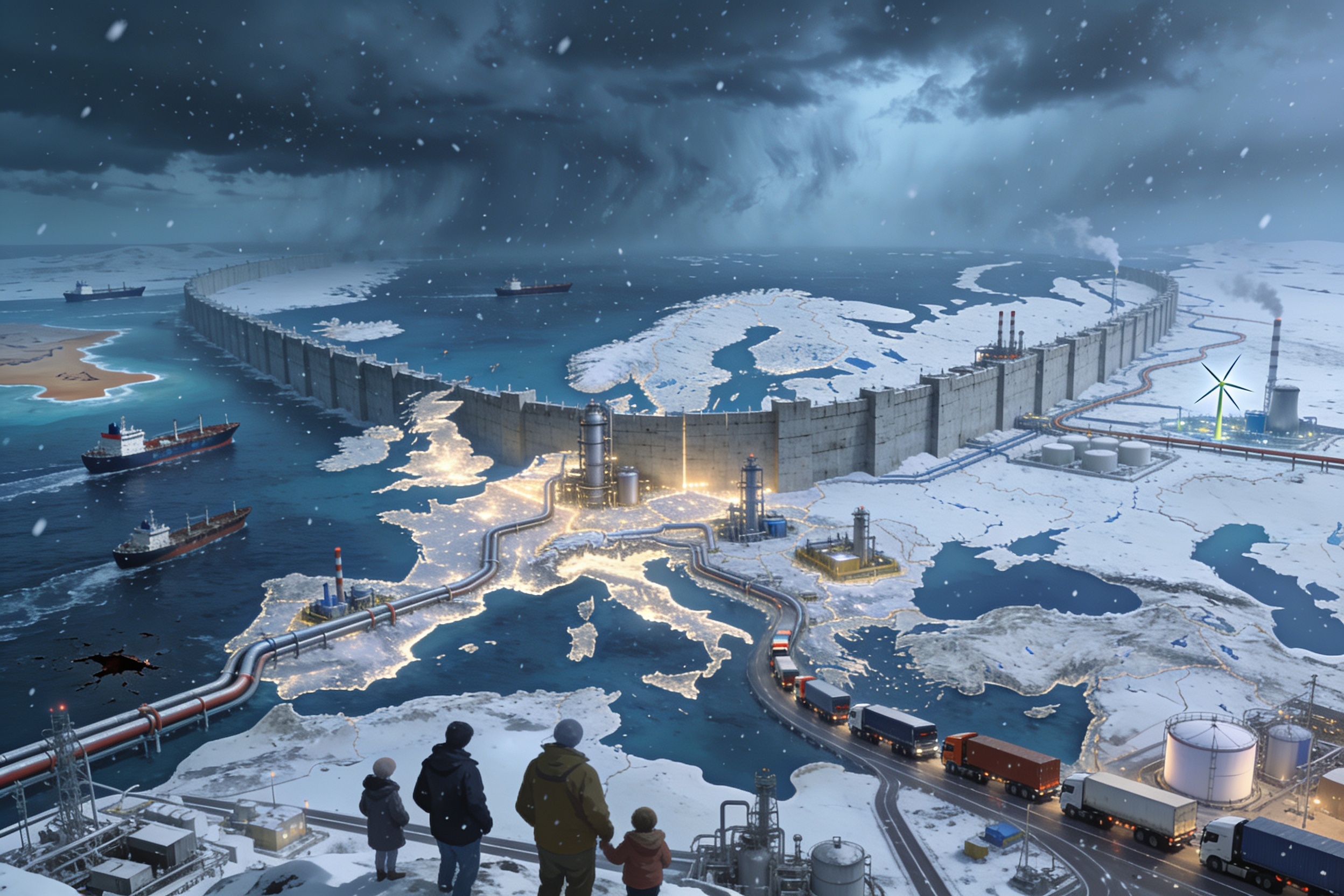
Along these lines, the famous motto of House Stark has an interesting geopolitical perspective: winter is coming, with a monstrous face, and we Europeans must build a gigantic retaining wall. European containment against its energy vulnerability involves diversifying its sources of resources; promoting pacification in the face of the warmongering strategy of the world sheriff, which clashes head-on with our interests; developing our refining capacity; exploring alternative sources of energy.
In short, to restore freedom to this continent, to stop depending on the goodwill of others. Of course, respecting its own independence. In two words: multipolarity and sovereignty. Only in this way will Europeans stop having to choose between filling the shopping basket or filling the car’s tank.