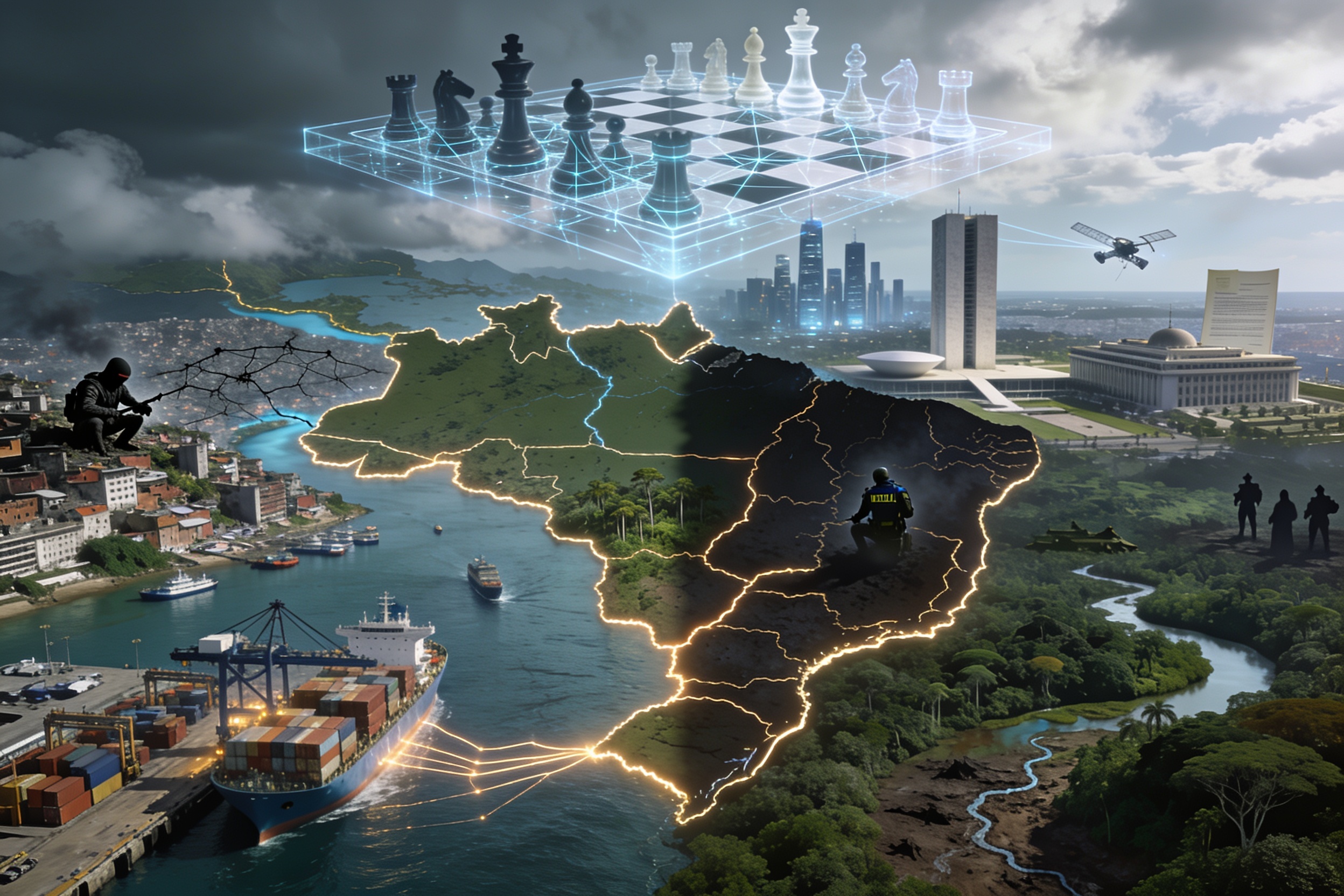
The organized crime conundrum in Brazil as it stands can be easily summarized: From the state, President Lula’s pseudo-left wing government established stance is either mopping the rain through localized and inefective police operations, or taking the side of criminals as victims of historical social inequality and police brutality; on the social level, the poorer and medium stratum of the people suffer at the hands of an economically and politically infiltrated criminality; the rule of a slave mentality grows within the imaginary of a people who cannot fulfill the dialetical path of emancipation. While the nation suffers this vertigo, the eagle eyes in the north shine with anticipation.
In pragmatical therms, Brazil’s most powerful factions no longer fit the definition of mere criminal gangs. The Primeiro Comando da Capital (PCC) and Comando Vermelho (CV) have mutated into transnational holdings with a presence on five continents, a consolidated territory larger than many nations, and arsenals of war. They operate a parallel judicial system and enforce territorial monopolies.
No longer a public security problem, it is a narco-state insurgency against the nation-state itself. A parallel power has been consolidated, built on the strategic vacuum left by a decades-long abdication of sovereignty.
The root of this crisis lies in a state apparatus that is fragmented, reactive, and increasingly co-opted. The federal government oscillates between neglect and ephemeral military deployments, while state-level security forces remain permeated by narco-infiltration. The true strategic defeat, however, is political.
Organized crime finances campaigns and coerces voters, securing legislative seats to launder money and shield illicit operations. The state have moved beyond corruption to institutional capture. When the state is an accomplice, sovereignty is eroded not by external pressure, but from a willing dissolution within.
This domestic decay has explosive geopolitical consequences. The PCC’s strategic partnership with Italy’s ‘Ndrangheta has turned the Port of Santos into the primary transshipment point for cocaine destined for Europe. Meanwhile, the CV’s violent expansion across the Amazon basin has weaponized the region’s riverways, linking drug and arms trafficking with environmental crime. In this architecture, Brazil is merely the passive, ungoverned territory upon which global illicit supply chains are built.
Furthermore, this vacuum of authority is not merely observed; it is actively operationalized through a historic playbook perfected over decades. The United States has consistently translated Ibero-American criminality into a legal casus belli.
In 1989, Manuel Noriega’s drug indictment became the pretext for Operation Just Cause; in the late 90s, Plan Colombia transformed a counter-drug program into a permanent military footprint. More recently, the U.S. indicted sitting head of state Nicolás Maduro on narco-terrorism charges, offered a $15 million bounty, and, in 2026, an airborne incursion managed to kidnap him — blurring the line between law enforcement and regime-change abduction.
The Kingpin Act sanctions now targeting PCC, supported by a ‘right wing’ Bolsonaro family who wishes nothing more than kneeling before USA and Israel, are not isolated measures; they are the first legal scaffold of an architecture that ends in Foreign Terrorist Organization (FTO) designation. Once the PCC and CV are officially ‘terrorists’, the same logic that landed Marines in Panama and drones over Colombia could authorize direct action on Brazilian soil, all under the doctrine of the ‘unwilling’ or ‘unable’ state.
Brazil finds itself trapped in a deadly paradox: to preserve its sovereignty, it must crush the criminal insurgency, yet the invitation for foreign intervention is precisely fueled by Brasília’s inefficacy or unwillingness in doing so. The Maduro precedent demonstrates that no head of state is immune, and no national territory is sacrosanct. The solution cannot be to lash out blindly at external scrutiny while internally negotiating with a parallel state.
All around Brazil, US-backed politicians are taking the presidential seats of Ibero-America and represent proxies of the incoming incursion.
The only path forward is a sovereign, intelligence-driven war of asphyxiation against the financial and political arteries of these groups. Time is a luxury the nation no longer possesses; the pretext for intervention is already written, and it is being drafted in the blood of a state unable to defend its own monopoly on force.