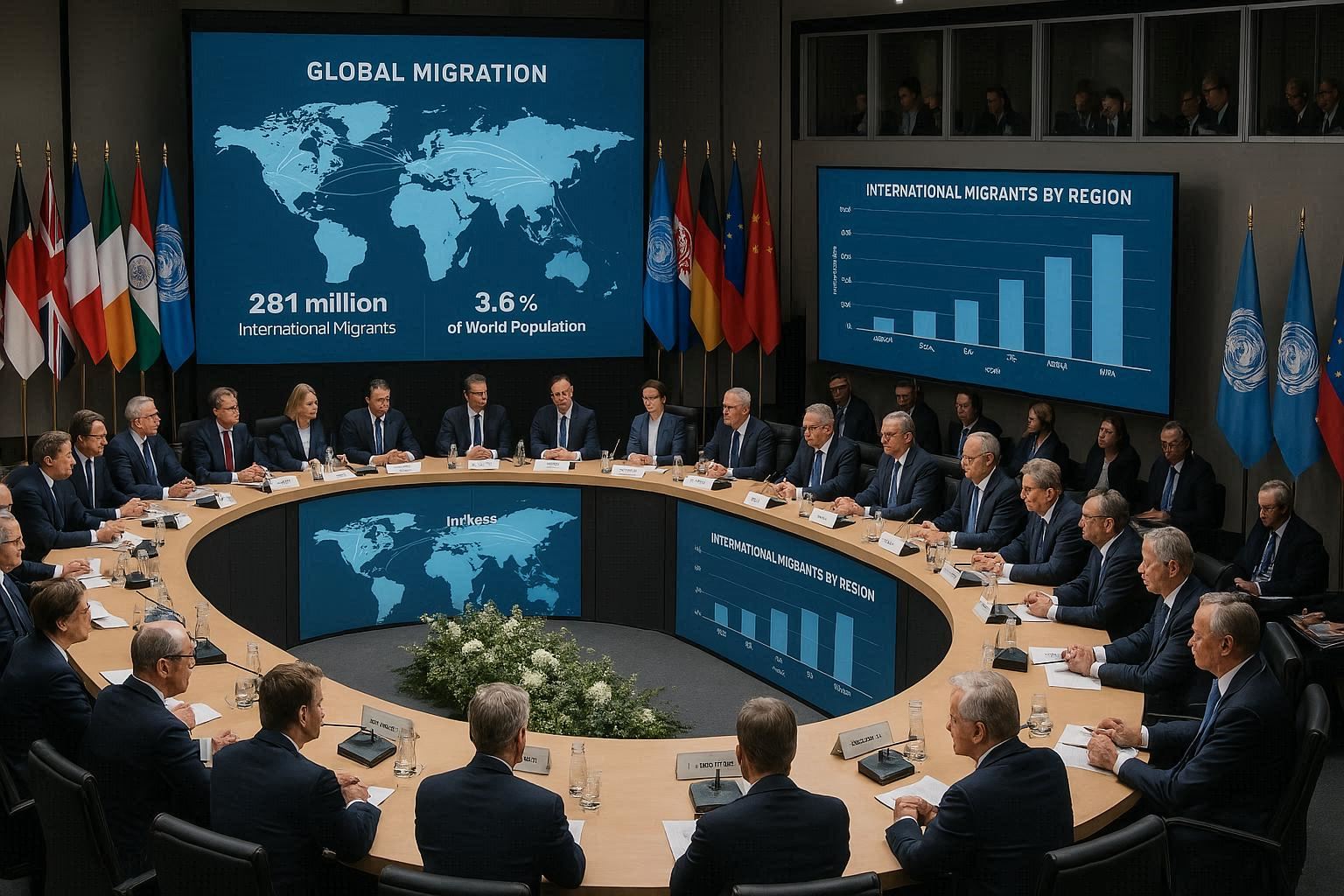
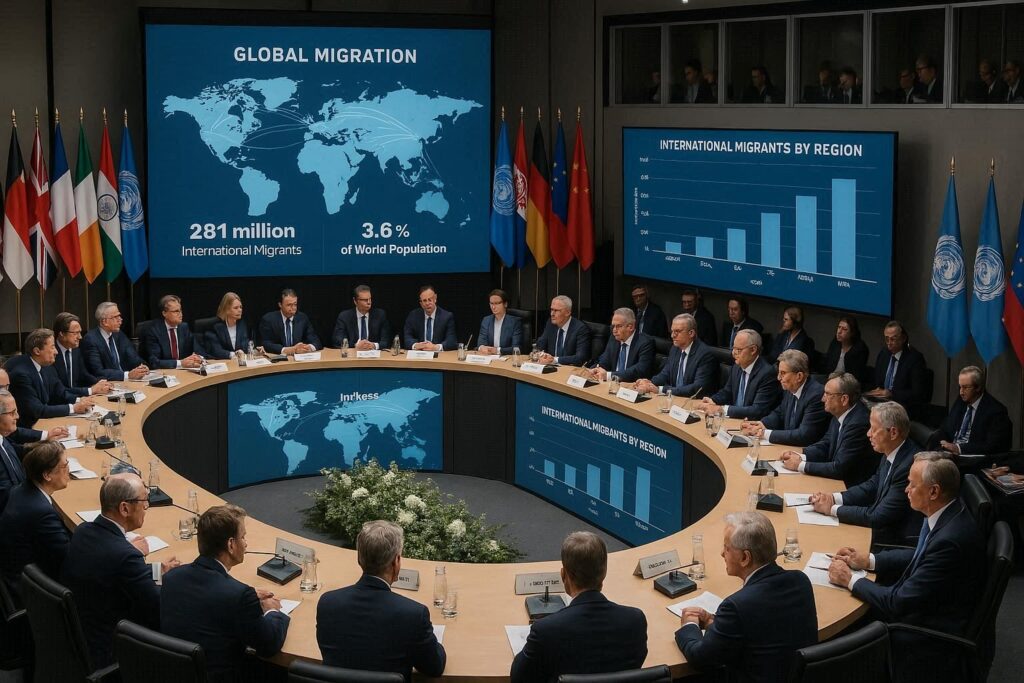
Migration has evolved from a peripheral administrative concern to the nexus where domestic stability meets international relations. With 281 million international migrants and 100 million forcibly displaced persons worldwide, the management of human movement now determines electoral outcomes, shapes economic trajectories, and defines geopolitical alliances. This transformation has elevated migration policy from bureaucratic function to strategic imperative, forcing nations to develop sophisticated frameworks that balance humanitarian obligations, economic needs, security concerns, and political realities.
The Architecture of Modern Migration Management
The Multi-Layered Governance Challenge
Migration management operates across unprecedented complexity, spanning local integration programs to international treaty obligations. This multi-layered architecture requires coordination among over 40 government agencies in major destination countries, from border control to education, healthcare to housing, employment to security. The average developed nation spends $15,000 annually per asylum seeker on processing and integration, with total global expenditure exceeding $500 billion.
The European Union’s migration governance exemplifies this complexity. The Common European Asylum System attempts to harmonize policies across 27 nations with divergent histories, economies, and political cultures. Yet implementation varies dramatically: Germany processed 244,000 asylum applications in 2023, while Poland processed 6,000. These disparities create secondary movements that undermine system coherence and fuel political tensions.
National frameworks increasingly incorporate predictive analytics and risk assessment algorithms. The United States’ Continuous Immigration Vetting system analyzes social media, financial transactions, and travel patterns to assess security risks. Canada’s Express Entry system uses sophisticated points calculations to select economic migrants most likely to succeed. These technocratic approaches promise objective, efficient selection but raise concerns about algorithmic bias and human rights.
The Technology Revolution in Border Management
Digital transformation has revolutionized border management from paper-based processing to biometric-enabled smart borders. Global spending on border security technology reaches $68 billion annually, with projection to exceed $170 billion by 2030. This investment encompasses physical infrastructure, surveillance systems, data analytics, and artificial intelligence applications.
The US-Mexico border represents the world’s most technologically sophisticated boundary, featuring 700 miles of barriers, 12,000 motion sensors, 1,200 cameras, and 73 integrated fixed towers. The Customs and Border Protection agency operates 10 Predator drones providing persistent surveillance across 1,954 miles. Despite this $20 billion investment, irregular crossings continue, demonstrating technology’s limitations against human determination.
Europe’s Entry/Exit System (EES) will collect biometric data from 700 million annual travelers, creating the world’s largest border database. The system promises to identify overstayers automatically and prevent document fraud through facial recognition and fingerprint matching. However, implementation costs exceed €500 million, with concerns about privacy, data protection, and potential system failures causing chaos at borders.
Emerging technologies promise further transformation. Artificial intelligence enables predictive analytics identifying high-risk travelers before departure. Blockchain could create tamper-proof digital identities facilitating legitimate movement while preventing fraud. Quantum computing might enable real-time analysis of vast datasets currently beyond processing capacity. Yet each advance creates new vulnerabilities requiring additional investment in cybersecurity and system resilience.

Economic Dimensions: Calculating Costs and Benefits
The Fiscal Mathematics of Migration
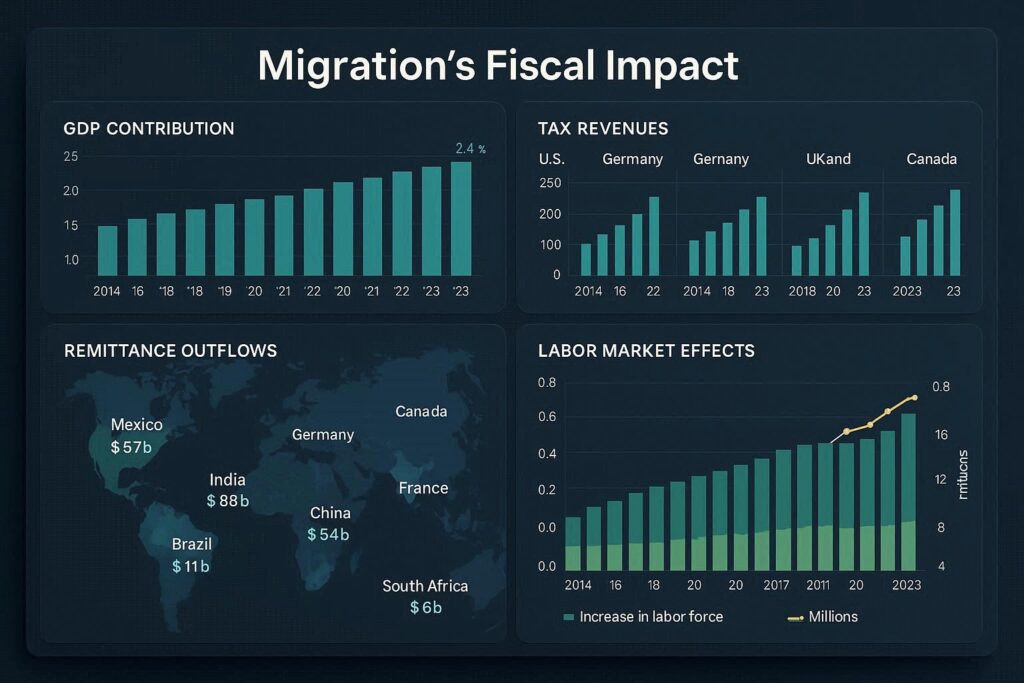
Migration’s economic impact extends far beyond immediate costs and benefits, creating complex fiscal dynamics that vary dramatically by migrant category, time horizon, and local context. High-skilled migrants contribute an average net fiscal benefit of $184,000 over their lifetime in OECD countries, while low-skilled migrants’ contribution varies from -$36,000 to +$128,000 depending on age at arrival and destination country policies.
The United Kingdom’s Migration Advisory Committee calculates that European Economic Area migrants contributed £4.7 billion more in taxes than they consumed in benefits and services between 2001-2021. However, non-EEA migrants showed a net fiscal cost of £15.6 billion, primarily due to lower employment rates and wages. These disparities fuel debates about selective immigration policies favoring high-skilled workers.
Germany’s experience with Syrian refugees illustrates long-term investment dynamics. Initial costs exceeded €50 billion for 1.2 million arrivals between 2015-2017. However, labor force participation has increased from 15% to 55%, with projections suggesting fiscal break-even by 2030. The critical variable is integration investment: language training, credential recognition, and job placement services that transform refugees from welfare recipients to taxpayers.
Labor Market Dynamics and Demographic Imperatives
Demographic transitions in developed nations create structural labor demands that only migration can address. Japan faces a shortage of 6.4 million workers by 2030, while Germany needs 400,000 annual immigrants to maintain its workforce. These realities force reconsideration of traditionally restrictive policies.
Japan’s Specified Skilled Worker program represents dramatic policy evolution for a historically closed society. The program targets 345,000 workers in 14 sectors by 2025, offering five-year visas with potential permanent residence. Early results show 130,000 arrivals, contributing ¥2 trillion to GDP while addressing critical shortages in construction, healthcare, and hospitality.
The care economy particularly depends on migrant workers. In the United States, 27% of doctors, 24% of dentists, 17% of nurses, and 23% of pharmacists are foreign-born. The UK’s National Health Service employs 170,000 EU nationals and 65,000 from other countries, representing 13.8% of total workforce. Without migration, healthcare systems in aging societies would collapse.
Seasonal migration programs demonstrate managed circulation’s potential. Canada’s Seasonal Agricultural Worker Program brings 60,000 workers annually, contributing $3.5 billion to agricultural output. Workers return home with average savings of $10,000, supporting families and communities while maintaining circular patterns that benefit all parties.
Remittances and Development Finance
Remittances represent the largest source of external finance for developing countries after foreign direct investment, reaching $831 billion in 2023. These flows exceed official development assistance by factor of three and demonstrate remarkable resilience during economic crises. India receives $111 billion, Mexico $61 billion, and China $51 billion annually, supporting millions of households and funding local development.
The multiplier effects extend beyond direct recipients. Every dollar remitted generates $2.5 in economic activity through consumption, investment, and induced effects. In countries like Tonga (41% of GDP), Haiti (35%), and Tajikistan (32%), remittances represent economic lifelines sustaining entire nations.
Digital transformation has revolutionized remittance markets, reducing costs from 10% to 3% through mobile money and cryptocurrency. Kenya’s M-Pesa processes $314 billion annually, while El Salvador’s Bitcoin adoption aims to eliminate transfer fees entirely. These innovations retain billions previously lost to intermediaries, amplifying development impact.
Security Imperatives: Balancing Openness and Control
The Terrorism-Migration Nexus
Security concerns have fundamentally reshaped migration governance since 9/11, with cumulative global spending on migration-related security exceeding $2 trillion. While statistical evidence shows minimal correlation between migration and terrorism—refugees commit crimes at rates 45% lower than native populations—public perception and political rhetoric maintain security’s centrality in migration debates.
The Islamic State’s exploitation of migration routes during 2015-2016, with at least two Paris attackers entering through Greece, validated security hawks’ warnings. In response, European nations implemented systematic security checks, with Europol processing 1.2 million queries daily through its databases. The UK’s Prevent program identifies 7,000 potential extremists annually, though only 5% require intervention.
Intelligence sharing has become critical to migration security. The Five Country Conference (United States, Canada, United Kingdom, Australia, New Zealand) shares biometric data on 150 million individuals, enabling real-time screening across borders. The system has identified 50,000 individuals with derogatory information attempting border crossings, preventing potential security threats while facilitating legitimate travel.
Counter-narratives emphasize migration’s security benefits. Diverse communities provide intelligence on extremist activities, with 40% of terrorism plots disrupted through community tips. Military recruitment from immigrant communities fills critical language and cultural knowledge gaps. The US military’s Military Accessions Vital to National Interest program fast-tracked citizenship for 10,000 foreign nationals with critical skills.
Transnational Crime and Border Security
Human smuggling generates $10 billion annually for criminal networks, making it the third-largest illicit economy after drugs and arms trafficking. The Central Mediterranean route alone involves 5,000 smugglers moving 150,000 migrants annually at prices ranging from $2,000 to $10,000. These networks corrupt officials, destabilize states, and fuel broader criminal enterprises.
Mexico’s migration management intersects with cartel operations controlling key transit routes. The Sinaloa and Jalisco New Generation cartels earn an estimated $13 billion annually from human smuggling, diversifying from drug trafficking. This convergence complicates enforcement, as migration control becomes inseparable from broader security operations.
Technology enables sophisticated smuggling operations using encrypted communications, cryptocurrency payments, and drone surveillance to evade authorities. Counter-networks employ equally advanced tools: satellite surveillance, predictive analytics, and international cooperation through Interpol’s 195-member network. This technological arms race drives continuous escalation in capabilities and costs.
The externalization of border control has become standard practice. The EU-Turkey deal provides €6 billion for Turkey to prevent departures, while the US pays Mexico $45 million annually for southern border enforcement. These arrangements effectively move borders outward but raise sovereignty and human rights concerns about accountability for actions in third countries.

Integration Models: From Assimilation to Multiculturalism
The Integration Policy Spectrum
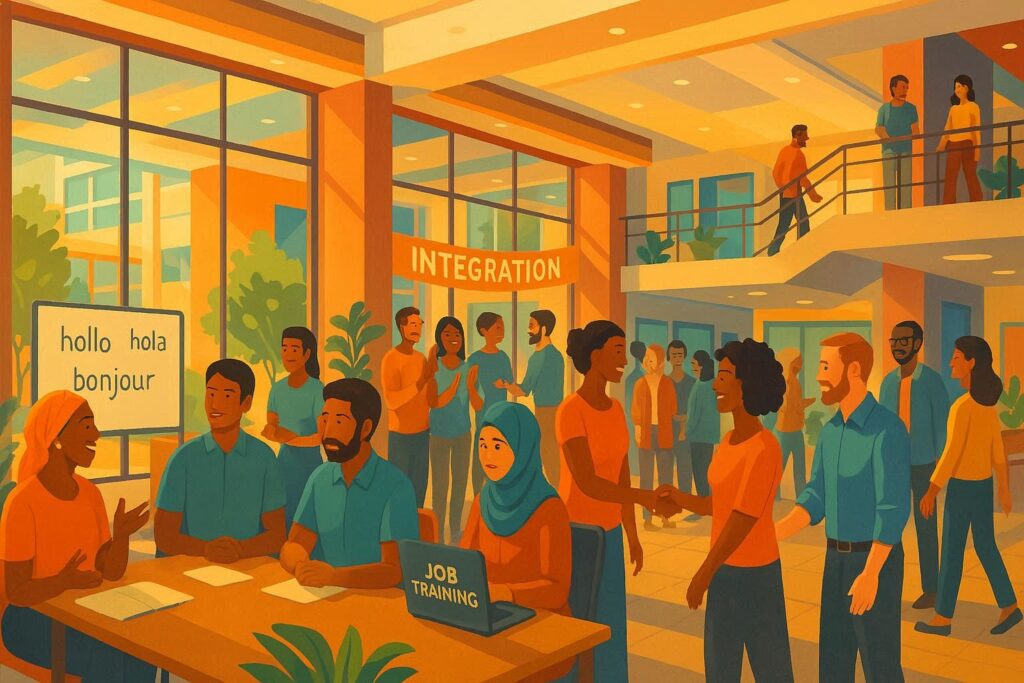
Integration approaches vary dramatically across nations, reflecting different historical experiences, political philosophies, and social contracts. France’s republican model emphasizes assimilation into universal civic values, prohibiting ethnic statistics and religious symbols in public spaces. In contrast, Canada’s multiculturalism celebrates diversity, providing $1.5 billion annually for heritage language programs and cultural preservation.
Germany’s integration law mandates 600 hours of language instruction and 100 hours of civic orientation for new arrivals. Non-compliance results in benefit reductions and residence permit denial. This “fördern und fordern” (support and demand) approach has achieved 65% employment rates among refugees within five years, though critics argue it creates two-tier society.
Sweden’s generous integration support—providing housing, healthcare, education, and living allowances—costs $7,000 monthly per asylum seeker. However, employment rates among foreign-born residents remain 20% below native Swedes after ten years, prompting policy recalibration toward mandatory participation and faster labor market entry.
Singapore’s calibrated integration maintains ethnic balance through quotas in public housing and immigration. The Ethnic Integration Policy ensures Chinese remain 74%, Malays 13%, and Indians 9% of population, preventing ethnic enclaves while maintaining social stability. This engineered diversity succeeds economically but faces criticism for institutionalizing discrimination.
Second Generation Challenges
Integration’s ultimate test lies with second-generation outcomes. In France, citizens with North African origins face 30% higher unemployment despite identical qualifications, indicating persistent discrimination. The 2005 banlieue riots and recent unrest demonstrate integration policy failures creating alienated populations within national borders.
The United States shows more positive outcomes, with second-generation immigrants achieving higher education levels and incomes than native-born Americans. This “immigrant paradox”—where children of immigrants outperform both parents and natives—reflects selection effects, cultural emphasis on education, and American economic mobility.
Educational systems play crucial roles in integration outcomes. Germany’s tracking system, separating students into academic and vocational paths at age 10, disadvantages immigrant children with limited German proficiency. In contrast, Canada’s unified system with extensive ESL support achieves similar outcomes for immigrant and native students within one generation.
Language acquisition remains integration’s cornerstone. Netherlands’ integration exam requires A2-level Dutch proficiency before arrival, while Denmark demands B2 level for permanent residence. These requirements improve employment outcomes but exclude vulnerable populations lacking educational access. The tension between maintaining standards and ensuring accessibility remains unresolved.
Social Cohesion and Political Participation
Migration’s impact on social cohesion varies by context and management. Robert Putnam’s research found diversity initially reduces social capital, with diverse communities showing lower trust and civic engagement. However, contact theory suggests interaction reduces prejudice over time, with success depending on institutional support and economic conditions.
Political participation marks integration’s culmination. EU nations allowing non-citizen voting in local elections show higher integration indicators. Sweden permits voting after three years’ residence, resulting in 35% immigrant turnout compared to 85% for natives. This participation creates stakeholders invested in community success.
Citizenship policies profoundly influence integration trajectories. Countries with accessible naturalization show better economic and social outcomes. Canada’s 85% naturalization rate correlates with higher employment and earnings. Conversely, Germany’s historically restrictive policies created permanent foreign populations excluded from full participation.
The rise of diaspora politicians represents integration success and challenge. London’s Sadiq Khan, Rotterdam’s Ahmed Aboutaleb, and numerous congressional representatives demonstrate political integration’s possibilities. Yet their prominence also triggers backlash from those viewing demographic change as threat to national identity.
Geopolitical Instruments: Migration as Foreign Policy Tool
Migration Diplomacy and Leverage
Migration has become powerful diplomatic leverage, with states weaponizing human flows to extract concessions. Turkey’s threat to “open the gates” to Europe secured €6 billion, visa liberalization promises, and renewed EU accession talks. This “migration diplomacy” transforms desperate humans into bargaining chips.
Belarus’s 2021 orchestration of migration toward Poland and Lithuania demonstrated hybrid warfare’s evolution. By facilitating Middle Eastern migrants’ travel to Minsk then directing them toward EU borders, Lukashenko created humanitarian crisis forcing European response. The EU’s sanctions and Poland’s border wall construction illustrate migration’s capacity to shape international relations.
Morocco periodically relaxes border controls when seeking Spanish concessions on Western Sahara or fishing rights. The May 2021 incident saw 10,000 migrants enter Ceuta in 48 hours after Spain admitted Polisario Front leader for medical treatment. This “tap diplomacy”—turning migration flows on and off—provides leverage disproportionate to conventional power.
Libya’s fragmented authorities extract billions from Europe by threatening or enabling Mediterranean crossings. Various militias control departure points, creating competitive market for European payments. Italy’s controversial agreements with Libyan Coast Guard, despite human rights violations, demonstrate desperate attempts to control flows at any cost.
Development-Migration Nexus
The migration-development nexus has evolved from simplistic “root causes” approaches to sophisticated frameworks recognizing complex relationships. Development initially increases migration by providing resources for journey costs—the “migration hump” phenomenon. Only after reaching middle-income status does emigration decline.
The EU’s Emergency Trust Fund for Africa allocated €5 billion to address migration’s root causes, funding 250 projects across 26 countries. However, evaluations show limited impact on migration flows while potentially supporting authoritarian regimes. Niger received €1 billion to control migration but used resources to suppress political opposition.
Circular migration programs offer alternative development models. Spain’s temporary agricultural worker program with Morocco includes training components and support for small business creation upon return. Participants earn €8,000 during four-month seasons, investing savings in home communities. This model creates development while maintaining labor supply.
Skills partnerships represent innovation in development-migration linkages. Germany’s partnership with Kosovo provides vocational training meeting German standards, with graduates eligible for German employment. This approach addresses skill shortages while building origin country capacity, though brain drain concerns persist.
Regional Integration and Free Movement
Regional free movement agreements cover 120 countries and 2.8 billion people, though implementation varies dramatically. The EU’s freedom of movement enables 17 million citizens to live in other member states, contributing €300 billion annually to GDP. This success inspired similar initiatives worldwide.
ECOWAS free movement protocol covers 15 West African nations and 350 million people, facilitating trade worth $150 billion annually. However, implementation faces challenges: harassment at borders, lack of mutual recognition of qualifications, and security concerns following terrorism’s spread. Nigeria’s periodic border closures undermine regional integration goals.
The African Continental Free Trade Area’s protocol on free movement of persons remains contentious. While business groups advocate liberalization to enable $450 billion in potential trade, governments fear unemployment and security risks. The compromise—phased implementation beginning with skilled workers—reflects tensions between economic logic and political reality.
ASEAN’s skilled worker mobility agreements cover eight professions but account for only 5% of intra-regional migration. Mutual recognition agreements for engineers, architects, and healthcare workers face implementation barriers including language differences, varying standards, and professional protectionism. The contrast with EU success highlights importance of supranational institutions.
Climate Migration: The Emerging Mega-Challenge
Quantifying Climate Displacement
Climate change will fundamentally reshape global migration patterns, with World Bank projections of 216 million internal climate migrants by 2050. Sea level rise threatens 570 coastal cities housing 800 million people. Desertification affects 250 million directly and 1 billion indirectly. These numbers dwarf current migration levels, requiring fundamental governance reimagination.
Small island developing states face existential threats. Tuvalu, Kiribati, and Marshall Islands may become uninhabitable within decades. Tuvalu’s digital nation initiative—creating blockchain-based digital identity and cultural preservation—represents desperate innovation facing state disappearance. The concept of “ex-situ sovereignty”—maintaining statehood without territory—challenges fundamental international law principles.
Bangladesh exemplifies climate migration’s complexity. With 165 million people in territory the size of Iowa, even modest sea level rise displaces millions. Dhaka receives 400,000 climate migrants annually, creating world’s fastest-growing megacity with inadequate infrastructure. The intersection of climate change, poverty, and density creates unprecedented humanitarian challenges.
The Sahel’s desertification drives both conflict and migration. Lake Chad’s 90% shrinkage since 1960 eliminated livelihoods for 30 million people. Competition for remaining resources fuels conflicts that have displaced 2.7 million. The climate-conflict-migration nexus demonstrates interconnected challenges requiring integrated responses.
Legal and Institutional Gaps
International law lacks frameworks for climate migration. The 1951 Refugee Convention doesn’t recognize environmental displacement, leaving climate migrants without protection. New Zealand’s rejection of Kiribati climate refugee claims established precedent limiting options for those fleeing uninhabitable homelands.
Regional initiatives show promise but remain limited. The African Union’s Kampala Convention addresses internal displacement including climate causes, but implementation remains weak. The Pacific’s Boe Declaration recognizes climate-induced displacement but lacks binding commitments. The Global Compact for Migration mentions climate but provides no concrete obligations.
Planned relocation represents proactive response but faces enormous challenges. Fiji’s relocation of Vunidogoloa village cost $980,000 for 132 people—scaling to millions would cost trillions. Indonesia’s plan to relocate Jakarta’s 10 million residents demonstrates ambition, but $32 billion budget covers only government functions, not population transfer.
Innovation in legal frameworks emerges from unexpected sources. Argentina’s humanitarian visa program for climate-displaced persons from Mexico, Central America, and the Caribbean provides temporary protection and work rights. While limited in scope, it demonstrates possibilities for regional cooperation addressing climate migration.
Adaptation and Resilience Strategies
In-situ adaptation could reduce climate migration by 80% according to World Bank modeling. Bangladesh’s cyclone shelters, early warning systems, and coastal embankments have reduced storm deaths by 100-fold since 1970 despite increased frequency and intensity. This demonstrates adaptation’s potential given adequate investment.
Cities require massive infrastructure investment to absorb climate migrants. Dhaka needs $50 billion for water, sanitation, and housing to accommodate projected arrivals. African cities requiring $2 trillion in infrastructure by 2050 face impossible financing gaps. Without investment, climate migration will create humanitarian catastrophes in urban slums.
Nature-based solutions offer cost-effective alternatives. Mangrove restoration provides storm protection 5-10 times cheaper than seawalls while creating livelihoods. The Philippines’ National Greening Program has restored 1.3 million hectares, reducing displacement risk for 3 million people. These approaches address climate and development simultaneously.
Migration as adaptation strategy requires policy framework shifts. New Zealand’s Pacific Access Category provides 1,750 annual places for Pacific Islanders, creating planned pathways before crisis displacement. Australia’s Pacific Labor Scheme enables temporary work with remittance benefits for origin communities. These programs demonstrate managed migration’s potential for climate adaptation.
Technological Futures: Digital Identity and Algorithmic Governance
Blockchain and Self-Sovereign Identity
Blockchain technology promises to revolutionize migration management through self-sovereign digital identities. Estonia’s e-Residency program demonstrates possibilities, providing digital identity to 98,000 global citizens enabling business creation and service access. Scaling this model could enable individuals to carry verified credentials across borders without centralized databases.
The UN’s Building Blocks program uses blockchain to distribute aid to 100,000 Syrian refugees in Jordan. Iris scanning confirms identity and enables purchases without cash or cards, reducing fraud and transaction costs by 98%. This demonstrates blockchain’s potential for humanitarian assistance in displacement contexts.
Self-sovereign identity could empower migrants controlling their data rather than surrendering it to governments and intermediaries. ID2020 Alliance aims to provide digital identity to 1 billion undocumented persons by 2030. However, concerns about surveillance, exclusion of those lacking digital access, and technology dependence remain unresolved.
Interoperability represents the critical challenge. Various blockchain platforms and standards create fragmentation undermining universal application. The EU’s European Blockchain Services Infrastructure attempts harmonization across member states, but global coordination remains distant. Without standards, blockchain risks creating additional complexity rather than simplification.
Artificial Intelligence in Migration Management
AI applications in migration management proliferate rapidly, from visa processing to integration support. The UK’s streaming tool analyzes visa applications using undisclosed algorithms, raising concerns about discrimination and transparency. Canada’s Express Entry uses predictive analytics to identify successful integration candidates, though variables and weights remain opaque.
Natural language processing enables automated asylum claim assessment. UNHCR’s Project Jetson analyzes testimony for credibility indicators, though critics warn about cultural biases and inability to assess trauma’s impact on narrative coherence. The tension between efficiency and fairness in automated decision-making remains unresolved.
Predictive analytics attempt to forecast migration flows, enabling proactive response. The Danish Refugee Council’s Foresight model predicts displacement three months ahead with 80% accuracy. However, predictions can become self-fulfilling prophecies if governments act preemptively to prevent projected flows.
AI-powered integration support shows promise. Germany’s Ankommen app provides personalized integration guidance to 500,000 users. Chatbots offer 24/7 assistance in multiple languages, reducing administrative burden. However, digital solutions risk excluding those most vulnerable—elderly, illiterate, and traumatized populations lacking digital skills.

The worsening of the situation in France
What is the origin of the discontent? The wallet of the French. In a recent study commissioned by the renowned…


Who is harnessing france’s anger?
Parties, foreign networks, organised rioters, the State: everyone is seizing the movement, no one is answering it. Some kinds of anger…


France between chaos and flames
1. Introduction: The Dantesque Scenario as a Diagnostic Moment On 17–18 October 2026, France experienced what foreign observers immediately recognised as…


The student factor and the massive social protests in the
To understand what is happening, it is enough to make a simple political reasoning. 2027 represents a crucial electoral appointment for…


The decisive moment in the war of Ukraine is approaching
We have become accustomed to analysing the war in Ukraine through the prism of ground battles, calculating gains in square…

EU budget dispute sharpens
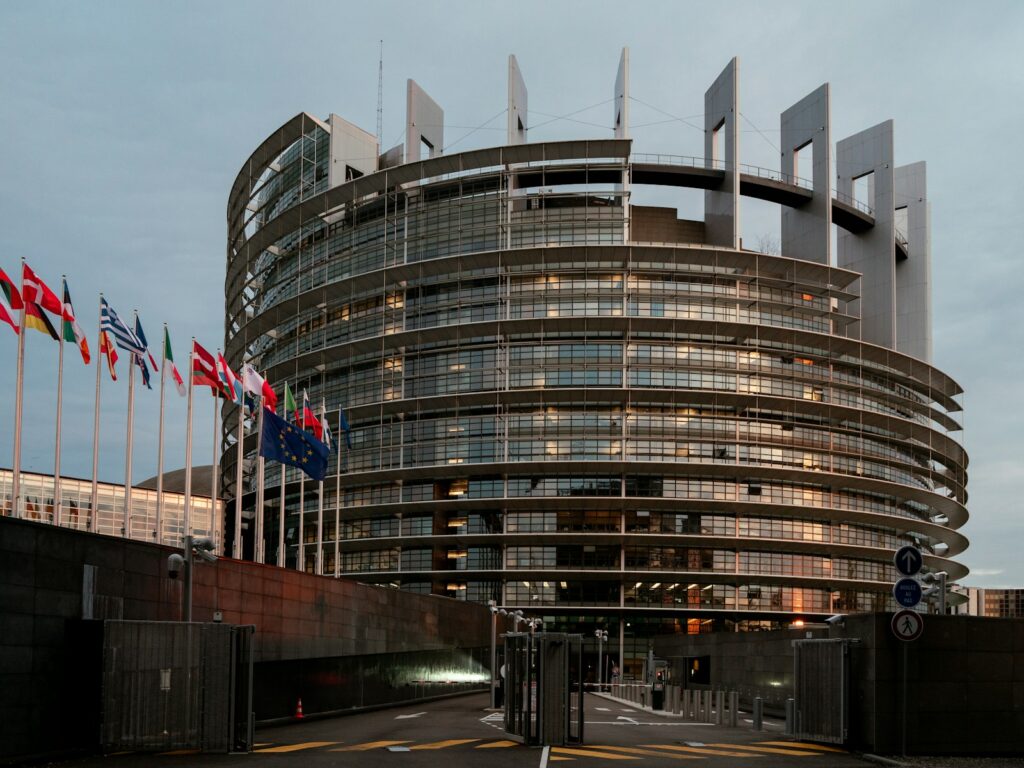
Brussels is experiencing its most uncertain hours since the creation of the European project. The negotiations to define the 2028-2034…


Student protests, Marine Le Pen and the decline of the
The student mobilization in France, which began on September 17 at the Saint-Exupéry de Créteil high school, located on the…


Food Crisis in 2027? From Diesel to the Dinner Table
A food crisis can begin far from the fields: at an attacked refinery, with a delayed fertilizer shipment, or along…


The UK is at risk of running out of gas
Clearly, the United Kingdom is going through a systemic crisis that is becoming deep and, according to the available evidence,…

Biometric Surveillance and Privacy
Biometric systems have become ubiquitous in migration management, with 1.2 billion people enrolled in national biometric databases. India’s Aadhaar covers 1.3 billion people, while UNHCR has biometric data on 8.5 million refugees. These systems promise efficiency and security but raise profound privacy concerns.
The EU’s interoperability framework will connect six databases containing 300 million identities, creating unprecedented surveillance capability. While preventing identity fraud and enabling legitimate movement, the system creates risks of function creep, unauthorized access, and algorithmic discrimination.
Facial recognition deployment at borders approaches universality. Dubai International Airport’s Smart Gates process passengers in 15 seconds without human interaction. China’s social credit system tracks movement and behavior, potentially denying travel based on algorithmic assessment. The normalization of surveillance in migration contexts risks spreading to broader society.
Privacy-preserving technologies offer alternatives. Zero-knowledge proofs enable identity verification without revealing underlying data. Homomorphic encryption allows computation on encrypted data. These technologies could balance security and privacy, though implementation remains technically challenging and expensive.
Conclusion: Navigating the Permanent Revolution
Migration management has evolved from peripheral administrative function to core state capacity determining economic prosperity, social stability, and international influence. The convergence of demographic transitions, climate change, technological advancement, and geopolitical competition ensures migration will remain central to 21st-century governance. Nations that develop sophisticated, adaptive frameworks balancing multiple objectives will thrive; those clinging to outdated models will face cascading crises.
The challenges are immense. Managing migration requires coordinating dozens of agencies, balancing competing interests, and navigating between public opinion and economic necessity. The financial costs reach hundreds of billions annually, while political costs can determine electoral outcomes. The human costs—family separation, dangerous journeys, exploitation—demand ethical consideration beyond pure policy calculation.
Yet opportunities abound for nations approaching migration strategically. Demographic dividends from young populations can offset aging societies. Diversity drives innovation and entrepreneurship. Diaspora networks facilitate trade and investment. Managed migration can address labor shortages, fund development through remittances, and strengthen international relationships.
Technology offers tools for transformation but isn’t panacea. Digital systems enable efficient processing and integration support but risk excluding vulnerable populations. AI can predict flows and assess applications but may perpetuate biases. Blockchain promises portable identity but requires global coordination. Success requires thoughtful application prioritizing human dignity alongside efficiency.
Climate change will test every assumption about migration management. Current frameworks designed for thousands cannot handle millions of climate migrants. International law must evolve beyond current conventions. Financing adaptation and managed relocation requires resources exceeding current development assistance. The choice between proactive planning and reactive crisis response will determine humanitarian outcomes for billions.
The future requires fundamental reconceptualization. Migration isn’t problem to solve but permanent reality to manage. Borders cannot stop human movement, only channel it. Integration isn’t endpoint but continuous process. National identity must accommodate diversity while maintaining cohesion. These adaptations challenge core assumptions about sovereignty, citizenship, and belonging.
International cooperation becomes essential despite political obstacles. Migration’s transnational nature requires coordinated responses, shared standards, and burden-sharing mechanisms. Yet nationalism and populism push toward unilateral actions undermining collective solutions. Breaking this deadlock requires leadership willing to articulate migration’s benefits while addressing legitimate concerns.
Ultimately, migration management reflects broader choices about society’s nature. Open societies that successfully integrate diversity will lead the knowledge economy. Closed societies protecting homogeneity will stagnate economically and demographically. The middle path—selective openness with strong integration—offers sustainability but requires careful calibration and constant adjustment.
The 21st century will be defined by human movement at scales unprecedented in history. Nations that embrace this reality, developing innovative frameworks for managing flows while preserving human dignity, will shape the emerging global order. Those that resist, attempting to maintain 20th-century models in a transformed world, will be overwhelmed by forces beyond their control.
Migration management has become statecraft’s ultimate test, requiring leaders to balance compassion with control, openness with security, and diversity with unity. Success demands not just policy innovation but fundamental reimagination of political community in an interconnected world. The nations that master this challenge will write the next chapter of human civilization.