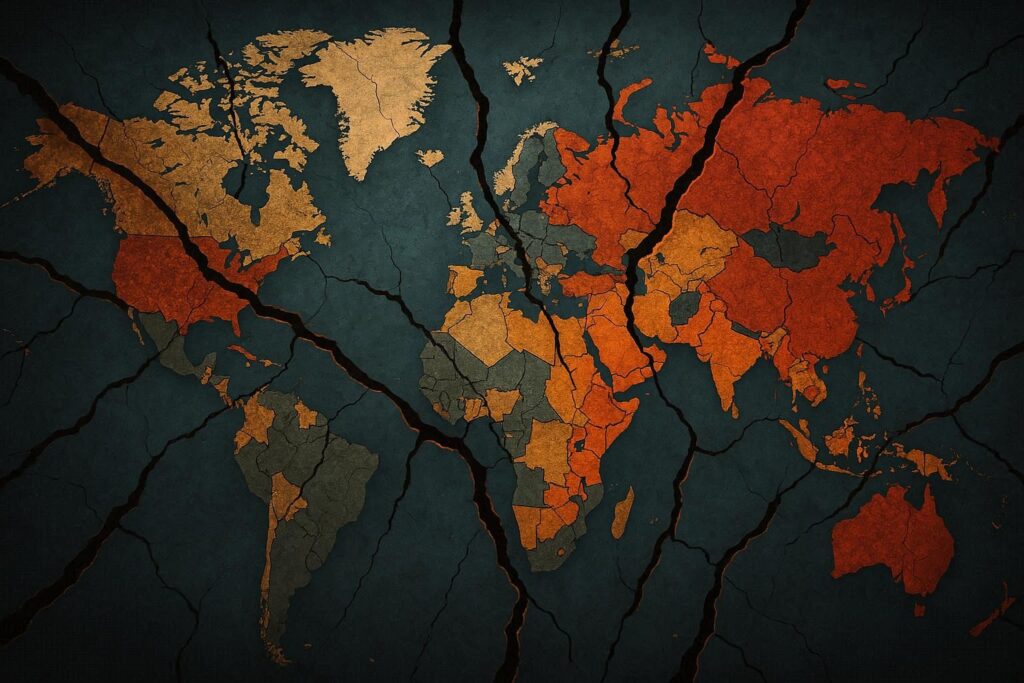
The tectonic plates of global power are shifting beneath our feet. When Saudi Arabia, the cornerstone of the petrodollar system since 1974, began accepting yuan for oil sales and joined BRICS as a full member, it marked more than economic diversification—it signaled the potential end of American financial hegemony. With BRICS+ now representing 46% of global population, 37% of world GDP, and controlling 44% of global oil production, the bloc has evolved from acronym to alternative world order. As 2025 unfolds with 34 nations formally applying for BRICS membership and the New Development Bank challenging IMF dominance, the question isn’t whether American hegemony is being contested, but whether we’re witnessing its final chapter.
The New Economic Gravity: BRICS by the Numbers
The GDP Revolution
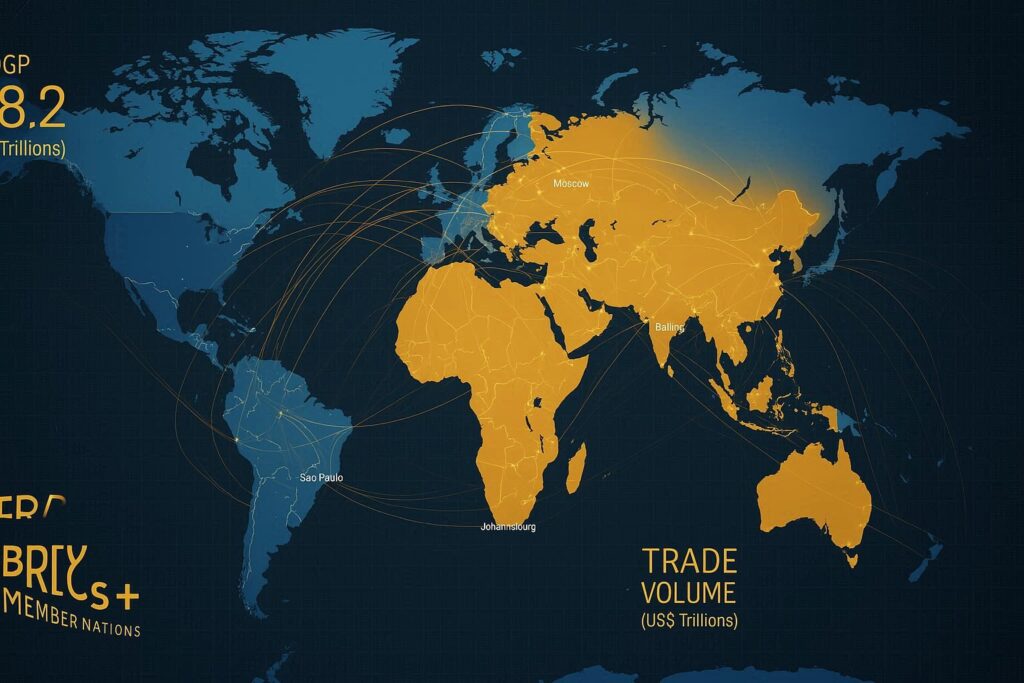
BRICS nations have achieved a historic milestone: their combined GDP in purchasing power parity (PPP) terms now exceeds the G7 for the first time in modern history. China alone contributes $33 trillion in PPP terms, India adds $14 trillion, Russia $5 trillion, Brazil $4.3 trillion, and South Africa $1 trillion. When including new members—Saudi Arabia, UAE, Egypt, Ethiopia, Iran, and Argentina—BRICS+ commands $65 trillion in PPP-adjusted GDP compared to the G7’s $52 trillion. This isn’t a projection; it’s today’s reality that Western media consistently underreports by using nominal GDP figures that disguise actual economic weight.
The growth trajectories diverge even more dramatically. IMF projections show BRICS economies growing at weighted average of 4.2% annually through 2030, while G7 nations struggle with 1.7% average growth. China and India alone will contribute 50% of global growth, while the entire G7 contributes just 20%. By 2030, BRICS+ could represent 50% of global GDP in PPP terms, fundamentally altering every assumption about international economics.
The composition of BRICS economies has evolved beyond resource extraction to technological leadership. China leads in 37 of 44 critical technologies tracked by the Australian Strategic Policy Institute, including artificial intelligence, quantum computing, and renewable energy. India’s IT services industry generates $250 billion annually, processing 65% of global back-office operations. These aren’t developing economies seeking Western technology transfer—they’re innovation leaders setting global standards.
Trade Flows Restructuring
BRICS internal trade has exploded from $100 billion in 2000 to $1.2 trillion in 2024, increasingly bypassing dollar-denominated Western financial systems. China-Russia trade reached $240 billion in 2023, conducted 90% in yuan and rubles. India-Russia trade, traditionally under $10 billion, surged to $65 billion as India became the largest buyer of discounted Russian oil, settling in rupees and dirhams. This trade reorientation represents not temporary sanctions evasion but permanent structural shift away from Western-centric commerce.
The Belt and Road Initiative has created $4 trillion in BRICS-centric infrastructure, establishing physical trade routes independent of Western control. The International North-South Transport Corridor, connecting India to Russia through Iran, reduces shipping time by 40% compared to Suez Canal routes. The China-Europe Railway Express handled 1.8 million containers in 2023, providing alternatives to maritime chokepoints controlled by US allies. These investments create trade architecture that will persist regardless of political changes.
Supply chain reorganization accelerates BRICS integration. China’s “dual circulation” strategy prioritizes BRICS and Global South partnerships over Western markets. Brazil’s agricultural exports to China reached $104 billion, making China its largest customer and reducing dependence on US and European markets. South Africa’s mineral exports increasingly flow to BRICS industrial bases rather than Western refineries. This reorientation creates economic interdependencies challenging to reverse even if political winds shift.
The Dollar’s Demise? Currency Wars and Financial Architecture
De-Dollarization Accelerates
The dollar’s share of global foreign exchange reserves has declined from 71% in 2000 to 58% in 2024—the lowest level since the euro’s creation. More concerning for Washington, the pace accelerates: $1 trillion in dollar reserves were sold by central banks in the past 18 months alone. When adjusted for valuation changes, active diversification away from dollars approaches $2 trillion. This isn’t gradual adjustment but deliberate policy choice by nations controlling majority of global reserves.
BRICS nations lead de-dollarization through multiple mechanisms. The People’s Bank of China has signed currency swap agreements worth $4 trillion with 40 countries, enabling trade without dollar intermediation. Russia’s disconnection from SWIFT forced development of alternative payment systems now processing $500 billion annually. India’s Unified Payments Interface (UPI) links with 30 countries’ payment systems, facilitating direct settlement. These bilateral and multilateral arrangements create parallel financial architecture immune to US sanctions.
Commodity trading’s de-dollarization threatens the petrodollar’s foundation. Saudi Arabia’s acceptance of yuan for oil sales to China—representing 25% of Saudi exports—breaks 50 years of exclusive dollar pricing. Russia prices oil to India in rupees, to China in yuan, and to Turkey in liras. Brazil and Argentina established common currency for bilateral trade. When commodities trade outside dollars, demand for dollar reserves collapses, potentially triggering currency crisis as $12 trillion in offshore dollars seeks alternatives.
The BRICS Currency Project
The proposed BRICS currency, tentatively called the “BRIC” or backed by R5 (Real, Ruble, Rupee, Renminbi, Rand), has moved from concept to active development. The technical architecture, based on distributed ledger technology similar to China’s digital yuan, would enable instant settlement between member nations without dollar intermediation. Unlike the euro’s political integration requirements, the BRICS currency would function as trade settlement mechanism preserving monetary sovereignty—a crucial distinction enabling broader adoption.
The currency’s proposed backing by commodities basket—40% gold, 30% oil, 30% rare earths and food—would provide intrinsic value independent of any nation’s creditworthiness. BRICS nations control 43% of global gold production, 44% of oil, and 90% of rare earths, providing unique capability to support commodity-backed currency. This design explicitly challenges fiat dollar hegemony by returning to modified gold standard abandoned by Nixon in 1971.
Implementation accelerates with concrete steps. The New Development Bank issued $5 billion in local currency bonds across member nations. BRICS Pay, integrating member nations’ payment systems, completed successful trials processing $100 billion in test transactions. Central banks of member nations have established BRICS Contingent Reserve Arrangement with $240 billion in committed resources. These technical preparations suggest currency launch could occur within 24 months rather than decades initially projected.
Financial Institution Alternatives
The New Development Bank (NDB), with $100 billion in subscribed capital, has approved $45 billion in infrastructure projects explicitly avoiding dollar denomination and Western governance conditions. Unlike IMF’s structural adjustment requirements, NDB provides financing respecting sovereignty—no democracy requirements, no privatization mandates, no austerity conditions. This “Beijing Consensus” alternative to “Washington Consensus” appeals to developing nations tired of Western conditionality.
The Asian Infrastructure Investment Bank (AIIB), with 109 member countries including most European nations, has deployed $50 billion for projects the World Bank wouldn’t fund. China’s policy banks—China Development Bank and Export-Import Bank—have outstanding loans of $1.5 trillion, exceeding combined World Bank and regional development bank lending. These institutions provide Global South nations alternatives to Western financial architecture, reducing IMF and World Bank leverage.
BRICS’ Contingent Reserve Arrangement, modeled on IMF Special Drawing Rights but without conditionality, provides emergency liquidity during crises. When Sri Lanka faced bankruptcy, China and India provided $8 billion in emergency support with infrastructure collateral rather than IMF’s demanded reforms. Egypt received $25 billion from BRICS nations during its currency crisis, avoiding IMF austerity requirements. This parallel crisis response mechanism undermines Western financial coercion capabilities.

Geopolitical Realignment: The New World Order
The Expansion Strategy
BRICS’ expansion from five to eleven members in 2024 wasn’t random but strategic, adding Saudi Arabia and UAE (energy dominance), Egypt and Ethiopia (Africa gateway and population), Iran (sanctions resistance), and Argentina (food security and lithium). The 34 nations formally applying for membership—including Indonesia, Mexico, Nigeria, and Turkey—would add another $15 trillion GDP and 2 billion people. This expansion strategy creates critical mass challenging Western institutional dominance.
The selection criteria prioritize strategic resources, geographic position, and willingness to challenge Western hegemony over traditional metrics like democracy or development level. Saudi Arabia’s inclusion despite human rights record, Iran’s membership despite sanctions, and Egypt’s acceptance despite authoritarianism demonstrate BRICS’ non-interference principle attracting nations rejected or sanctioned by the West. This inclusive approach contrasts with Western institutions’ conditional membership, appealing to sovereignty-conscious governments.
Geographic distribution ensures global reach: Brazil dominates South America, South Africa anchors Africa, Saudi Arabia controls Middle East energy, India influences South Asia, and China leads East Asia. This continental coverage provides BRICS influence in every region, unlike Western alliances concentrated in North America and Europe. When including observer states and membership applicants, BRICS influence extends to 140 countries representing 85% of global population.
Military and Security Dimensions
While BRICS isn’t military alliance like NATO, security cooperation deepens rapidly. Joint military exercises have evolved from bilateral to multilateral, with “Peace Mission 2024” involving all member militaries in coordinated operations. Combined BRICS military spending reaches $700 billion annually, approaching NATO’s $1.2 trillion. More significantly, BRICS includes three nuclear powers with 90% of non-Western nuclear weapons, providing ultimate deterrent against Western military coercion.
Arms trade within BRICS has exploded, reducing Western leverage through weapons sales. India purchases 70% of military equipment from Russia, while China provides military technology to African and Middle Eastern members. The joint development of military technologies—hypersonic missiles, quantum radar, space weapons—creates capabilities independent of Western military-industrial complex. This autonomous defense capability prevents Western military pressure from compelling political compliance.
Intelligence sharing through BRICS security framework challenges Five Eyes dominance. When Edward Snowden revealed NSA global surveillance, BRICS nations accelerated development of sovereign internet infrastructure and encrypted communications. China’s quantum satellite network, Russia’s sovereign internet, and India’s data localization laws create information sovereignty preventing Western intelligence penetration. This “digital sovereignty” model appeals to nations concerned about Western surveillance and information warfare.
Ideological Competition
BRICS presents civilizational alternative to Western liberal democracy, embracing “sovereign democracy” respecting different governance models. China’s “whole-process people’s democracy,” Russia’s “sovereign democracy,” and India’s “mother of democracy” narrative challenge Western monopoly on defining legitimate governance. This ideological pluralism resonates with developing nations whose histories and cultures don’t align with Western political models.
The “BRICS Consensus” emphasizes economic development over political transformation, infrastructure over institutions, and sovereignty over intervention. This appeals to Global South nations experiencing Western democracy promotion as neo-colonialism. When BRICS nations achieved poverty reduction exceeding all Western aid impact—lifting 1.5 billion from poverty since 2000—their development model gained credibility challenging Western prescriptions.
Cultural initiatives promote alternative narratives to Western soft power. BRICS Film Festival, BRICS Games, and BRICS Universities Network create cultural exchange independent of Western institutions. Confucius Institutes, RT networks, and Bollywood exports provide alternative media narratives. While not matching Hollywood or BBC influence yet, these initiatives erode Western narrative monopoly, especially among younger Global South populations.
Technology and Innovation: The New Frontiers
The Digital Silk Road and Tech Sovereignty
China’s Digital Silk Road has deployed $79 billion building digital infrastructure across 100 countries, creating technological ecosystem independent of Silicon Valley. Huawei alone has built 70% of Africa’s 4G networks and leads 5G deployment globally despite US sanctions. When African nations choose Chinese technology over Western alternatives, they’re selecting proven infrastructure at lower cost without political conditions—a compelling value proposition.
India’s technology stack—Aadhaar identity system, UPI payments, and DigiLocker documents—provides digital public infrastructure model adopted across BRICS. Brazil’s PIX payment system, processing $1.3 trillion annually, was built on Indian architecture. Russia’s Mir payment system integrates with China’s UnionPay, creating payment network covering 4 billion people. These indigenous technologies reduce dependence on Visa/Mastercard duopoly and SWIFT messaging.
Artificial intelligence development within BRICS challenges Western assumptions about innovation monopoly. China leads in AI patents with 75% of global filings, while India produces 40% of global AI talent. Russia’s military AI applications and Brazil’s agricultural AI innovations demonstrate diverse capabilities. The BRICS AI Partnership, sharing research and development, could create AI ecosystem rivaling US-EU cooperation. When combined with data from 4 billion citizens, BRICS has AI training advantages Western nations cannot match.
Space and Quantum Leadership
BRICS nations’ space capabilities increasingly match or exceed Western achievements. China’s Chang’e lunar program and Tianwen Mars mission demonstrate independent deep space capability. India’s Chandrayaan-3 lunar landing at fraction of NASA’s cost shows frugal innovation potential. Russia’s continued ISS participation and planned lunar station with China creates alternative to Western-dominated space exploration. The combined BRICS space budget of $25 billion approaches NASA’s $30 billion, but achieves more through efficiency and cooperation.
Quantum technology race sees BRICS nations leading in crucial areas. China’s Micius quantum satellite enables unhackable communications, while their Jiuzhang quantum computer achieved quantum supremacy in specific applications. India’s National Mission on Quantum Technologies invests $1 billion developing quantum capabilities. Russia’s quantum research, though opaque, reportedly includes quantum radar defeating stealth technology. These capabilities could render current encryption obsolete, fundamentally disrupting global communications security.
The semiconductor challenge remains BRICS’ greatest technological vulnerability, with China depending on Western technology for advanced chips. However, massive investment—$150 billion in China alone—and technological espionage are closing gaps faster than expected. When SMIC produced 7nm chips despite sanctions, it demonstrated indigenous innovation capability. Russia’s return to 90nm production and India’s semiconductor mission show determination to achieve technological sovereignty despite Western export controls.
Green Technology Dominance
BRICS nations dominate renewable energy technology and deployment, controlling 80% of solar panel production, 70% of wind turbine manufacturing, and 90% of battery production. China alone installed more renewable capacity in 2023 than the rest of the world combined. This green technology leadership positions BRICS to control energy transition technologies as strategically as OPEC controlled oil.
Critical mineral control amplifies green technology advantages. BRICS nations control 90% of rare earth processing, 70% of cobalt, and 60% of lithium processing. When Western nations require these materials for their own energy transitions, they depend on BRICS supply chains. This reverses traditional energy dependence, with developed nations requiring BRICS resources for decarbonization.
Nuclear technology exports showcase BRICS alternative to Western energy solutions. Russia’s Rosatom builds 70% of global nuclear reactors under construction, offering financing and fuel supply Western companies cannot match. China’s Hualong One reactor competes globally with Western designs at lower cost. When developing nations seek clean baseload power, BRICS provides solutions without climate conditionality or governance requirements Western institutions demand.
Challenges and Contradictions: The Fault Lines
Internal Tensions and Competing Interests
BRICS unity faces severe tests from internal contradictions. The India-China border dispute, with 100,000 troops facing off in the Himalayas, represents active military confrontation between members. India’s strategic partnership with the United States through QUAD directly opposes China’s regional ambitions. These fundamental conflicts question whether BRICS can maintain cohesion when members view each other as strategic threats.
Economic competition within BRICS undermines cooperation rhetoric. Indian manufacturing competes directly with Chinese exports, leading to trade disputes and protectionist measures. Brazil’s agricultural exports to China undercut Russian grain sales. South African mining companies compete with Russian and Brazilian firms for Chinese markets. This internal competition suggests BRICS might fragment when economic interests diverge from political solidarity.
Governance disparities create operational challenges. Democratic India and Brazil struggle cooperating with authoritarian China and Russia on values-based issues. South Africa’s independent judiciary conflicts with other members’ controlled legal systems. These differences manifest in inability to create binding agreements or dispute resolution mechanisms comparable to Western institutions. Without institutional architecture, BRICS remains talking shop rather than effective bloc.
Economic Vulnerabilities
BRICS economies face structural weaknesses threatening their challenge to Western hegemony. China’s demographic collapse—working age population declining by 200 million by 2050—threatens economic dynamism. Russia’s economy remains resource-dependent, vulnerable to energy transition. India’s manufacturing sector employs only 12% of workforce despite government initiatives. Brazil and South Africa face middle-income traps with declining productivity growth.
Financial fragilities could trigger crises undermining BRICS cohesion. China’s property sector collapse threatens $50 trillion in wealth and banking system stability. India’s banking sector carries $200 billion in non-performing loans. Russian financial system operates under severe sanctions limiting international integration. These vulnerabilities suggest BRICS economies might face internal crises before successfully challenging Western financial dominance.
Currency cooperation faces practical obstacles beyond political will. The renminbi’s capital controls prevent true reserve currency status. The rupee’s volatility and limited convertibility restrict international use. The ruble’s sanctions and the real’s instability make them unsuitable for reserves. Creating common currency from these weak foundations might prove impossible, leaving dollar dominance intact despite political desires.
Western Responses and Countermeasures
The United States and allies haven’t remained passive facing BRICS challenge. The Indo-Pacific Economic Framework, Partnership for Global Infrastructure, and EU Global Gateway mobilize $1.8 trillion countering Belt and Road Initiative. These Western initiatives offer developing nations alternatives to BRICS financing, though with governance conditions many find onerous.
Technological denial strategies aim to maintain Western advantages. Export controls on semiconductors, quantum technology, and AI attempt to slow BRICS technological advancement. The “small yard, high fence” approach targets critical technologies while maintaining broader economic engagement. However, these restrictions accelerate BRICS self-reliance efforts, potentially backfiring by creating independent innovation ecosystems.
Financial warfare capabilities remain predominantly Western. Dollar weaponization through sanctions has proven devastating against Russia and Iran, demonstrating continued US financial power. The Federal Reserve’s interest rate decisions still drive global capital flows, causing currency crises in vulnerable BRICS members. Until alternative financial architecture fully develops, Western financial coercion remains potent tool limiting BRICS ambitions.
2025 and Beyond: Scenarios for the Future
The Acceleration Scenario
Multiple factors could accelerate BRICS rise and US decline in 2025. A Taiwan crisis forcing global nations to choose sides could consolidate BRICS as anti-Western bloc. Dollar crisis triggered by unsustainable US debt ($34 trillion and rising) could accelerate de-dollarization. Success of BRICS currency launch could cascade into rapid reserve diversification. Technology breakthrough in semiconductors or quantum computing could eliminate Western advantages.
The expansion to 30+ members could create unstoppable momentum. If Indonesia, Mexico, Nigeria, and Turkey join simultaneously, BRICS would represent 60% of global GDP and 70% of population. This critical mass would enable setting global standards in trade, technology, and finance independent of Western input. Network effects could then trigger cascade of additional memberships, leaving Western nations isolated.
Generational change favors BRICS as younger Global South populations view China’s development model more favorably than Western democracy. When 65% of Africans view China’s influence positively versus 35% for the US, future alignment becomes clear. As these populations gain political power, their nations will naturally gravitate toward BRICS, accelerating Western relative decline.
The Fragmentation Scenario
Alternatively, BRICS could fragment under internal contradictions and external pressure. India-China conflict escalating to military confrontation would shatter cooperation framework. Economic crisis in China triggering global recession could discredit BRICS model. Democratic movements in authoritarian members could align some with the West. These fractures could reduce BRICS to bilateral relationships rather than coherent bloc.
Western technological breakthroughs could reassert dominance. Fusion energy commercialization would eliminate energy dependence. Room-temperature superconductors would revolutionize technology. AGI achievement by Western companies could create insurmountable advantages. These innovations could restore Western economic dynamism and attract Global South nations back to Western orbit.
The middle path might see parallel systems persisting indefinitely. BRICS and Western blocs could establish separate spheres with limited interaction. Companies would choose ecosystems, nations would align explicitly, and individuals would operate within distinct digital and financial worlds. This “two-world” scenario would reduce efficiency but might prevent direct confrontation.
The Transformation Scenario
Most likely, both BRICS and the West will transform through competition. The United States might adopt industrial policy and state capitalism elements proving successful in China. BRICS nations might incorporate transparency and rule of law attracting international investment. This convergent evolution could create hybrid systems combining both models’ strengths.
Climate catastrophe could force cooperation transcending geopolitical competition. When flooding threatens Shanghai and New York simultaneously, when drought devastates both American and Indian agriculture, when climate refugees number hundreds of millions, current divisions might seem trivial. Shared existential threat could create new cooperative frameworks making BRICS-West competition obsolete.
Technological revolution could make current economic models irrelevant. If artificial general intelligence emerges, traditional concepts of economic competition, labor, and growth become meaningless. If life extension technology defeats aging, demographic projections collapse. If space resources become accessible, terrestrial resource competition ends. These discontinuities could completely reshape global order beyond current BRICS-West framework.

The worsening of the situation in France
What is the origin of the discontent? The wallet of the French. In a recent study commissioned by the renowned…


Who is harnessing france’s anger?
Parties, foreign networks, organised rioters, the State: everyone is seizing the movement, no one is answering it. Some kinds of anger…


France between chaos and flames
1. Introduction: The Dantesque Scenario as a Diagnostic Moment On 17–18 October 2026, France experienced what foreign observers immediately recognised as…


The student factor and the massive social protests in the
To understand what is happening, it is enough to make a simple political reasoning. 2027 represents a crucial electoral appointment for…


The decisive moment in the war of Ukraine is approaching
We have become accustomed to analysing the war in Ukraine through the prism of ground battles, calculating gains in square…


EU budget dispute sharpens
Brussels is experiencing its most uncertain hours since the creation of the European project. The negotiations to define the 2028-2034…


Student protests, Marine Le Pen and the decline of the
The student mobilization in France, which began on September 17 at the Saint-Exupéry de Créteil high school, located on the…


Food Crisis in 2027? From Diesel to the Dinner Table
A food crisis can begin far from the fields: at an attacked refinery, with a delayed fertilizer shipment, or along…


The UK is at risk of running out of gas
Clearly, the United Kingdom is going through a systemic crisis that is becoming deep and, according to the available evidence,…

Implications for Different Stakeholders
For Policymakers
Western policymakers must acknowledge BRICS challenge as structural rather than temporary. Strategies should focus on competing through innovation and attraction rather than coercion and denial. Recognizing legitimate BRICS grievances about Western-dominated institutions could enable reform preserving influence. Most critically, avoiding military confrontation while competing economically requires delicate balance.
BRICS policymakers must manage internal contradictions while maintaining external unity. Creating functional institutions beyond rhetoric requires compromising sovereignty—difficult for nations prioritizing independence. Balancing China’s dominance with other members’ interests needs careful management. Avoiding Western provocations triggering unified response requires strategic patience.
Developing nation policymakers gain leverage through BRICS-West competition. Playing both sides enables better terms from each. However, choosing sides prematurely risks isolation if chosen bloc fragments. Maintaining strategic autonomy while benefiting from both systems requires sophisticated diplomacy smaller nations often lack.
For Business Leaders
Corporations must prepare for bifurcated global economy requiring presence in both ecosystems. Dual supply chains, technology stacks, and governance structures increase costs but become necessary. Political risk assessment becomes crucial as geopolitical alignment affects market access. Companies must choose between global reach with complexity or regional focus with simplicity.
Financial institutions face fundamental restructuring as dollar dominance erodes. Reserve diversification, payment system multiplication, and sanctions risk require new frameworks. Cryptocurrency and digital currencies become essential capabilities rather than optional innovations. Traditional correspondent banking might fragment into regional networks requiring multiple partnerships.
Technology companies confront hardest choices as US-China decoupling accelerates. Choosing sides means losing massive markets; maintaining neutrality risks both sides’ retaliation. Indigenous innovation becomes necessary as technology transfer restrictions expand. The era of single global technology standards ends, replaced by competing ecosystems requiring multiple product versions.
For Citizens
Individuals in Western nations must prepare for relative decline in living standards as resource access diminishes and competition intensifies. The assumption of perpetual prosperity based on global dominance requires revision. Skills in understanding and navigating multiple cultural contexts become essential. Learning Mandarin, understanding Islamic finance, and appreciating non-Western perspectives become career advantages.
BRICS citizens might experience improved global standing and economic opportunity as their nations rise. However, internal inequality and governance challenges could limit benefits to elites. Navigating between nationalist rhetoric and global integration requires critical thinking. The promise of BRICS alternative might disappoint if internal contradictions prevent effective cooperation.
Global South citizens gain options but face complexity choosing between systems. Access to finance, technology, and markets improves through competition for influence. However, becoming proxy battleground for BRICS-West competition risks stability. The opportunity for development must be balanced against risks of alignment.
Conclusion: The Multipolar Reality
The rise of BRICS represents historical inevitability rather than temporary phenomenon. The unipolar moment following Soviet collapse was historical anomaly; multipolarity represents return to historical norm. The question isn’t whether American hegemony ends but how it transforms into more balanced global system. 2025 might not mark definitive end but certainly represents inflection point in centuries-long power transition.
BRICS success in creating alternative institutions, payment systems, and development models has already ended Western monopoly on defining international order. Even if the bloc fragments, the precedent of successful challenge to Western hegemony inspires others. The psychological shift—demonstrating Western systems aren’t inevitable—might prove more significant than economic metrics.
However, BRICS victory isn’t assured or necessarily desirable. Internal contradictions could prove insurmountable, economic vulnerabilities could trigger crises, and Western innovation could reassert dominance. More fundamentally, replacing one hegemony with another might not improve global governance. The ideal outcome might be genuine multipolarity with multiple centers of power checking each other.
The implications extend beyond international relations to fundamental questions about human organization. Does democracy represent universal value or Western particular? Can capitalism function without liberal institutions? Is technological progress possible without intellectual property? These philosophical questions, previously settled in Western favor, now have competing answers from successful BRICS models.
Looking ahead, the 2020s will likely be remembered as the decade when five hundred years of Western dominance conclusively ended. Whether replaced by Chinese hegemony, BRICS collective leadership, or genuine multipolarity remains undetermined. What’s certain is that assuming continued Western dominance represents dangerous delusion. The tectonic plates have shifted; the earthquake has begun; the landscape will never be the same.
For the United States, acknowledging relative decline while maintaining significant influence requires psychological adjustment comparable to Britain’s post-imperial transition. For BRICS nations, managing rise without triggering catastrophic conflict requires restraint despite historical grievances. For everyone else, navigating between competing powers requires skills humanity hasn’t needed since the 19th century’s Great Game.
The rise of BRICS doesn’t guarantee better world—merely different one. Whether this transition occurs peacefully or through conflict, whether it improves human welfare or simply redistributes suffering, whether it enables solutions to global challenges or fragments response capabilities—these questions remain open. What’s clear is that the unipolar moment has ended. The future is multipolar, complex, and uncertain. Welcome to the new world disorder.