If anyone thinks – perhaps rightly – that the President of the United States, Donald John Trump, loves to shoot big, they must admit that even the new Muslim mayor of New York, Zohran Kwame Mamdani, does not seem to be far behind.
The latest intemato of the New York First Citizen, in fact, was to declare that his administration is considering whether to arrest the Israeli Prime Minister, Benjamin Netanyahu, if he were to travel to New York, as planned, for the United Nations General Assembly next September.
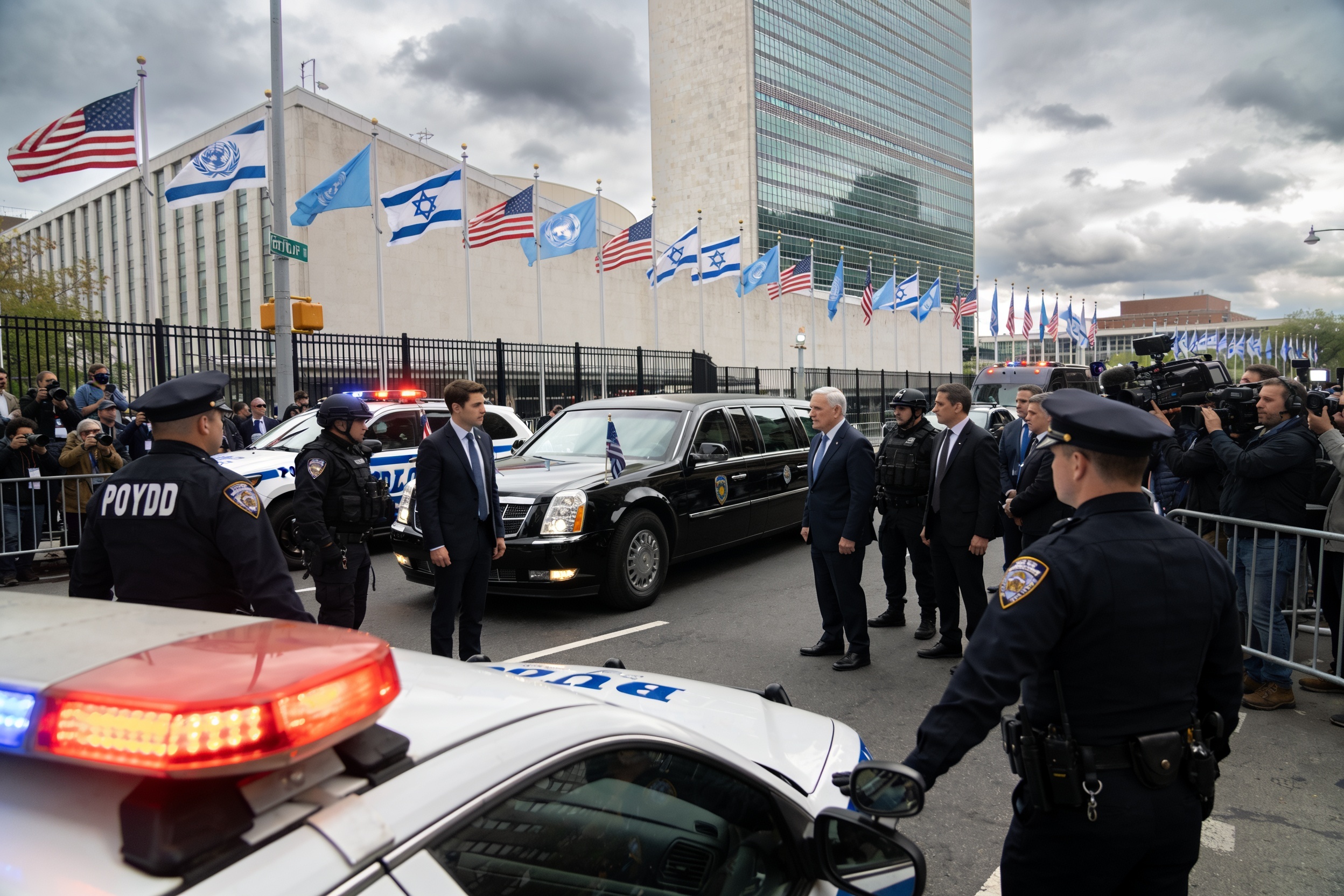
It wasn’t a joke at the bar. Mamdani, in fact, made this statement in an interview with the “New York Times”, in which, among other things, he also called the Israeli prime minister “a war criminal indicted by the International Criminal Court, who must be tried in The Hague”. The idea, very suggestive for some, would be to send the legendary NYPD police, the New York City Police Department of American TV series, to arrest the “war criminal” Netanyahu, directly at the airport as soon as he should set foot on US soil.
How many concrete possibilities are there to witness such a scene worldwide? Practically none. Unless you want to challenge the law and create an institutional short circuit.
Yes, because from a strictly legal and constitutional point of view, New York Mayor Zohran Mamdani has no authority to have Israeli Prime Minister Benjamin Netanyahu arrested.
Such an idea, although trumpeted in “The New York Times”, comes up against at least three insurmountable legal obstacles. The first concerns the legal title necessary to proceed with the detention measure. The Mayor of New York, in fact, intends to act in the name of the arrest warrant of the International Criminal Court (ICC), without considering, however, an essential fact: the United States of America is not a member of the ICC and does not recognize the authority of its warrants on US territory.
Not to mention the recent frictions between the Trump administration and the Court itself.
The second insurmountable obstacle is diplomatic immunity. Israeli Prime Minister Benjamin Netanyahu, in fact, would enjoy this legal status as a foreign head of government visiting the United Nations, an immunity, moreover, guaranteed by international law and by agreements between the United States and the UN.
The third obstacle, difficult to overcome, that Zohran Mamdani would encounter is the prevalence of federal authorities. According to the US legal system, in fact, foreign policy and the management of visits by diplomatic personalities are the exclusive competence of the US federal government.
In the event of an attempted action by the New York City Police (NYPD), federal authorities, such as the Secret Service or the State Department, would intervene immediately to block the arrest and protect the foreign leader. This would be a beautiful and surreal scene from a movie: federal agents arresting the “cops” of the New York Police Department while trying to arrest Netanyahu. Surreal but not impossible in the bizarre sublunar world in which we have to live these days. Although practically all legal experts agree that the statements of the mayor of New York have a purely political and symbolic value, nothing is impossible anymore nowadays.
Perhaps Zohran Mamdani with the provocative interview really intends to demonstrate his solidarity with international law and, more likely, to contest the line of the American federal government, but from a purely legal point of view here we are at the one who shoots the biggest.
The fact is that he is not a winked patron of a tavern.
We are talking about the mayor of one of the most important cities in the world: New York. A sign, certainly, of the decadence of the times.
It is sad to note that without a Christian vision of the world and of history, politics ends up being reduced to mocking slogans, surreal provocations, hyperbole that has risen to a communicative criterion.
There is nothing to be done, the only antidote to this delirium, as Matthew Petrusek argues in his latest book Evangelization and Ideology, is Christian social thought, through the concept of the common good, the dignity of the person and the need for a transcendent perspective. Without this, only the madness of men remains.