1. Introduction: The Dantesque Scenario as a Diagnostic Moment
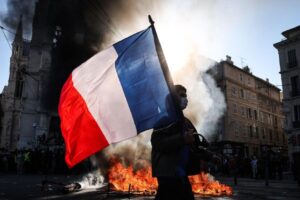
On 17–18 October 2026, France experienced what foreign observers immediately recognised as a threshold event.
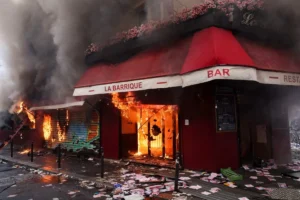
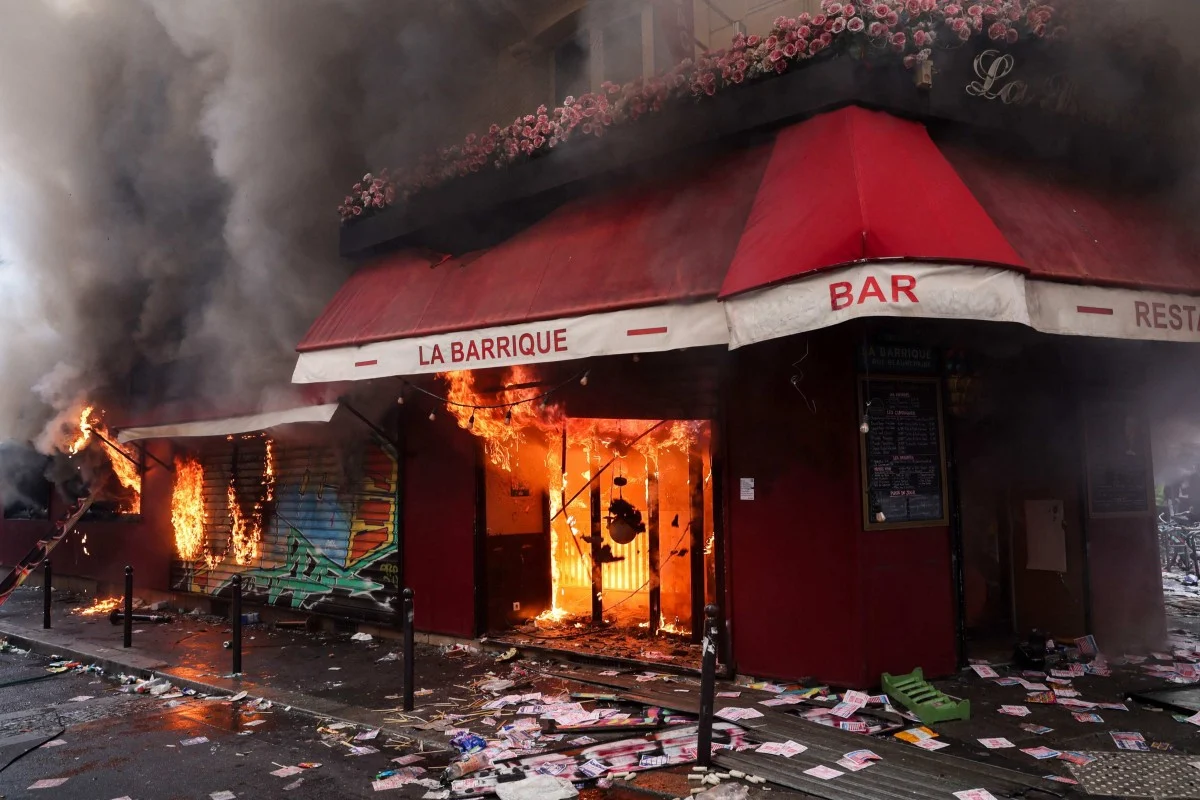
Approximately 550,000 demonstrators took to the streets; at least 1,200 people were arrested, with other counts placing detentions at around 2,400; nearly 1,000 police officers and firefighters were injured; insured losses from looting and damage exceeded €1 billion, already above the €730 million cost of the 2023 riots. In Limoges, masked demonstrators entered the nineteenth-century town hall and set it alight; the bell tower collapsed, and the prefect reported that the building was “largely lost”. The Spanish daily *El País* declared that France had “certified the death of Macronism”. *The Telegraph* described the unrest as the “death throes of Macronism”. The *Neue Zürcher Zeitung* observed that the state had spent tens of billions of euros on banlieue renewal since 2004, yet the residents who received the most felt themselves not privileged but discriminated against; “France and its society,” the NZZ concluded, “is the enemy”.
This article takes the foreign press’s diagnostic language seriously, but it does not treat it as sufficient. The task is to explain *how* a government that presented itself as the defender of the “radical centre” against the extremes produced the conditions for a Schmittian rupture between the state and significant segments of the population it claimed to integrate. The argument proceeds in three steps.
First, it reconstructs the legal architecture of Macron-era integration policy, showing that the 2024 immigration law raised the formal requirements for residence and nationality while defunding the linguistic formation necessary to meet them.
Second, it applies Schmitt’s friend/enemy distinction and Tilly’s repertoire of contention to show that the disorder is not a failure of Frenchness but a pathological expression of it. Third, it introduces a Brazilian comparative vantage point: a multi-ethnic nation with grave racial inequalities in which, nevertheless, subaltern groups contest their place *within* the nation rather than constituting themselves as a counter-people. The Brazilian mirror does not absolve French policy; it sharpens the indictment by showing that diversity as such does not generate Schmittian rupture. What generates rupture is a sovereignty that refuses to decide.
A note on method and standpoint is necessary. The analysis is a critical interpretive synthesis, not a causal identification exercise. It adopts what may be called a *situated outsider* perspective: the author writes from Brazil, and this vantage point is used deliberately as a comparative heuristic. The claim is not that Brazil is morally superior, the myth of “racial democracy” has been rightly dismantled by generations of scholars, but that the Brazilian experience illuminates what the French model has refused to see: that a political community can incorporate difference without eliminating it, and that the alternative to incorporation is not assimilation but counter-identification.
2. Theoretical Framework: Schmitt, Tilly, and the Politics of Belonging
2.1 Schmitt: The Political as the Intensity of Association and Dissociation
Carl Schmitt’s concept of the political is deliberately minimal and deliberately uncomfortable. “The specific political distinction to which political actions and motives can be reduced,” he writes, “is that between friend and enemy”. This distinction is not a moral judgement: the political enemy “need not be morally evil or aesthetically ugly; he need not appear as an economic competitor,” but he is “nevertheless, the other, the stranger”. The friend/enemy relation denotes “the utmost degree of intensity of a union or separation, of an association or dissociation”. Sovereignty, in Schmitt’s decisionism, consists in the capacity to draw this line, to determine who belongs to the political community and who does not, especially in exceptional circumstances.
The Schmittian framework is useful here not because it prescribes enmity, but because it names what happens when the sovereign refuses to decide. A state that neither integrates nor excludes, that raises formal barriers while withdrawing material support, does not abolish the political; it delegates the drawing of the friend/enemy line to other actors. In France, those actors are the political extremes and, in the banlieues, a population that has increasingly come to experience the state as an alien power.
2.2 Tilly: The French Repertoire of Contention
Charles Tilly’s concept of the repertoire of collective action explains why French disorder looks the way it does. “Any given population tends to have a fairly limited and well-established set of means for action on shared interests,” Tilly observed; the repertoire is like a game with basic rules around which “a considerable degree of extemporization is not only permitted but required”. In the French case, the repertoire was forged through centuries of contention and crystallised after the Revolution: the demonstration, the barricade, the roadblock, the occupation and burning of public buildings, the appeal to the street as the ultimate arbiter. William Sewell’s classic article argued that the French Revolution “made a difference” precisely because it transformed the grammar of collective violence and collective loyalties.
The implication is paradoxical and central to this article: the October 2026 rioters acted in a recognisably French idiom to communicate. They did not import a foreign grammar of disorder; they used the grammar of 1789, 1830, 1848, 1871, 1968, and 2005. But they were not culturally French, as they politically refused French identity. This is the deepest indictment of the Macron era: it produced a population that speaks French, partially acts as Frenchly in its contention, and yet does not see itself as French.
3. The Architecture of Indecision: Macron’s Integration Law
3.1 Raising the Bar, Defunding the Ladder
The 2024 immigration law, adopted on 26 January 2024, represents the most explicit codification of Macron-era integration policy. It “drastically tightened” language requirements for residence permits and nationality, raising the required level to B1 for a resident card and B2 for naturalisation. It also introduced a civic examination whose content was enriched, and it shifted the logic of policy from an obligation of means to an obligation of results. The Senate’s preliminary study estimated that the new requirements would result in 20,000 fewer multi-year residence permits being issued. Associations warned that by making regularisation more complex and slower, the measures would increase precarity and irregularity.
At the same time, the government reduced the resources devoted to the linguistic formation that alone could allow applicants to meet the new standards. From 1 July 2025, most OFII French courses were dematerialised: learners were required to train entirely online, through a platform using artificial intelligence. The cost per trainee fell from €6,000 with a face-to-face trainer to €25 for a digital licence, a reduction of 99.6%. The Senate acknowledged that this “minimising of the costs of the reform” explained the non-revalorisation of the budget dedicated to linguistic formation, even as the number of eligible signatories was set to rise by nearly 40% in 2026.
This is the core of what may be called the *flexing* of integration law. The law raises the formal bar to belonging while withdrawing the material ladder. It is not a policy of integration; it is a policy of performative exclusion that signals toughness to the native working class while delivering neither effective selection nor genuine incorporation. The result is a legal order that is restrictive in symbol and permissive in practice, and that, in bending under the weight of its own contradictions, generates the disorder it claims to combat.
3.2 The Sovereignty That Does Not Execute
The same contradiction appears in the enforcement of removal orders. The rate of execution of *obligations de quitter le territoire français* (OQTF) stood at 10.9% over the first nine months of 2025, according to the Senate. Other sources place the figure below 10%, or around 7% in some periods. In 2025, 137,550 OQTTFs were issued, but fewer than 14,940 people were actually deported. The state proclaims a sovereign power to expel that it does not exercise. This is Schmittian sovereignty in reverse: the decisive act is announced but not performed, and the announcement itself becomes a substitute for the decision.
Meanwhile, legal immigration has continued to rise. In 2025, 384,230 first residence permits were issued to non-European nationals, an increase of 11.2% on 2024 and a historic record; since 2011, the number of first permits has doubled. Regularisations, by contrast, fell by just over 10%, to 28,610, reflecting the restrictive “Retailleau circular” of January 2025. The overall picture is not a fortress France but a France that has lost control of the relationship between inflows, integration, and enforcement, while continuing to claim that it controls all three.
3.3 The Admission: Darmanin and the Limits of Assimilation
The most revealing statement came from Gérald Darmanin, Macron’s former Interior Minister and, at the time, Minister of Justice, a man who had served in almost every Macron government since 2017. In May 2026, Darmanin proposed a three-year moratorium on legal immigration, declaring that “we have reached the limit of our integration and assimilation capacities”. He called for revising residence-permit rules for labour migrants, limiting the right to family reunification, and amending the Constitution to establish binding quotas.
That a sitting minister can make such a declaration at the end of a decade in which his own government presided over rising legal inflows is not an indictment of immigration as such. It is an indictment of the coherence of the Macronist project. The government that claimed to hold the centre could not publicly admit, until the end, that its integration policy had failed on its own terms. Darmanin’s statement is the confession that the sovereign had not decided, and that the decision was being deferred to the 2027 election.
4. The Schmittian Rupture: Friend, Enemy, and the Counter-People
4.1 The Return of the Political from Below
The October 2026 events revealed a reciprocal Schmittian dynamic. The government attributed the violence primarily to left-extremists, and the arrest in Limoges was of a known left-extremist. Many of those detained were minors: nine out of ten arrests on the Saturday were of minors, according to *El País*. The actor composition was therefore heterogeneous, banlieue youth, left-radicals, students, and others. But the political meaning of the events cannot be reduced to their composition.
The NZZ captured the deeper dynamic with uncomfortable precision. Those who receive the most state money, it observed, “do not feel themselves to be the privileged beneficiaries of a society that has invested tens of billions in their integration, but rather as the discriminated-against. They see not themselves but the French state as the debtor”. The left, the NZZ continued, has for decades rhetorically transformed transfer recipients into victims of racism and colonialism; Jean-Luc Mélenchon speaks of a “nouvelle France”, a new, migrant-shaped France that is to replace the old France with all its deficits. “It is the same rhetoric as that of the ‘great replacement’ on the far right,” the NZZ notes, except that demographic change is seen not as catastrophe but as salvation. The result is that “France and its society is the enemy”; “Nique La France” has been a staple of French rap for decades.
This is Schmitt’s friend/enemy distinction operating from below. A political identity is constituted through opposition to the existing state rather than through identification with it. The rioters are not “enemies” in any moral sense; they are, in Schmitt’s precise terminology, “the other, the stranger” who has been constituted as such by a state that will not decide whether to include or exclude them, and who returns the favour by refusing the friend/enemy line the state claims to draw.
4.2 The French Grammar of Disorder
The paradox is that this refusal is expressed in a French idiom. Tilly’s repertoire explains why the burning of a town hall, the erection of barricades, and the confrontation with police are legible as French contentious performances. The rioters are culturally foreign; but their ways of action is french in their contention. They express their exclusion through the most French of political languages: the language of revolt against the state. The Moroccan-French scholar Omar Youssef Souleimane, cited by the NZZ, spoke with hundreds of pupils in French banlieues and concluded that most of them consider France a racist country, almost half want to leave, and their hero is Mélenchon. This is not the attitude of people who have never been socialised into French political culture. It is the attitude of people who have been socialised into it and have concluded that the promise was false.
Me a brazillian observer cannot help noting the contrast. In Brazil, the repertoire of contention is also national, samba, football, carnival, the pluri ethnic admixture, but the demand is almost always for inclusion *within* the nation. In France, the repertoire is national but the demand has increasingly become a refusal of the nation itself. That is the Schmittian rupture.
5. The Brazilian Mirror: Pluri-Ethnicity without Counter-People
5.1 The Myth and Its Critique
Brazil is not a racial democracy. Gilberto Freyre’s influential mid-twentieth-century depiction of Brazil as a “racial democracy” in which racial concerns were of minimal importance was a source of national pride, but from the 1970s onwards it was denounced as a myth. Florestan Fernandes, Octavio Ianni, and Fernando Henrique Cardoso argued that the myth obscured a troubled record of oppression, exploitation, and prejudice. Fernandes concluded that racism was widespread in Brazilian society, even as he attributed the effects of slavery to the social and psychological conditions of black Brazilians themselves. The Brazilian state’s official ideology of “estiçagem”,mixture, has coexisted with “horizontal” relations of intermarriage and residential proximity and “vertical” relations of exclusion in markets and institutions.
None of this is a defence of Brazil. It is the opposite: it is the recognition that a multi-ethnic society can be deeply racist and still produce a shared national identity. The point is analytical, not apologetic. In Brazil, subaltern groups contest their place *as Brazilians*. They may reject the myth of racial democracy, but they do not generally constitute themselves as a counter-people against the Brazilian nation. The national identity was historically constructed as incorporative and syncretic, through a shared language, a unitary state, mass media, football, carnival, military service, and a civic culture that, however hypocritically, insisted on mixture as the national form.
5.2 Incorporation versus Republican Universalism
France took the opposite path. The republican model refuses to recognise intermediate communities in public law: there is only the citizen and the state. This universalism was historically emancipatory, but it has also made it difficult to name and remedy discrimination. The Brookings Institution notes that the French “one-law-for-all” republican model has been unmasked by successive riots, and that racism and discrimination remain “very much alive” in housing, the job market, and social life. Young people in the banlieues are “angered at the failure of the Republic to treat them as the equals of people from more affluent areas”. The universalist tradition excludes thinking about social or spatial organisation by means of ethnic diversity, which makes segregation invisible to the state that is supposed to combat it.
The result is not assimilation but counter-identification. The NZZ reports that among the second generation of immigrants from West African states such as Mali, more people live in social housing than among the first generation, more than 60%. The French state has spent tens of billions of euros on banlieue renewal since 2004, yet the neighbourhoods remain economically abandoned and the schools poor; worse, the programmes have made residents dependent on state benefits from which they cannot escape. The state has produced dependency without belonging.
5.3 What the Brazilian Sees
The Brazilian vantage point sharpens the critique in three ways. First, it shows that multi-ethnicity as such does not generate Schmittian rupture per se. Brazil’s multi-ethnic composition has not produced a durable counter-people, despite grave racism and inequality. What generates rupture is a state that refuses to make the constitutive decision of the political, neither integrating nor excluding, neither recognizing, assimilating, or remigrating these people, while allowing the costs of that indecision to fall on the native working class and on the very populations it claims to integrate.
Second, it shows that the French rioters’ contention is paradoxically hyper-French. Tilly’s repertoire is not a foreign import; it is the historical grammar of French politics. The rioters speak French, but do not Frenchly, and neither see themselves as French. That is a deeper crisis than simple exclusion: it is the production of a population that is culturally French but politically alienated.
Third, it identifies who suffers most. Not the political class in Paris, which manages the crisis with communiqués and crisis meetings. Not the European institutions, which observe from Brussels. The ones who suffer most are ordinary French people: small shopkeepers whose businesses are looted, residents of affected neighbourhoods whose cars and town halls burn, police officers and firefighters injured in the line of duty, and the working-class and lower-middle-class taxpayers who fund a state that delivers neither security nor integration. The NZZ records that the looters targeted neighbourhood shops, pharmacies, bars, and luxury stores, the assets of ordinary people, not the symbols of the elite. In Brazil, multi-ethnic conflict is absorbed into a shared national identity and therefore, however painfully, into a common political project. In France, the Macron government’s flexing of integration law has produced a situation in which the most vulnerable French people bear the costs of a sovereign failure they did not create.
6. The Road to 2027: The Consolidation of the Schmittian Trap
6.1 Electoral Polarisation
The polls for the April 2027 presidential election confirm that the structural conditions for the “Dantesque scenario” will not dissipate. Marine Le Pen leads the first round with 37–38% in the Odoxa survey of 12,000 people conducted between 24 September and 7 October 2026; Mélenchon is second with 18–18.5%; Philippe is at 17%, and Attal at 11%. Macron’s approval has fallen to 18% favourable and 82% unfavourable, a personal record and close to François Hollande’s historic low of 16%. The centre cannot reconstitute itself: the Macronist “radical centre” was always a coalition of convenience held together by Macron’s personal dominance, and with his constitutional exclusion from a third term, the centrist field fractures.
6.2 Fiscal Constraint
The fiscal room for the traditional French response, more money, has disappeared. Public debt rose from 98% of GDP at the start of Macron’s first term to 119% today, according to *El País*; the NZZ puts it at nearly 116% in 2025, with a deficit of 5.1% and interest payments of €65 billion, more than the defence budget. International bond markets may abandon France as it prepares to issue €340 billion of debt. The classic French “solution model”, more programmes, more money, more promises, is no longer available. This is not a conjunctural constraint; it is the cumulative result of a decade of governing through expenditure without integration.
6.3 The Article 16 Temptation
I predict a scenario that is not a prediction but a structural possibility: could deep civil unrest, a severe financial crisis, or both, before the 2027 election tempt Macron to invoke Article 16 of the Constitution, assume exceptional powers, and propose a “Sixth Republic” with a third mandate otherwise constitutionally barred?. Article 16 permits exceptional presidential powers when the Republic’s institutions, national independence, territorial integrity, or international commitments face a grave and immediate threat, and the regular functioning of public authorities is interrupted. It was designed as a last resort, not a device for constitutional self-extension; any attempt to use emergency rule to redesign the Republic and reset term limits would provoke fierce legal and political resistance.
Whether Macron would attempt such a move is uncertain. What is certain is that the conditions which make it thinkable, the collapse of legislative authority, the fiscal constraint, and the Schmittian rupture between state and banlieue, are the direct product of the decade of governance that is now ending. The sovereign who refused to decide in normal times may be tempted to decide exceptionally in crisis. That is the logic of decisionism: the exception becomes the substitute for the everyday exercise of political judgement.
7. Conclusion: The Debt of Indecision
The critical verdict on the Macron era, read through a Schmittian lens and corroborated by the foreign press, is this: it was a sovereignty that refused to exercise the constitutive decision of the political. It raised the legal bar to belonging while defunding the means of belonging. It proclaimed the power to expel while exercising it at a rate of roughly 10%. It spoke of integration while presiding over record legal inflows and deepening territorial segregation. It left the friend/enemy distinction to be drawn by Marine Le Pen and Jean-Luc Mélenchon, and then expressed “anger and shame” when the line was drawn in flames.
The “Dantesque scenario” before 2027 is therefore not an aberration but an unfolding: the logical development of a political order that substituted procedural flexibility for sovereign decision, and that now confronts the return of the political in its most intractable form, a population that has ceased to recognise itself in the state that claims to speak for it. The Brazilian mirror does not soften this verdict; it sharpens it. Brazil shows that multi-ethnicity can be incorporated into a single people, however imperfectly and however much racism persists, it must not be forced upon the native people, generations are taken for that to happen and the manny ethnic groups must share the same identity and culture, not only the language. France shows what happens when a state refuses that incorporation while insisting on the rhetoric of universality. The disorder is not only caused by diversity. It is caused by a sovereignty that would not decide, and by a government that flexed the law of integration until it broke.
References
Assemblée nationale. *Question écrite n° 13748*, 24 March 2026. https://questions.assemblee-nationale.fr/dyn/17/questions/QANR5L17QE13748.pdf.
Légifrance. *Article 16, Constitution du 4 octobre 1958*. https://www.legifrance.gouv.fr/loda/article_lc/LEGIARTI000019241008/2023-03-01.
Sénat. *Projet de loi de finances pour 2026: Immigration, asile et intégration*, Rapport général n° 139 (2025–2026), tome III, annexe 15. https://extranet.gslb.senat.fr/rap/l25-139-315/l25-139-3158.html.
Sénat. *Le nombre d’éloignements reste en deçà des attentes et des niveaux observés avant 2020*, 2025. https://www.senat.fr/rap/a25-145-2/a25-145-21.pdf.
Schmitt, Carl. *The Concept of the Political*. Translated by George Schwab. Chicago: University of Chicago Press, 2007 [1932].
Tilly, Charles. *The Contentious French*. Cambridge, MA: Harvard University Press, 1986.
Tilly, Charles. “Barricades as Repertoire: Continuities and Discontinuities in the History of French Contention.” *Social Science History* 17, no. 2 (1993): 309–323.
Sewell, William H., Jr. “Collective Violence and Collective Loyalties in France: Why the French Revolution Made a Difference.” *Politics & Society* 18, no. 4 (1990): 527–552.
Freyre, Gilberto. *The Masters and the Slaves*. 1933.
Fernandes, Florestan. *A Integração do Negro na Sociedade de Classes*. São Paulo: Dominus/EDUSP, 1965.
Brochier, Christophe. “Le concept de ‘démocratie raciale’ dans l’histoire intellectuelle brésilienne.” 2014. https://hal.science/halshs-01003509.
Eakin, Marshall C. “Masters at the Movies, Take 20: Marshall Eakin Looks at Brazilian Identities through a Cinematic Lens.” *Perspectives on History*, May 2012. https://www.historians.org/perspectives-article/masters-at-the-movies-take-20-marshall-eakin-looks-at-brazilian-identities-through-a-cinematic-lens-may-2012/.
*Le Monde*. “Half of New Immigrants in France Are Students or Refugees.” 28 January 2026. https://www.lemonde.fr/en/france/article/2026/01/28/half-of-new-immigrants-in-france-are-students-or-refugees_6749887_7.html.
RFI. “Mixed Picture for Migration in France as Permits Rise and Enforcement Steps Up.” 27 January 2026. https://www.rfi.fr/en/france/20260127-mixed-picture-for-migration-in-france-as-permits-rise-and-enforcement-steps-up.
Franceinfo. “Le ministre de la Justice, Gérald Darmanin, propose ‘un moratoire de trois ans sur l’immigration’.” 25 May 2026. https://www.franceinfo.fr/societe/immigration/le-ministre-de-la-justice-gerald-darmanin-propose-un-moratoire-de-trois-ans-sur-l-immigration_8026784.html.
Public Sénat. “Sondage: avec 82 % d’opinions défavorables, Emmanuel Macron atteint son record d’impopularité.” 29 September 2026. https://www.publicsenat.fr/actualites/politique/sondage-avec-82-dopinions-defavorables-emmanuel-macron-atteint-son-record-dimpopularite.
APA/Reuters. “Le Pen and Melenchon Gain Momentum ahead of French 2027 Election, Poll Shows.” 14 October 2026. https://en.apa.az/europe/le-pen-and-melenchon-gain-momentum-ahead-of-french-2027-election-poll-shows-530086.
*The Spectator*. “Could This Be the End of the French Fifth Republic?” 20 October 2026. https://www.spectator.com.au/2026/10/could-this-be-the-end-of-the-french-fifth-republic/.
CNEWS. “Mobilisation du 17 octobre: ‘acte de décès du macronisme’, ‘chaos’… La presse étrangère très sévère.” 18 October 2026. https://www.cnews.fr/france/2026-10-18/mobilisation-du-17-octobre-acte-de-deces-du-macronisme-chaos-la-presse-etrangere.
*El País*. “Francia prende fuego al macronismo.” 18 October 2026. https://elpais.com/internacional/2026-10-18/francia-prende-fuego-al-macronismo.html.
*The Week*. “Morning Report: Macron Urges Calm as Protests Grip France.” 19 October 2026. https://theweek.com/uk/edition/theweekuk-morning-report-2026-10-19-043642.
*Neue Zürcher Zeitung*. “Frankreich in Flammen, Linkspopulisten fachen an: Integration scheiterte trotz Milliarden.” 19 October 2026. https://www.nzz.ch/meinung/frankreich-brennt-und-die-linkspopulisten-fachen-das-feuer-an-obwohl-der-staat-seit-jahrzehnten-milliarden-in-die-banlieues-investiert-ld.10038002.
Tagesschau. “Unruhen in Frankreich: Festnahme nach Brand von Rathaus in Limoges.” 20 October 2026. https://www.tagesschau.de/ausland/europa/frankreich-limoges-brandstiftung-festnahme-100.html.
TVR Info. “Turnul istoric al primăriei din Limoges, cuprins de flăcări în timpul protestelor din Franţa. Peste 1.200 de persoane arestate.” 18 October 2026. https://tvrinfo.ro/video-turnul-istoric-al-primariei-din-limoges-cuprins-de-flacari-in-timpul-protestelor-din-franta-peste-1-200-de-persoane-arestate/.
Brookings Institution. “Understanding Urban Riots in France.” 28 July 2016. https://www.brookings.edu/articles/understanding-urban-riots-in-france/.