Parties, foreign networks, organised rioters, the State: everyone is seizing the movement, no one is answering it.
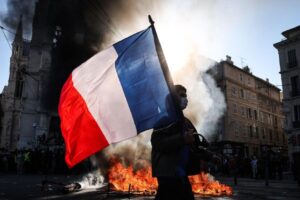
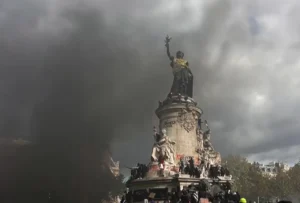
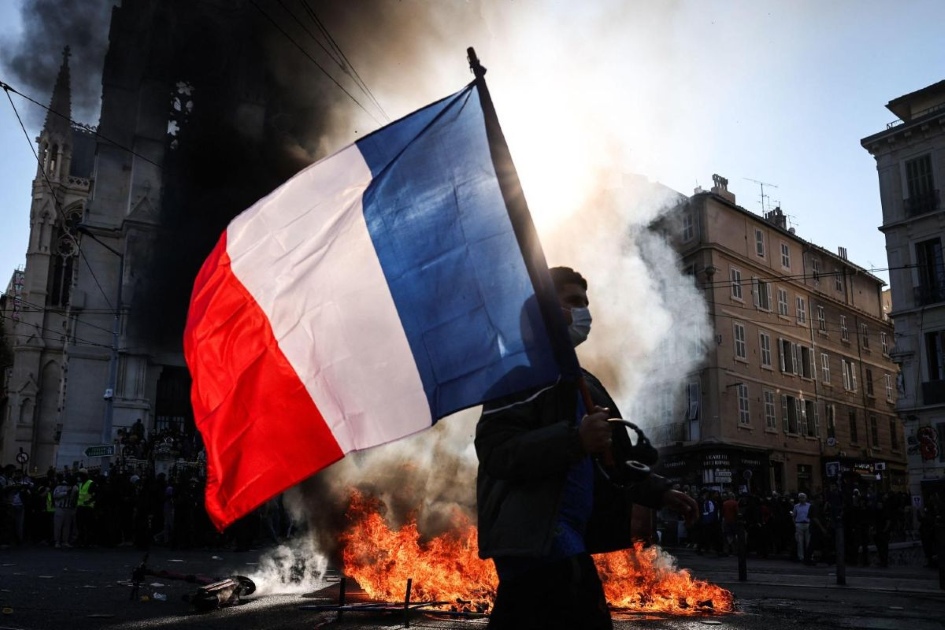
Some kinds of anger are heterogeneous, and fuse at a given moment in history. That of 17 October 2026 is one of them. No party and no trade union called for it: a single anonymous video, posted on TikTok1, was enough to bring 550,000 people onto the streets according to the Interior Ministry, joined by secondary school pupils.2 Yet anger without a head belongs to whoever chooses to claim it.
The parties, or anger as capital
La France insoumise, the Communist Party and the Greens backed the call even before the trade unions rallied to it.3 The Prime Minister, for his part, summoned La France insoumise to ‘choose its side’.4 The right, meanwhile, took on the role of the party of order, much as Giorgia Meloni has done in Italy, where the movement has crossed the Alps.5 So the left counts the demonstrators while the right counts on fear. Yet neither answers the questions that brought France out onto the streets.
Foreign actors, or anger as narrative
One name remains almost unknown in France: that of Neville Roy Singham. The founder of the IT company Thoughtworks, which he sold for some 785 million dollars, this American, a long-standing admirer of Maoism according to those close to him, who was already active in 1971 in a Maoist-inspired Black revolutionary movement in Detroit 6 ,now lives in Shanghai.7 In August 2023, The New York Times exposed the network he funds: associations, research centres and media outlets spread from the United States to India and from South Africa to Brazil. The American organisations alone have received at least 275 million dollars. His Shanghai office houses a production company, Maku Group, whose stated mission is to ‘tell China’s story well’, a phrase dear to official propaganda. He categorically denies taking orders from any government.8
In July, however, a committee of the House of Representatives subpoenaed three of his organisations, which had refused to hand over their documents.9
This network has made the French revolt a chapter in its own epic. Vijay Prashad, a Marxist historian and director of the Tricontinental institute, hailed it with ‘Paris–New Delhi Buenos Aires. Let fury have the hour, anger can be power’ (adding a line from ‘Clampdown’, a 1979 song by the British punk band The Clash, that celebrates fury and anger as a force). The outlet BreakThrough News edited the footage. Jodie Evans, Neville Roy Singham’s wife and co-founder of the association CodePink, urges Americans to ‘watch France’.10
Her turnaround is striking: in 2015 she was still denouncing China’s ‘brutal repression’ of women’s human rights defenders; since her marriage in 2017 she has become one of Beijing’s most ardent advocates.11 Nothing indicates that this network financed or directed the movement, but it gives it a narrative.
Others have tried their hand. Iranian, Russian, Algerian, Turkish and Chinese state media have looped the images of looting. Police sources also suspect influencers linked to Tehran, Algiers or Moscow of having fanned the flames.12 It is true that in France the political reflex is to point at Moscow at the slightest incident. Viginum, the State service tasked with tracking foreign digital interference, has indeed attributed other operations to Russian networks in the past. This time, however, it detected nothing significant behind the call.13 An open-source analysis concludes that the school pupils’ movement was ‘captured and prolonged’ rather than ‘instrumentalised from outside’.14 Everyone sees the hand of their adversary; in truth, all these powers are warming themselves at a fire they did not light.
The following days confirmed this finding without settling the question. On 21 October, the President of the Republic judged that there had been ‘no visible foreign interference in the events’, while denouncing ‘foreign manipulation of information’ and the ‘unacceptable and stupid comments’ of foreign leaders. He was responding in particular to the Israeli Prime Minister, Benjamin Netanyahu, according to whom France had ‘given in to radical Islamism’.15 European authorities are in turn examining possible pro-Russian interference and the responsibility of the major platforms in spreading false narratives.16 Relays of the Russian Storm-1516 and Matryoshka campaigns, which Viginum has already identified among more than a hundred operations targeting the presidential election since the summer,17 have spread false information, and signs of Iranian and Algerian influence have been noted.
A video viewed nearly six million times on X, presented as French, had in fact been filmed in Tbilisi in 2024. European intelligence services nonetheless consider it too simplistic to blame Moscow for the unrest, and see its causes as primarily domestic.18 The commission of inquiry that the National Assembly decided to set up on 20 October is expected to examine both the failures of public-order policing and foreign interference.19
That leaves the Open Society Foundations, created by George Soros, which are readily pointed to behind protest movements and which the Hungarian government accuses of interference, to the point of passing a so-called ‘Stop Soros’ law in 2018.20 The foundations have long funded French associations: in 2017 they gave US$2.65 million to some fifty organisations, including the Ligue des droits de l’Homme, their priorities ranging from combating discriminatory identity checks to civic participation.21
Several organisations they support or have supported, from the Ligue des droits de l’Homme to Human Rights Watch and from Attac to 350.org, relayed the call for 17 October or denounced the policing. It should be noted that the foundations announced in 2023 that they were withdrawing from most of their activities in the European Union,22 and the press that listed these links itself concedes that none of them shows that they funded, organised or directed the violence.23
Durably funding an ecosystem of associations is not lighting a riot, but it does nonetheless weigh, upstream, on the ideology at work. On the question of transparency: the register of foreign influence, opened in 2025 with the High Authority for Transparency in Public Life, covers only actions carried out on behalf of a foreign power, an entity closely linked to it or a party stemming from it.24 Consequently, a private foundation subsidising French associations falls outside it. It would be important to analyse this other type of interference.
The rioters, or anger as pretext
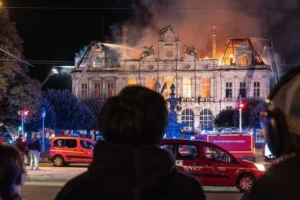
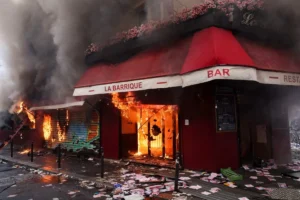
The looting was not the work of the demonstrators. On 17 October, more than 1,500 shops were ransacked and 2,397 people arrested; 997 police officers and gendarmes were injured, seven of them seriously.25 Later tallies put the number of shops damaged or looted nationwide at between 2,000 and 3,000.26 In Paris, two men died on the fringes of the gatherings: one of a probable heart attack according to the police prefecture, the other in circumstances that the prosecutor’s office is still checking.27 In Limoges, where the town hall, inaugurated in 1883, was set ablaze and its belfry partly collapsed, the prefect spoke of ‘rioters, not demonstrators’.28 The police counter-terrorism sub-directorate has been brought in and the national counter-terrorism prosecutor’s office is examining the case.29
In Paris as in Marseille, hooded groups forced their way into apartment buildings and villas.30 The Minister of Justice reports 2,513 people held in police custody and some fifty judicial investigations, and points to the possibility of an ultra-left organisation.31
The loot, moreover, gives its perpetrators away. Although some supermarkets were emptied, it was above all perfume shops, luxury and fashion boutiques, sportswear, video game and mobile phone stores that were targeted.32 Anger at the cost of living can be recognised by its demands. These lootings, however, stem less from need than from covetousness: that of a consumer society which no longer offers any horizon other than the branded object.
That of a society which is gradually shedding morality and respect, and which no longer enforces public order. That of a demoralised society, in the sense meant by Yuri Bezmenov, the KGB defector who made demoralisation the first stage of subversion, something Sun Tzu had already summed up: to subdue the enemy without fighting.33
That of a society that has fallen into the trap captured by the word ‘tittytainment’, attributed to Zbigniew Brzezinski in 1995: a population kept quiet by entertainment and consumption.34 That, too, of a society that has said yes to every transgression in the name of greater freedom and of progress.
24 October 2026 is being prepared along the same lines: anonymous calls, train times, meeting points, invitations to ‘go up’ to Paris for an ‘Act II’.35 The threat has, however, changed in scale: calls whose origin has yet to be established are urging groups from other cities, notably Marseille, to converge on the capital. The Cercle national des armées, the armed forces’ club in Paris, has been the target of threats, and the State will deploy a thousand soldiers from Operation Sentinelle in the capital, alongside the BRI, RAID and GIGN intervention units.36
When destruction and looting are coordinated to spread fear, they fall outside ordinary criminal law. The Criminal Code classifies them as acts of terrorism where they are connected with an undertaking intended seriously to disturb public order through intimidation or terror.37 It will be for the national counter-terrorism prosecutor’s office to say whether that threshold has been crossed. But these are no longer mere words: acts have been committed, and their repetition has been announced.
The State, or anger as alibi The French Republic was founded in revolutionary violence and in the Terror. Is that why it seems so helpless in the face of looters? The courts, admittedly, prosecute after the event. Nevertheless, on 17 October, the State was not there to prevent the vandalism. Sixty thousand police officers and gendarmes had been mobilised across the country. On 8 December 2018, at the height of the Yellow Vests movement, the government had deployed 89,000, for a crowd four times smaller.38 The Interior Minister, who had expected 200,000 demonstrators, acknowledged a ‘lack of anticipation’ and a ‘loss of control’ in some major cities.39 In Limoges, the mayor, Guillaume Guérin, summed it up in one sentence: ‘We have been abandoned by the State.’ Observing that ‘the republican police has retreated in this country’, he is threatening to hand back his mayoral sash unless the State guarantees in writing the funding of the reconstruction. The Prime Minister has promised to shed light on the failings of the security arrangements.40
In Marseille, the mayor does not blame the police officers, who ‘do what they are asked to do’, but wants to know ‘what orders were given’, given that only one company of CRS riot police was deployed when the unrest began.41 Peaceful demonstrators describe being ‘gassed like vermin, penned in the streets’,42 while elsewhere shop windows were smashed without a single uniform stepping in. One documentary maker sees in this the effect of a doctrine of total crowd control, which ‘creates a pressure-cooker effect rather than de-escalation’.43
As for the Centaure armoured vehicles, which the gendarmerie had deployed in December 2025 against cattle farmers in the Ariège who were opposing the culling of their herd,44 they appeared in Marseille and Bordeaux only as reinforcements, once the violence had broken out.45
Against farmers, the State anticipated in a wholly disproportionate manner. Against the looters, by contrast, the State held back and handled them with kid gloves.
This is where the essential issue lies, for the raison d’être of political authority is not a contract concluded between individuals. What is really at stake is the common good. Aristotle already said as much: the city comes into being for the sake of life, but exists for the sake of the good life.46
Thomas Aquinas defines law as an ordinance of reason for the common good, promulgated by whoever has care of the community.47 The common good implies first of all peace, that is, ‘the stability and security of a just order’. It presupposes that authority ensures the security of society and of its members, and it is the common good that grounds ‘the right to legitimate personal and collective defence’.48 A State that levies on its citizens one of the heaviest tax burdens in the OECD49 and no longer protects either their property or their security is failing in its very raison d’être.
Left to fend for themselves, shopkeepers have seen the fruit of long years of work disappear in a single night, and many now speak of defending themselves. This natural right has not disappeared: the Criminal Code enshrines it as self-defence, within limits that Thomas Aquinas had already set, defence ceasing to be legitimate as soon as it uses more violence than necessary.50
The response must be immediate, necessary and proportionate to the attack. In defence of property, intentional homicide is excluded. Any citizen may also apprehend a person caught in the act of committing an offence in order to bring them before the nearest judicial police officer.51 Beyond that, organised ‘self-defence’, whether armed patrols or neighbourhood militias, falls foul of the law.52
Yet this shift says something essential: when the State no longer guarantees security, everyone withdraws into themselves and mistrusts everyone else. Thus takes hold a society of the mistrust of all towards all, which the philosopher Claude Polin traced to an individualism that has dissolved natural communities.53 It bears repeating: those who demonstrate over the real issues facing the French are within their rights, and their anger is legitimate.
Nearly one in three French people say they cannot afford three healthy meals a day.54 More than one household in three was cold at home during the winter of 2024–2025, and three in four restricted their heating for lack of means.55
To these hardships are added a crushing tax burden, public services withdrawing from whole areas of the country and a State that has become impervious to those it governs. Lumping these French people together with the looters who took advantage of their marches is another way of silencing them: the demand is discredited by the violence of a few, and the authorities spare themselves the trouble of answering it.
Here, then, is the capture with the heaviest consequences: absent when it should have protected, the State is present when it comes to restricting. The former Prime Minister Gabriel Attal, a candidate in the presidential election, would like to be able to shut down social networks during riots, even though the Conseil d’État, France’s highest administrative court, ruled unlawful the suspension of TikTok in New Caledonia in 2024.56 Others are demanding access to the encrypted messaging of the French.
Curfews have been imposed.57 As early as 17 October, several prefects had authorised the surveillance of marches by camera-equipped drones, from the Hérault to Toulon and from Nancy to Saint-Étienne. The so-called Ripost Act of 18 August 2026 extended the experiment with algorithmic video surveillance until 2030 and opened it to public roads. Facial recognition remains prohibited, but the line between monitoring looters and monitoring demonstrators is growing thin.58
For 24 October, the Interior Minister has asked prefects to ban demonstrations ‘likely to disturb public order’ and to request mobile units and water cannon ‘to the maximum’.59
Centaure armoured vehicles, helicopters, Sentinelle soldiers and elite units are this time planned from the outset, and curfews have been renewed.60 The anticipation that was lacking on 17 October is now being deployed, but in the form of surveillance and bans that weigh on everyone.
Responding to a crisis of consent61 by curtailing everyone’s freedoms confirms the very diagnosis one claims to be fighting. It is a genuine admission of powerlessness, but also an admission of cynical opportunism.
Conclusion
What should be done.
Four measures follow from the above. First, anticipate: the ministry expected 200,000 demonstrators and 550,000 turned out. Intelligence services must size the deployment on signals from social networks, not on administrative forecasts alone. Next, protect shops, not just the marches, by positioning heavy resources before the violence rather than after it.
Compensate shopkeepers quickly, with more than 2,000 businesses affected according to CCI France,62 through an emergency procedure and reduced insurance excesses. In Lyon, where 150 to 200 shops were attacked or looted, the Métropole released a 10 million euro fund as early as 19 October:63 the local level was able to act faster than the State. Finally, open a political outlet for legitimate anger, by giving the people back the last word.
That the rioters must answer for their acts, and that foreign interference must be proven rather than presumed, goes without saying. But the State must first fulfil its primary mission in the service of the common good: to protect. As long as the causes of the anger remain unanswered, everyone will continue to seize upon it. The only response that is not a form of capture is to give a voice back to those who demonstrate, somewhere other than in the street.64
References:
1 ‘Appel à manifester le 17 octobre : y a-t-il une réalité derrière cette tendance des réseaux sociaux ?’, Public Sénat, 18 September 2026.
2 ‘17 octobre 2026 : ce qu’il faut retenir de cette journée et de ses conséquences’, Brut, October 2026.
3Public Sénat, op. cit.
4 Brut, op. cit.
5 ‘Comment la colère française a gagné l’Italie : Giorgia Meloni face au “baptême du feu” de ses banlieues’, IntelliNews, 19 October 2026.
6 M. Hvistendahl, D. A. Fahrenthold, L. Chutel and I. Jhaveri, ‘A Global Web of Chinese Propaganda Leads to a U.S. Tech Mogul’, The New York Times, 5 August 2023; New Lines Magazine, cited by Business Today, 7 August 2023 (membership in 1971 of the League of Revolutionary Black Workers, Detroit).
7 InfluenceWatch, profile ‘Neville Roy Singham’.
8 M. Hvistendahl et al., The New York Times, 5 August 2023, cited above.
9 House Committee on Ways and Means, ‘Chairman Smith Issues Subpoenas to CCP-Linked Singham Network Nonprofits’, press release of 24 July 2026.
10 A. Nomani, ‘Who’s Who: Inside France’s “Chaos Inc.” franchise of communist groups, labor unions and global activists’, Fox News, 19 October 2026, which reproduces Vijay Prashad’s post on X in full
11 M. Hvistendahl et al., The New York Times, 5 August 2023, cited above.
12 ‘Violences du 17 octobre : y a-t-il eu des ingérences étrangères sur les réseaux sociaux, notamment sur X ?’, 20 Minutes, 20 October 2026.
13 ‘Violences du 17 octobre : Attal veut pouvoir couper les réseaux sociaux’, Cryptoast, 19 October 2026.
14 ‘Lycéens, réseaux sociaux et nouvelles formes de contestation : la crise qui a pris l’État de vitesse’, OSINT analysis note, Veillemag, 12 October 2026.
15 ‘Macron dénonce les “commentaires inacceptables et stupides” de dirigeants étrangers sur les violences du 17 octobre’, i24NEWS, 21 October 2026.
16 ‘Violences du 17 octobre : Bruxelles examine le rôle des réseaux sociaux dans la diffusion de fausses informations’, Le Figaro, 21 October 2026.
17 ‘Plus de cent opérations étrangères visent déjà la présidentielle française’, AFP, republished by Le Singulier, 14 October 2026 (remarks by Anne-Sophie Dhiver, deputy head of Viginum).
18 Financial Times, 21 October 2026, reported by LIGA.net, ‘Protests in France — the European Union is investigating Russia’s influence’, 21 October 2026 (analysis by David Colon, Sciences Po, and remarks by European intelligence officials).
19 ‘Violences du 17 octobre : accord entre les groupes à l’Assemblée pour lancer une commission d’enquête’, Europe 1, 20 October 2026.
20 Hungarian ‘Stop Soros’ law, adopted on 20 June 2018 and held contrary to EU law by the Court of Justice of the European Union (CJEU, 16 November 2021, Commission v Hungary, C-821/19).
21 Open Society Foundations, ‘Open Society en France’, factsheet, July 2018 (US$2.65 million granted to 50 grantees in 2017).
22 ‘Fondation Soros : la réduction des activités en Europe menace la démocratie selon les associations’, Carenews, 20 September 2023.
23 ‘Siete organizaciones vinculadas a George Soros aparecen relacionadas con los disturbios de islamistas en Francia’, La Bandera, 21 October 2026 (Ligue des droits de l’Homme, Human Rights Watch, FIDH, OMCT, Amnesty International, 350.org and Attac). Despite its headline, the article acknowledges that none of these links shows that the foundations funded, organised or directed the violence.
24 Law No. 2024-850 of 25 July 2024 to prevent foreign interference in France; ‘Ingérences étrangères : naissance d’un répertoire pour mieux informer élus et citoyens’, Banque des Territoires, 8 October 2025.
25 ‘Mobilisation du 17 octobre : 2 397 personnes ont été interpellées et 997 policiers et gendarmes ont été blessés’, CNews, 18 October 2026; Le JDD, 20 October 2026.
26 LIGA.net, reporting the Financial Times, 21 October 2026, cited above (at least 2,000 shops); ‘Manifestation du 24 octobre à Paris : parcours, armée et interdictions’, Sortiraparis, 21 October 2026 (about 3,000).
27 ‘Mobilisation du 17 octobre : un manifestant est mort à Paris des suites d’un malaise’, CNews, 18 October 2026; ‘Manifestations du 17 octobre : 2 morts, un tournant’, La Relève et La Peste, 19 October 2026 (based on the police prefecture, the Paris prosecutor’s office and Le Parisien).
28 Brut, op. cit.
29 ‘Mairie de Limoges incendiée : voici ce que l’on sait du suspect’, Watson, 20 October 2026.
30 Europe 1, republished by Titrespresse, 20 October 2026.
31 ‘2 513 gardes à vue : les violences du 17 octobre s’invitent dans une audition de Gérald Darmanin sur le budget du ministère de la Justice’, LCP, 20 October 2026.
32 M. Roudaut, ‘17 octobre : des pillages en marge des cortèges ont visé la grande distribution, mais pas que’, HuffPost, republished by Yahoo! Actualités, 18 October 2026.
33 Yuri Bezmenov, former KGB agent who defected to the West, interview with G. Edward Griffin, 1984; Sun Tzu, The Art
of War, chap. III.
34 Hans-Peter Martin and Harald Schumann, The Global Trap, London, Zed Books, 1997 (German original 1996), who attribute the word to Zbigniew Brzezinski at a conference held in San Francisco in 1995.
35 ‘“Acte II” le 24 octobre, mobilisation le 5 novembre… À quoi s’attendre pour la suite du mouvement ?’, France 24, 19 October 2026; Viralmag, 20 October 2026.
36 ‘24 octobre : Arc de Triomphe, ambassades, 500 soldats… Le détail du dispositif militaire pour protéger les lieux sensibles’, Le JDD, 20 October 2026; L’Express, republished by Orange Actu, 20 October 2026.
37 French Criminal Code, Article 421-1(2).
38 ‘17 octobre : comment les casseurs ont pu casser en toute liberté’, i24NEWS, October 2026 (60,000 police officers and gendarmes mobilised according to the Interior Minister, who expected around 200,000 demonstrators; 89,000 on 8 December 2018). The Interior Ministry then counted 136,000 demonstrators.
39 ‘Violences urbaines : Laurent Nuñez reconnaît “une perte de contrôle” de la police dans certaines villes’, Weka, October 2026 (statements by the Interior Minister and by the mayor of Limoges, Guillaume Guérin).
40 ‘“On a été abandonnés par l’État” : le maire de Limoges dévasté après l’incendie de l’hôtel de ville’, L’Express,
republished by Orange Actu, 19 October 2026; ‘Hôtel de ville de Limoges incendié : Guillaume Guérin réclame des réponses après les violences du 17 octobre’, Entrevue, 20 October 2026 (letter from the Prime Minister of 18 October).
41 ‘“Je n’ai pas les mots” : la colère de Benoît Payan au lendemain des violences du 17 octobre à Marseille’, Yahoo! Actualités, 18 October 2026; ‘“30 000 pilleurs à Marseille ?” : Benoît Payan conteste les chiffres de la préfecture et accuse l’État d’avoir laissé la ville sans protection’, Entrevue, 19 October 2026.
42 ‘“Gazés comme des malpropres, parqués dans les rues” : ces manifestants choqués par le maintien de l’ordre le 17 octobre’, actu.fr, 18 October 2026; on looting committed with no visible police presence, i24NEWS, cited above.
43 ‘Maintien de l’ordre du 17 octobre : “La volonté de contrôle total de la foule crée un effet bouilloire plutôt qu’une désescalade”’, L’Obs, 18 October 2026.
44 Gendarmerie nationale, ‘Ariège : retour sur une opération de maintien de l’ordre gérée avec grand professionnalisme’, Gend’info, December 2025 (two Centaure armoured vehicles deployed at Les Bordes-sur-Arize on 10, 11 and 12 December 2025, during the culling of a herd reportedly affected by lumpy skin disease).
45 ‘Mobilisation du 17 octobre : qu’est-ce que le Centaure, ce véhicule blindé déployé à Marseille et à Bordeaux ?’, TF1 Info, 17 October 2026; ‘Manifestation du 17 octobre : un blindé léger de la gendarmerie appelé en renfort’, Ouest-France, October 2026.
46 Aristotle, Politics, Book I, chap. 2, 1252b.
47 Thomas Aquinas, Summa Theologiae, I-II, q. 90, a. 4.
48 Catechism of the Catholic Church, 1992, nos. 1906 and 1909.
49 OECD, Revenue Statistics 2025: in 2024, France ranked second for its tax-to-GDP ratio (43.5 per cent), behind Denmark (45.2 per cent).
50 Thomas Aquinas, Summa Theologiae, II-II, q. 64, a. 7.
51 French Criminal Code, Article 122-5; Code of Criminal Procedure, Article 73.
52 French Criminal Code, Articles 431-13 et seq. (combat groups); Internal Security Code, Article L. 212-1 (dissolution of combat groups and private militias).
53 Claude Polin, L’Esprit totalitaire, Paris, Sirey, 1977; Le Totalitarisme, Paris, PUF, coll. ‘Que sais-je ?’, 1982.
54 Secours populaire français, 19th Ipsos barometer of poverty and precariousness, 11 September 2025.
55 Médiateur national de l’énergie, energy-info barometer, 28 October 2025 (35 per cent of households suffered from cold for at least twenty-four hours; 74 per cent restricted their heating for financial reasons).
56 Cryptoast, op. cit.
57 Brut, op. cit.
58 A. Boero, ‘Drones, vidéos, reconnaissance faciale… comment la police surveille vraiment les manifestations en France’, Clubic, 19 October 2026.
59 ‘Après les émeutes du 17 octobre, Nuñez ordonne aux préfets d’interdire les manifestations à risque prévues samedi’, Le JDD, 20 October 2026 (telegram of 19 October).
60 Sortiraparis, 21 October 2026, cited above; i24NEWS, 21 October 2026, cited above (curfews reinstated in Paris, Lyon and Bordeaux, among other cities).
61 On this crisis of consent, see Virginie de Araújo-Recchia, ‘After Macron: What Will Survive Beyond 2027’, 17 September 2026, and ‘France: A Debt Crisis, or a Crisis of Sovereignty?’, Sovereignty, 12 October 2026.
62 ‘Violences urbaines : Laurent Nuñez reconnaît “une perte de contrôle” de la police dans certaines villes’, Weka, cited above (estimate by CCI France).
63 ‘Violences et pillages à Lyon : près de 200 commerces touchés, un fonds de 10 millions d’euros débloqué’, LyonMag, 19 October 2026.
64 See Virginie de Araújo-Recchia, ‘Giving the People the Last Word’, forthcoming.