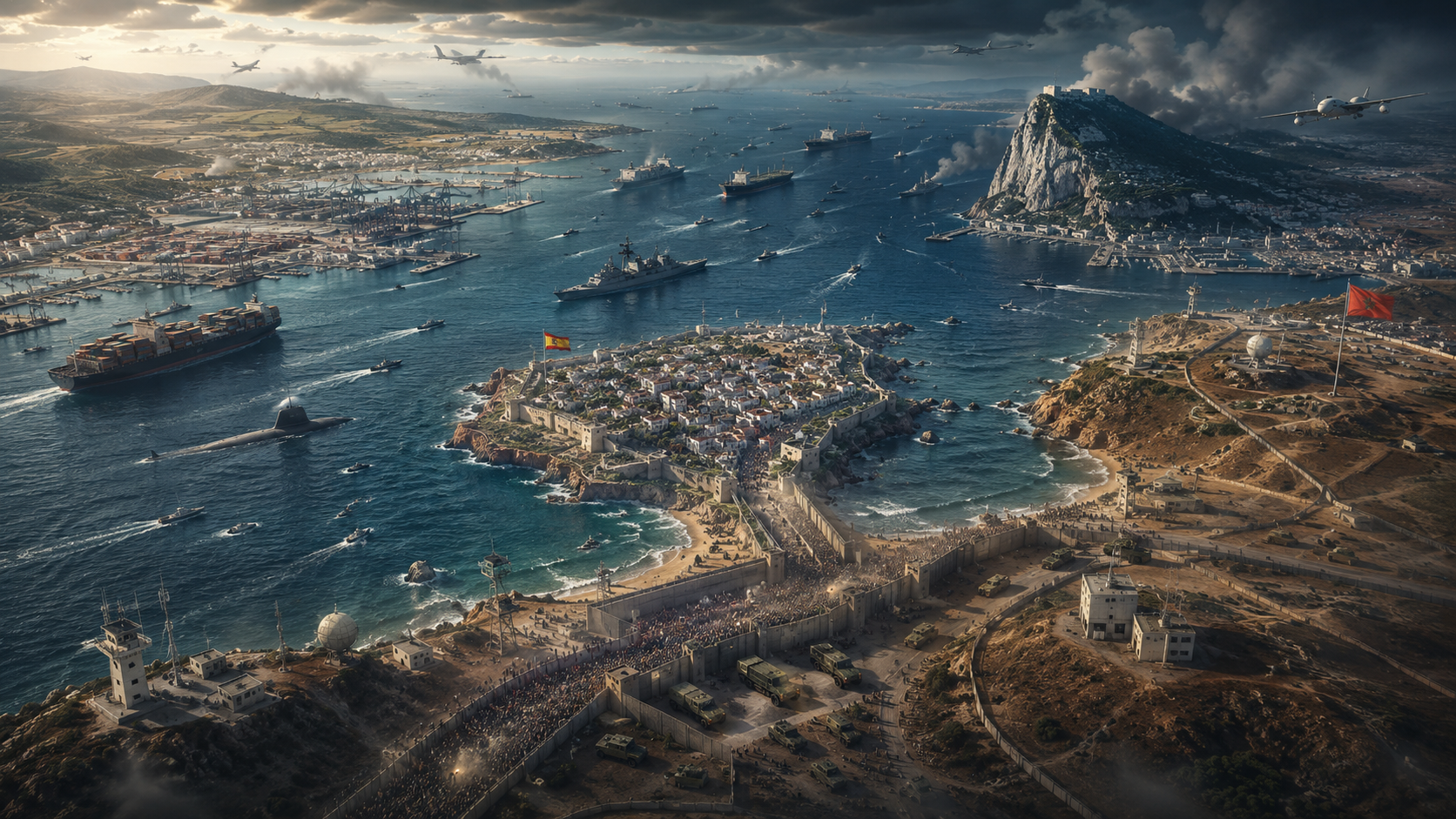
On July 30, 70,000 young Moroccans managed to enter the city of Ceuta, overcoming all kinds of control by the Spanish, leaving the military units garrisoned by orders from above. Meanwhile, thousands of Moroccans looted supermarkets, shops and raided homes. Today, half have returned with the stolen loot to their villages and there are officially 23 cases of rape of women and adolescents. The contingents, as evidenced by videos from direct witnesses, were transferred to the border in trucks escorted by the Moroccan gendarmerie.
The ease of access requires accurate information, logistics prepared by higher bodies, and instructions through the networks that show us that we are facing a hybrid war attack. The possibility of a Green March on the Spanish cities of North Africa had already been known for months in military circles, but there was no response from the Spanish executive.
The city of Ceuta has been Spanish since 1580, when the kingdom of Portugal was inherited by our monarch Philip II, as Melilla has been since 1497, being essential in the process of military protection of the Balearic Islands-Strait-Canary Islands axis.
On the contrary, Morocco dates back to 1956, although we want to delay its origins to 1660, when Muley Rachid in tafilete conquered the city of Fez and proclaimed himself sultan. Spain’s presence in North Africa is heir to the Visigothic kingdom and the Roman Empire, and clearly Morocco did not exist, although they now claim Islamic expansion in their favour.
Ceuta’s strategic importance comes from its control of the Strait of Gibraltar. This nerve centre is 42 miles long and nine miles wide, supports a sea passage density of 120,000 ships per year. The responsibility for its security has been the responsibility of Spain and Morocco since 1956, when it acquired independence. In the case of Spain, it is Ceuta, since Gibraltar was occupied by the British in the War of the Spanish Succession and its loss was recognised in the Treaty of Utrecht in 1713. The Gibraltar naval base is a decisive point in the military structure of the Atlantic Alliance led by the United States, and a repair point for the Royal Navy’s nuclear submarines.
In terms of maritime traffic, the port of Algeciras was the protagonist with 70% of the control of goods. However, Morocco, thanks to international aid, has developed Tangier Med, which already concentrates 47% of the containers that pass through the Strait. In that year, the European Union forced shipping companies to pay a special tax for polluting emissions in community ports, the payment of which does not exist in Morocco, so the EU has made it possible to transfer the transport of containers to North Africa.
At the strategic military level, Spain has ceased to claim Gibraltar, and Morocco and Great Britain have been carrying out joint exercises for some time since 1989. The last one was in June of this year, which consisted of joint operations by divers and ships from the navies of both countries. Spain’s loss of Ceuta would mean the end of its control of the strait, with the defensive isolation of the Canary Islands, which faces the same problem of denationalisation by Moroccan mafias that, with the help of international NGOs, help human trafficking.
The United States from the bases of Rota and Morón, together with Morocco, and Great Britain from Gibraltar, present themselves as the true guardians of the Strait of Gibraltar and the gateway between the Mediterranean and the Atlantic, one of the main commercial accesses to southern Europe and the Middle East.
Spanish politics has developed a policy of surrender. As Charles Powell shows in his book King in Democracy, where the monarch Juan Carlos I was willing to hand over our cities in 1979, as he had done four years earlier with the province of the Sahara.
The Ceuta crisis showed that the US, Israel and France diplomatically supported Morocco, that NATO and the EU did not make any move in favour of Spain, and that the defence of the cities lies exclusively in Spanish military sovereignty. Meanwhile, families are taking their wives to safety on the peninsula for fear of rape and European NGOs are helping the invaders.