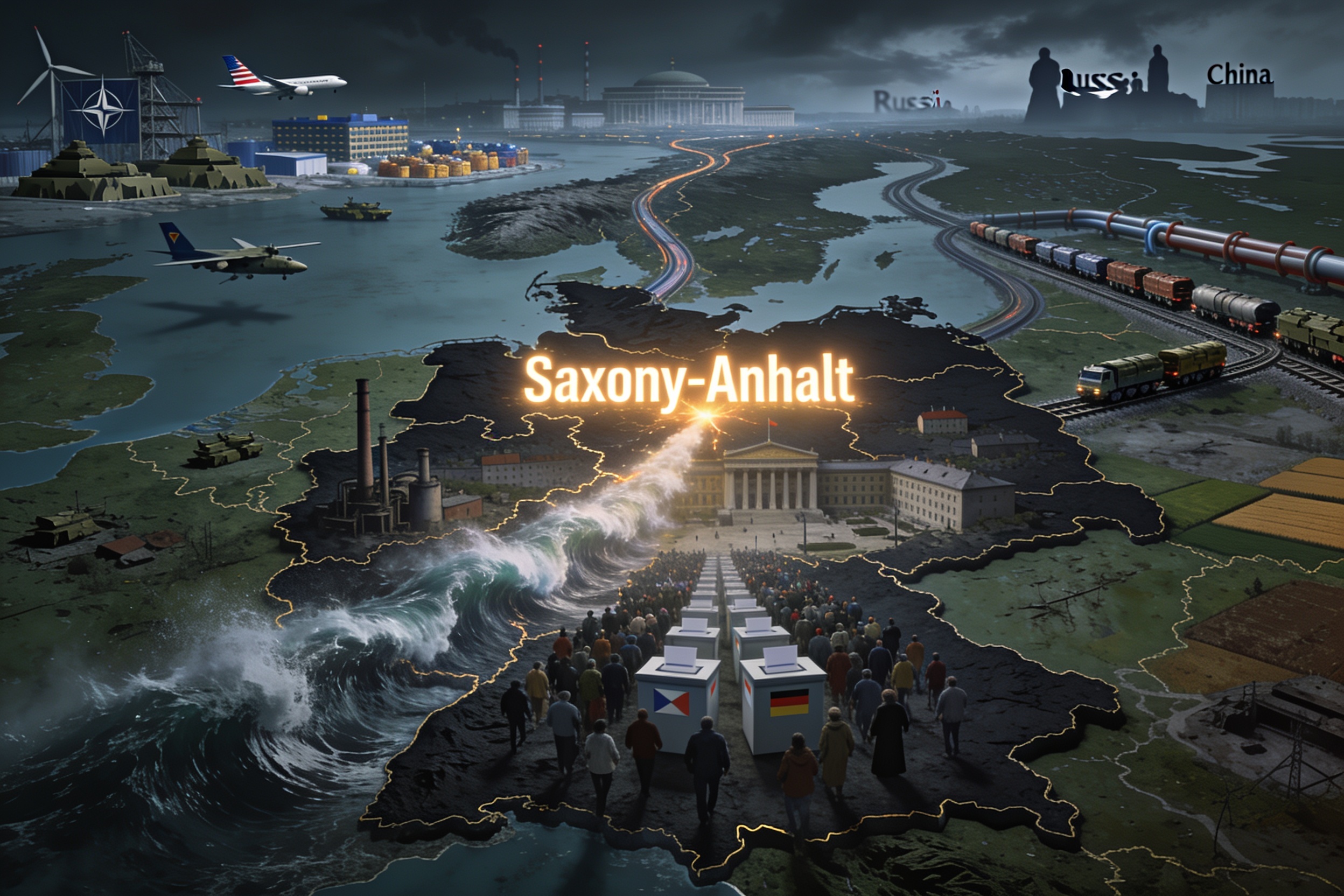
The Alternative for Germany (AfD) is polling 40-42 per cent in Saxony-Anhalt ahead of the East German state’s Landtag election due to be held on 6 September, according to opinion polls conducted at the end of August. [1][2] The AfD’s closest challenger, the Christian Democratic Union of Germany (CDU), trails far behind at 22-23 per cent. The AfD would get at such a support 40-45 seats in the Landtag, just below the majority. [3][4]
The possible rise of the AfD into power, even in just one German state, is a problem for the whole transatlantic system due to East Geman AfD politicians’ opposition to the EU and the NATO. The AfD top candidate in Saxony-Anholt, Ulrich Siegmund, opposes large net transfers from Germany to the EU[5] and Ukraine’s EU membership[6]. Moreover, he supports withdrawal of Germany from the EU, if the EU “cannot be scaled back to something closer to its founding concept”[7]. In foreign and security policy, Siegmund opposes German military and financial support for Ukraine and supports lifting sanctions on Russia[8]. He emphasises a sovereign Germany that deals with the United States, Russia, and China on equal terms while putting its own economic and security interests first.[9]
The German and western establishment’s fear of the AfD’s rise into power in Saxony-Anhalt contains certain practical aspects. If the AfD won a majority in the Landtag and if it was able form a government, it would obtain control over internal security, policing and other powers. Consequently, an AfD government in Saxony-Anhalt, according to certain military analysts, could impede vital Nato supply lines to the east in case of a war with Russia.[10]
Possible success of the AfD in Saxony-Anhalt state elections is twice as much worrying for the German and western establishment due to internal power dynamics of the AfD, personified as tensions between the party’s co-chairs Alice Weidel and Tino Chrupalla. For years, there has been a tug-of-war between Eurasian-minded leaders in the East and more transatlantic-minded leaders in the West.[11]
Weidel is a former Goldman Sachs banker from West Germany, who has “sought to anchor the party in a civilizational West”, whereas Chrupalla, who is from East Germany, “is more firmly rooted in the AfD’s eastern strongholds and is more receptive to an eastward reorientation of German foreign policy”.[12] Chrupalla’s advisor Dimitrios Kisoudis has even called for Germany to align itself with a consolidated “Eurasian” pole in the world system.[13] The AfD’s rise into power in East Germany could give the upper hand to East Germany’s AfD and change the party’s internal power dynamics to favour the Eurasian geopolitical line over the transatlantic alignment.