Without a correct geopolitical and socio-political orientation-approach, the fight against insecurity and organized crime does not exist, it is in essence false or at least epidermal. By correct I mean a sovereign position that attends to true regional interests.
Although there can and should be a politics and by expansion a geopolitics without mafia, organized crime cannot exist without the complicity and connivance of politics and by ramification of geopolitics. Without the coverage of politics and governments involved with organized crime, mafiosi would be simple common criminals vulnerable to the security and justice institutions of a State and government that really exercises their function.
It is wrong, as the Latin American academy genuflects in general, to “analyze” our security problem from a simple criminological approach. To these analysts I ask: Is the existence of tax havens a criminological or geopolitical problem? It is a matter of looking at a map to visualize where most tax havens are located. It is there, in tax havens, where all the money from corruption and organized crime is “laundered” and stored, therefore, banks have to do with the phenomenon of insecurity.
Our America, which is very familiar with the aforementioned “war on drugs”, plans for Colombia, etc., should be clearly aware that these so-called “wars and plans” to confront drug trafficking, organized crime and insecurity in general in our countries, have only been instruments of US imperialist geopolitics to sustain hegemony in what they consider their “backyard”. They are the punitive-interventionist tool for the pretext of “cooperation”, but with this in reality they manage to domesticate governments and limit the strategic autonomy of our countries. Today that “old baby” has been renamed, it is called the “Shield of the Americas”.
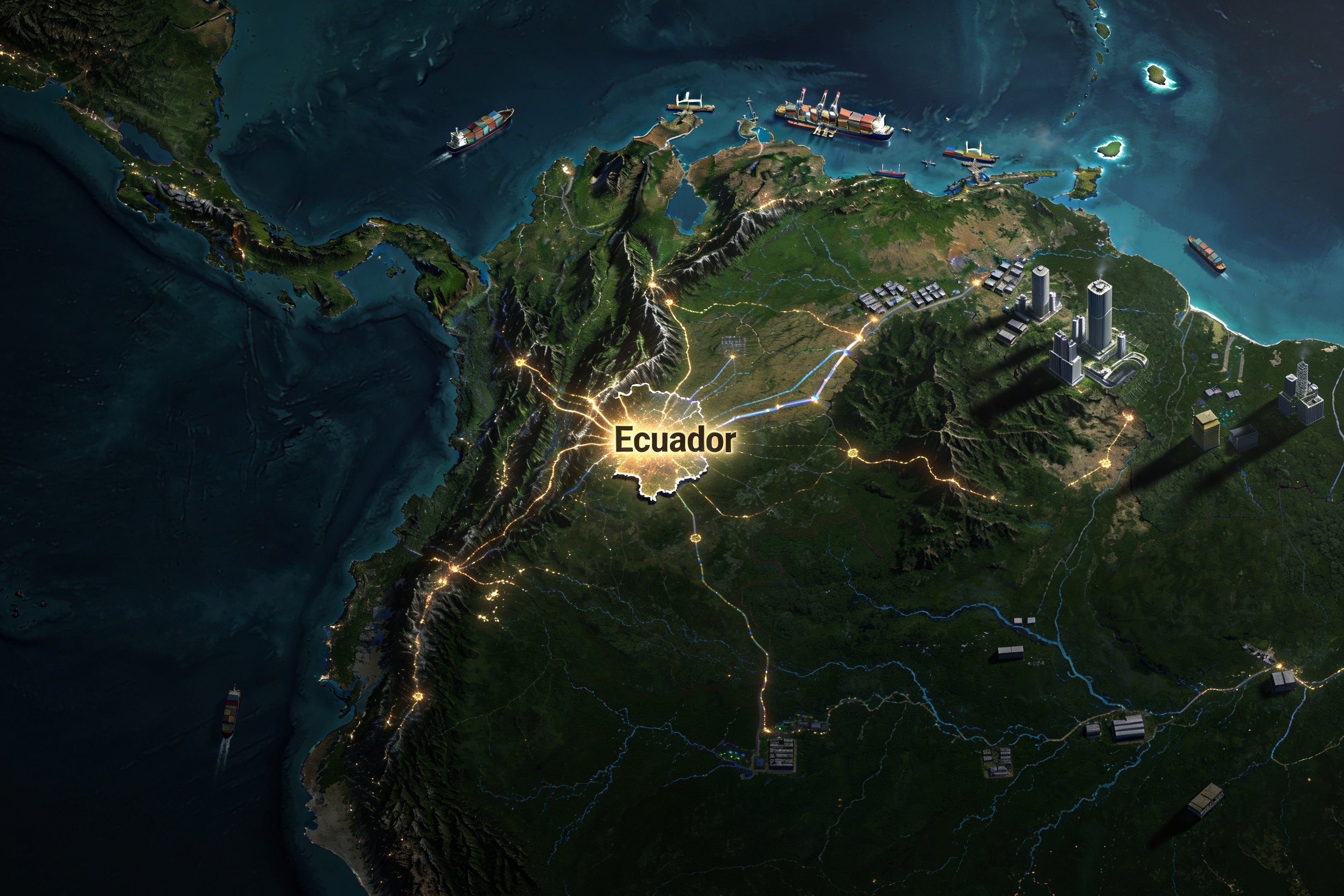
Of how geopolitics influences security, or rather, insecurity, the case of Ecuador is paradigmatic. Until 2017 Ecuador was considered the second safest country in Latin America, in just 8-9 years we are the most unsafe country in this hemisphere. According to statistics, of the 10 most violent cities in the world, at least five are located in Ecuador, 50% of the most violent cities in the world are in Ecuador!
How did it come to that? The Ecuadorian right and oligarchy, traumatized by the effects of Rafael Correa’s reformist government, dedicated themselves to dismantling all the institutions that allowed us to become a safe country. But from Moreno to Noboa we have “evolved” to have a “war”. By a brief semantic and geopolitical exercise, simple gangs of common criminals, many of them unknown to most Ecuadorians, became terrorists, that is, the epithet that the usual suspects love, when in a strict conceptual and historical sense there is no war in Ecuador and those criminals, no matter how violent they may be, are not terrorists.
Today fear is widespread in this Andean country, no wonder, neoliberal governance systematically ensures that fear expands to every corner. It is no exaggeration to say that in Ecuador the rule of law is no longer existent.
Insecurity in Our America is less and less a problem of internal crime and more of a problem of criminal geopolitics. We have approximately 9% of the world’s population but about a third of the world’s homicides. Organized crime, closely linked to the interests of the northern hegemon, has become the underground ally to keep the hemisphere under control, which is used selectively and narratively according to contexts and businesses. So poverty and other related variables do not explain the phenomenon of insecurity.
Our region not only produces drugs, it is an integral part of the global criminal logistics chain. In these things it is not possible to count on exact data, but according to organizations such as UNODOC, the cocaine produced in Colombia and Peru has now found in ports of Ecuador and Brazil the privileged route to send it to the United States and Europe. The security of a port is not only a police matter, in the current context it is a matter of national security, intelligence and geopolitics.
Our region is violent because here the routes are disputed, the drugs are produced, transported and stored. But the demand is global and is largely concentrated in the US and Europe.
We speak of a criminal ecosystem when organized crime controls territories, ports, borders, roads, prisons, markets, illegal mining, migratory routes, trade, local authorities and governments. When an organization acquires this capacity, we are facing criminal governance, where its businesses are also diversified: weapons, migrants, extortion, money laundering, etc.
Latin American insecurity cannot be studied solely from criminology, it requires a geopolitical, intelligence and political economy approach. How can we not consider the geopolitical variable when we remember, UNASUR, which sought through three of its Councils to address the problem in a regional way, deliberately disappeared: a) South American Council on the World Drug Problem, b) South American Council on Citizen Security, Justice and Coordination of Actions against Organized Crime and the South American Defense Council.
Latin America is not simply facing an epidemic of crime, but a transformation of the nature of power within the framework of the current financial-neoliberal capitalism, producing a much more accentuated symbiosis between power groups, so to speak, traditional and criminal geoeconomics-geopolitics.
This can connect and explain the serious security problem that several countries in Our America are experiencing, highlighting the Ecuadorian case. Ignoring the geopolitical dimension that the phenomenon of insecurity has acquired in Latin America prevents a full understanding of the problem. Police and military announcements are to keep the common people entertained.