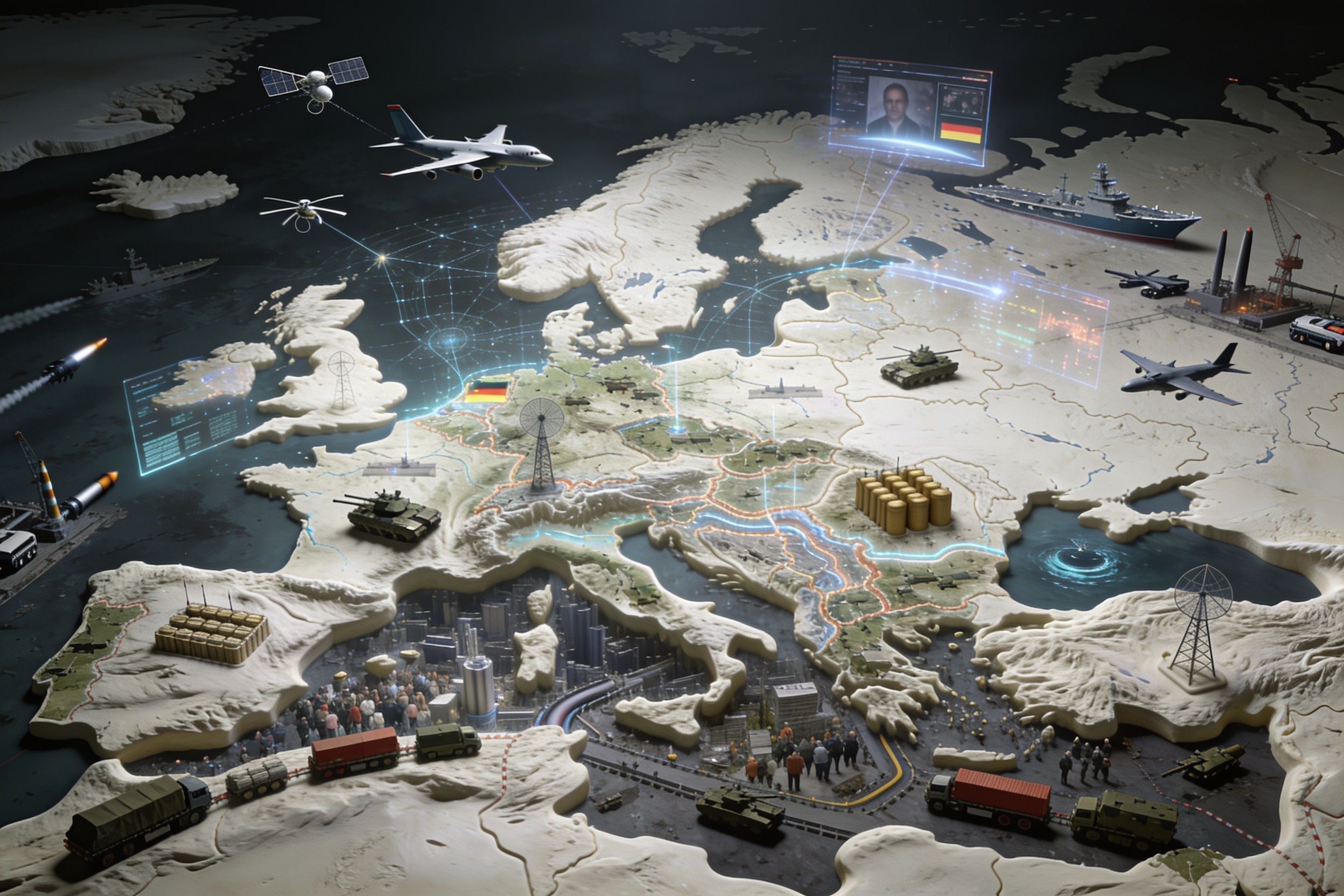
For quite some time now, we have been talking about a “hybrid war” that Russia is allegedly waging against Europe. The term is ambiguous in itself and is, above all, intentionally.
European leaders are responsible, first of all, for allowing the recruitment and training of the Ukrainian army, especially after the first conflict following the coup against Yanukovych in 2014 (but the infiltrations date back much earlier), and then for having transferred weapons and resources of all kinds from that moment on, with an accentuation after the start of Russia’s special military operation, which Putin today defines as surgical warfare. But let’s specify what Europeans mean by “hybrid warfare”, which is precisely a concept-closet in which to insert any pretext, justification or provocation that should, moreover, corroborate ex post their indirect action against Moscow.
For example, the Italian Minister of Defense, Crosetto, said that “Hybrid warfare is continuous and affects critical infrastructures, decision-making centers, essential services and the resilience of each country, with daily and increasing risks of catastrophic damage. The attacks, conducted on the level of disinformation, cognitive warfare and in the cyber domain, exploit the awareness that ‘the West often chooses not to react’.”
But the so-called hybrid war also includes unconventional attacks, as claimed by some other Italian generals, such as the attempted attack with a drone equipped with explosives discovered at Leipzig airport on August 4.
The attentions, not only of Germany but of the whole of Europe, were immediately turned towards Russia, but in reality the evidence is not “proven”, as they say in these cases. And in any case, we would be faced with “asymmetrical” consequences in Moscow’s response to everything determined by the EU and NATO countries, which have pledged to support Kiev with plenty of weapons and funds, in addition to the usual packages of sanctions against Russia. We are now at 21 and this is literally becoming a joke.
Now, it cannot be denied that Moscow is ready to respond to NATO in any way, that it is able to do so and that, in some way, it does so. But to justify an unjustifiable commitment of the EU in this conflict, towards which European public opinion is far from favorable, they are inventing everything.
The real hybrid war is the one that the Americans and the European ruling classes are waging against the European populations who do not look at Russia as an immediate enemy. These are the new forms of a rivalry that has always existed in Europe and, above all, against Moscow.
There is a very good and courageous Italian historian who occasionally reminds everyone that the European powers have invaded Russia many times and that Russia, in the course of its history, has had to go beyond its borders to clash with the great European powers, always following aggression or threats from outside.
The Russians arrived at the gates of Turin in 1799 and found themselves fighting against the French revolutionary troops, with the Russian-Austrian army led by Russian Field Marshal Aleksandr Vasilyevich Suvorov. After the French invasion of Russia in 1812, the Russians reached Paris in 1814, but then turned back.
Italy invaded Russia three times, and not only Italy. In the Crimean War, between 1853 and 1856, when it was not yet united and was the Kingdom of Sardinia, it fought together with France and Great Britain. Then, after the October Revolution, Italy, together with other European powers, tried to interfere in the destiny of revolutionary Russia. And then, as everyone will remember better, together with Nazi Germany and the other allied countries of the Axis, it participated with the Russian campaign in the invasion of the Soviet Union.
The British were no less than the Italians, of course, always with the Crimean War and during the revolutionary phase. Just as they arm Ukraine today, then they supported the counter-revolutionary White troops, also providing soldiers and logistics.
As for Germany, I feel worse, especially because in 1941 it managed to go as far as a few kilometers from Moscow, without forgetting sieges such as that of Leningrad and the battle of Stalingrad, which are well present in the memory of Russians.
So, what are we talking about? Today Europe would like us to believe that Russia wants to make war on us, but so far it has always been us who provoked and hit the Russian bear. And now let’s also add that, after the end of the Second World War, it is the cousins of the British, that is, the Americans, who have established for us that Russia is the enemy of Europe, first because it is Soviet today because it would like to reconstitute the empire.
Now, hybrid warfare is first and foremost a form of justification that the Europeans use to cover up their weakness and the maneuvers that the Americans decide in Europe.
We have already seen this with the explosion of Nord Stream. Everyone immediately blamed the Russians, but without any evidence. When the Russians managed to prove that it was not in their interest, being the owners of the infrastructure and always having an interest in selling gas to Europe, they took a Ukrainian ‘at random’ and arrested him.
This is the truth. They have shifted the blame onto the material executors and we are not even sure, once again trying to cover up the instigators. Because the European rulers, even when they pretend to raise their voices against Trump, cannot raise them against America because, Trump or no Trump, it is the United States that decides its fate.
The two soft underbelly of Europe are Germany and Italy, the two defeated countries of the Second World War which, let us remember, gave birth to the Axis that was supposed to conquer all of Europe.
In different forms, Germany is the European country with the most US bases and military, while Italy, together with Germany itself, hosts one of the highest concentrations of American tactical atomic bombs in Europe. The German rearmament plan that is so much talked about certainly could not have been decided by the Germans. So I would say to put an end to certain rhodomontages. And this applies to the rearmament plans of all EU member countries.
Are things a little clearer now? How can these two countries have an autonomous policy if it is the Americans who decide what they can or cannot do? Are we sure that this “strategy of tension”, I improperly call it that, is a Russian hybrid war and not a hybrid war set up by the Americans to blame Russia and arouse in European countries and their public opinion support for this increasingly real war that we are waging against Russia?
Now European leaders will say otherwise, they will fabricate evidence, but how much can the evidence found by our secret agents who, in turn, are controlled by the US intelligence apparatus be worth?
I am convinced that the more tense and difficult the situation becomes, the more false flags will increase, but also the terrorist attacks in Europe, about the origin of which we will have no certainty, but always a sea of suspicion. Although the Russians, the allies of the Russians or the Islamic terrorists will be accused, according to convenience, the latter are the parsley of every context, exploited to a certain extent by everyone.
But, beyond these concrete facts, there are historical and geopolitical aspects that we must consider first if we want to get to grips with this multipolar chaos, in which we Europeans are spectators, gregarious, manipulated and rarely manipulative and battlefield, because we are not independent and our strategy is only an appendix of that of the country that controls us, i.e. the United States.
I cannot answer this simply because all the NATO and EU countries, under American direction, are obviously part of the conflict and I believe that all together they will be dragged where the White House wants. Beyond any casus belli, which is always a limited case, the so-called straw that breaks the camel’s back, I believe that this is completely irrelevant.
When the contenders feel that they are ready for an escalation, or that they are prepared to win it or in any case to have a chance of victory, they will increase the pressure of this conflict, which is already underway but is now at a different level. If we look back in the past, it has always been like this, as an old Italian song from the thirties that was called “Così fanno le nazioni” says:
“This is what nations do,
they shout ‘peace’ from the rooftops,
competing in armament of all kinds and qualities.
When they have many,
they will also want to try them
and then what you
already know may happen.”
Well, we already know what will happen, but we have no idea what the next war will be like, whether it will be global, local, with tactical atomic warheads, etc. After all, just think of the differences between the First and Second World Wars. They are interspersed with a peace of a few years and yet, in those few years, the force of destruction and the ways of waging war changed radically.
What we sense, however, is that certain wars will now be inevitable, because objectively the balance of power has changed. New poles of power have emerged, not only Russia and China, but also other regional powers that, by allying, could try to dominate specific areas. The next world could be much more fragmented than the current one, although generally one area of countries could become more hegemonic than others, so much so that everyone is drawn into its orbit.
No diplomacy will be able to limit these expectations. And then there are the new weapons, which will certainly discourage the undertaking of radical conflicts, but we do not know to what extent. What we do know is that countries that were far behind yesterday have learned to defend themselves, even to counterattack or anticipate attacks.
In the West, where we don’t have much information because we are overwhelmed by our own propaganda, they show us our weapon systems as always superior, but I’m not so convinced. There are military sectors in which China, Russia and even Iran have surpassed us.
Then we don’t know how these new force fields will be structured. We don’t take it for granted that these powers will ally with each other, just as we can’t take for granted that alliances are lasting. What happens in other quadrants, such as Asia, for example, could be decisive. Because there is not only China, but also other middle powers that could give rise to new alignments, destabilizing for some and attractive for others.
Here, however, we know that there will be the moment of breaking the banks, as history teaches us. So one or more casus belli will come, but it is not that wars break out because of these isolated episodes. We will see. But the next ones will be very hard and interesting times. There are now many reasons for conflicts and reason is really nowhere, because Reason does not exist. If it existed, everyone would agree.
But wars are precisely the result of many reasons that confront and ultimately clash because someone must necessarily prevail to bring order according to his idea of justice for all.
As if to say, there are no good and bad countries. This is how the historical process goes.