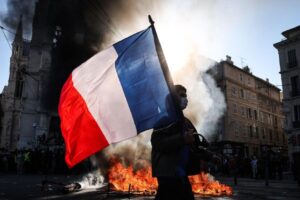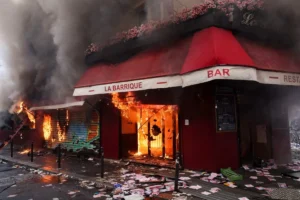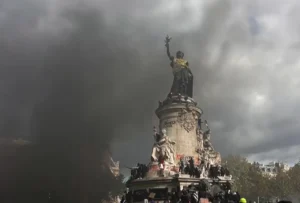
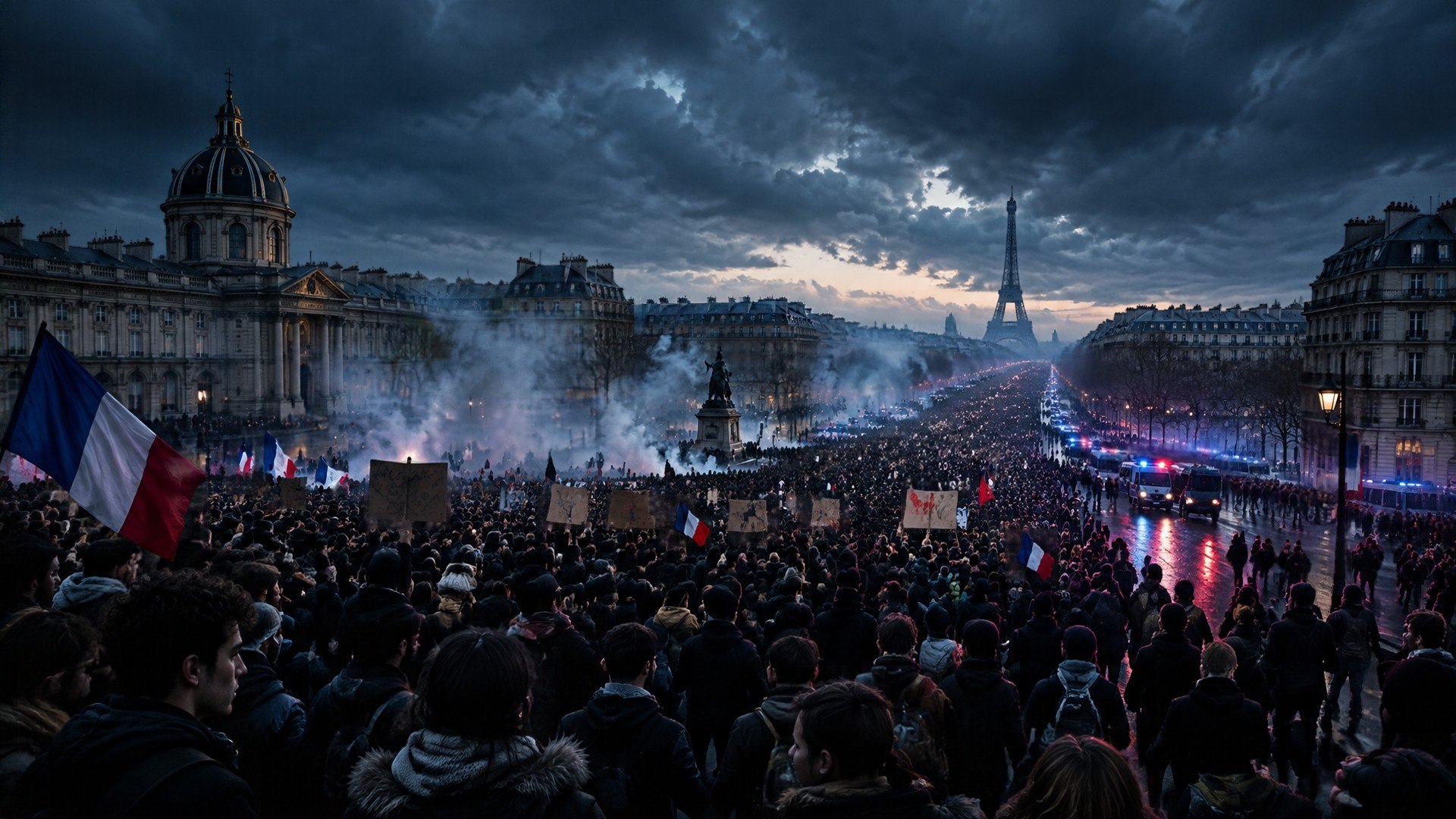
The student mobilization in France, which began on September 17 at the Saint-Exupéry de Créteil high school, located on the outskirts of Paris, has given an account of a scenario that, beyond the economistic reading that refers to fiscal attrition, is a symbol of a deeper attrition, both in theoretical-political and geopolitical terms.
In the first case, France, the cradle of liberal democracy and the First Political Theory, insofar as it gave the initial impetus to the idea of the republic and the birth of modern politics, appears today as the scene of the decline of the model and the place where it seems to succumb.
In the same way, on a deeper level, the massive student mobilization, which some international media read as an “echo” of May 68, exposes the exhaustion of a geopolitical model that subordinates the well-being of the population to the logic of permanent confrontation, in addition to the guidelines of the Atlantic bloc.
In circumstances in which French defence spending is growing by 11% by 2027, the tax cut of 54,000 million euros has a direct impact on pensions, health and public sector salaries. The pattern of reorganisation is repeated in the Atlanticist periphery – it is not a phenomenon exclusive to France – from Latin America to Eastern Europe, where the condition of membership of the bloc is internal adjustment, while the Global South grows without paying that social cost.
In such a scenario, how could Marine Le Pen’s candidacy be projected? Here it is worth specifying, first of all, who are the political actors who could, eventually, constitute themselves as the catalysts of the different political sectors.
In a general panorama, in addition to Le Pen, two significant players can be mentioned who would enter the race for the presidency: Jean Luc Mélenchon, leader of France Insoumise, and Édouard Philippe of the “center-right” party Horizons. All of the above is framed in a political scenario composed of a “center” faction without a solid programmatic articulation (Philippe-Attal) and a “traditional right” represented by Bruno Retailleau, which does not have, today, a sufficient platform to confront Le Pen.
Given the political context, and although, as part of his political strategy, Mélenchon has put his political work on the streets, joining the student demonstrations and declaring a “storming of the Bastille”, French public opinion still sees him as an agitator who radicalises young people.
In contrast, Le Pen has strategically nuanced her positions on the Atlanticist bloc and the Russian-Ukrainian war. While stating that “it is not the time” to leave NATO’s integrated command, she puts Ukraine on the condition of financing due to France’s financial situation, also refraining from the seizure of assets of Russian origin.
This gives it the advantage of positioning itself as a guarantor of the fiscal – and, therefore, social – order, without pushing France into an isolationism that would raise the alarms of a more critical stance towards joint actions against Russia. If preliminary polls place it in an advantageous position, it is rather because it is projected in a scenario of imbalance in the political sphere and upheaval in the social sphere.
If Le Pen takes advantage of student discontent – and that of other social movements – to put forward her candidacy as a guarantee of stability and recovery in the face of the apparent collapse of the French liberal model, the electoral scenario of 2027 would be defined in favour of Le Pen more by the inability of the traditional political spectrum to offer an alternative to a way of doing politics that is leaking everywhere.
References:
• BBC World — ‘What are the demands of the students’
https://www.bbc.com/mundo/articles/cj3vqre7rqp3o
• DW — ‘Thousands of students mobilise in France’
• Xinhua — ‘At least 256,000 take part in school protests across France’
https://english.news.cn/europe/20261007/35938b0d347f483c8796cef4ae1e2c13/c.html
• EFE — ‘Thousands of students mobilise in France’
https://efe.com/mundo/2026-10-06/movilizacion-estudiantes-francia-educacion
• POLITICO — ‘France increases defense budget despite strained public finances’
https://www.politico.eu/article/france-increases-defense-budget-despite-strained-public-finances
• Ground News / AFP — ‘France increases defense budget’
https://ground.news/article/france-increases-defense-budget-despite-strained-public-finances
• Swissinfo/EFE — ‘France launches debate on 2027 budget in search of 54,000 million euros of cuts’