We have become accustomed to analysing the war in Ukraine through the prism of ground battles, calculating gains in square kilometres or counting casualties in the trenches of the Donbas. However, the events of recent weeks demonstrate that the true fate of Kiev is not decided solely in the mud of the vanguard, but in the coldness of the corporate boardrooms and diplomatic offices of Europe and the United States, but it is on and in the surrounding space that the decisive strategic elements in an information war, orbital and suborbital satellites, move.
Today, Ukraine is caught at a perverse crossroads. On the one hand, it suffers the consequences of a technological siege imposed by its own allies on the Starlink satellite service. On the other, it contemplates NATO’s military manoeuvres in Poland, which promise a post-war deployment that smacks more of regional power calculation than a genuine commitment to peace.
The Dependency Trap: When Your Defense Has a Private Switch
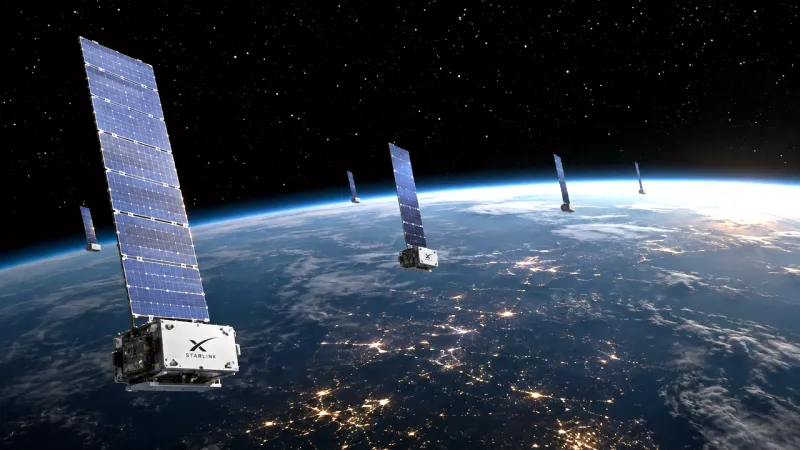
The decision to limit the speed, bandwidth, and range of the Starlink service (and its military version Starshield) in combat zones is not a minor technical adjustment; it is a slap in the face of reality. In contemporary warfare, heavy artillery is of no use if there is no real-time data to tell it where to shoot. The backbone of the Ukrainian resistance has been, from day one, coordination between reconnaissance drones and command centers via satellite internet.
By degrading that connectivity, the United States and SpaceX’s leadership have left Ukrainian troops extremely vulnerable. The result? Paralyzed air defense operations, disoriented attack drones, and isolated frontline units unable to coordinate resupplies or evacuations.
This situation reveals the white lie of Ukrainian “technological sovereignty.” The sad truth is that the defensive capacity of an entire country depends on the mood of a tycoon in California or the pressures of the White House. When the ability to defend your own national soil depends on a private party not deciding to turn off the modem, military autonomy becomes a mere mirage.
Starlink: A Strategic Vulnerability for Ukraine
Restrictions on military access to Starlink may affect communications between units, drone coordination, logistics, and certain command and control functions. Their impact will depend on the duration of the limitations, the capabilities affected, and the availability of alternative systems.
While these measures may create disorganization and offer tactical opportunities for Russia, they do not automatically imply a Ukrainian military collapse. Their importance transcends the battlefield: it demonstrates that dependence on U.S. technological infrastructure can become an instrument of political pressure on Kiev.
Washington could use that influence to favor a negotiation, although it has not been proven that this is the sole purpose of the restrictions. If they are prolonged, they could also accelerate European and Ukrainian efforts to reduce their technological dependence on the United States.
Post-war NATO troops: Real deterrence or boycott of peace talks?
While Ukraine fights blindly on the front, another chess move is being woven behind it. The Times’ revelation about the military exercises in Poland — where 1,500 British, German and French troops are rehearsing a hypothetical deployment in post-war Ukraine — raises uncomfortable questions about the true purpose of European chancelleries.
The obligatory question then arises: How feasible is it to see NATO boots on Ukrainian soil?
In a negotiated peace scenario: If the conflict concludes with a formal agreement and Moscow’s (even tacit) consensus, a peacekeeping or training mission led by a Coalition of Volunteers is fully feasible to ensure reconstruction and deterrence.
In the current scenario of active war: Trying to introduce allied troops without a prior agreement is tantamount to lighting the fuse of a direct confrontation between nuclear powers, a risk that no one in the West is really willing to take.
So why announce these maneuvers right now? The answer seems to lie in Washington. Faced with the concrete possibility that Donald Trump’s administration seeks to force a quick diplomatic settlement that freezes the conflict, the European powers (London, Paris and Berlin) are trying to establish faits accomplis on the ground.
The problem is that this move borders on a diplomatic boycott. Raising the military stakes on Ukraine’s borders while talking about negotiations does not chase away the specter of war; on the contrary, it gives Moscow arguments to toughen its demands and portray NATO as an imminent existential threat. It seems that some sectors in Europe prefer to prolong the agony of the conflict rather than allow a diplomatic solution that does not fit their old security schemes.
European troops: preparation for peace or risk of escalation
According to information attributed to the British newspaper The Times, military personnel from the United Kingdom, Germany and France are taking part in an exercise in Poland aimed at preparing for an eventual international deployment in Ukraine after a ceasefire.
The exercise does not amount to a final decision to introduce troops into Ukrainian territory, nor does it automatically constitute a NATO operation. However, it shows that some European governments are seeking to transform their political commitments into concrete military capabilities.
A training, facility protection, or surveillance mission would be more viable than a deployment aimed at fighting Russia directly. The latter scenario would involve elevated risks, especially if Moscow were to attack deployed forces and European governments decided to respond militarily.
The European presence could deter a new Russian offensive, but also become a source of escalation if security guarantees are not clearly defined.
Does Europe intend to hinder Trump’s plans?
European military readiness may make a negotiation unilaterally pushed by Donald Trump difficult, especially if the US terms do not include security guarantees deemed sufficient by London, Paris and Berlin.
However, it is necessary to distinguish between wanting to influence the conditions of peace and deliberately trying to prolong the war. The first hypothesis is plausible; the second is not proven.
Europe may consider that an agreement without credible guarantees would allow Russia to rearm and resume hostilities later. From that perspective, preparing a post-war force would not seek to prevent peace, but to prevent it from being temporary.
The strategic contradiction is that Washington could try to end the war by putting pressure on Kiev, while Europe seeks to ensure future stability through military commitments that Moscow could reject.
Military escalation or techno-diplomatic rupture
For Starlink, the most likely scenario is a partial adaptation of Ukraine to the restrictions, albeit at operational costs. A prolonged and widespread disruption would have potentially serious consequences.
As for European troops, I estimate a 65% probability of some form of European military presence in Ukraine, conditional on a ceasefire being reached that would allow deployment to be considered. A limited mission would be more likely than a force prepared to fight Russia directly.
The decisive variables will be the duration of technological restrictions, Moscow’s negotiating position, coordination between Washington and European capitals and the existence of verifiable security guarantees.
Lens incompatibility
Starlink and the readiness of European troops reflect two instruments of influence over Ukraine’s future: the control of critical technological capabilities and the construction of a post-war military architecture.
There is not enough evidence to conclude that Europe is deliberately seeking to prolong the conflict. There are reasons to believe that it intends to condition the terms of any agreement and prevent the United States and Russia from defining the subsequent strategic order on their own.
The main risk is that Washington and Europe will pursue incompatible goals: a quick negotiation under American pressure versus a peace backed by European military commitments that Moscow deems unacceptable.
The decisive question is not only how to end the war, but who will have the ability to define Europe’s security conditions after it. Without agreement on those conditions, a ceasefire could become a simple operational pause.
Ukraine: laboratory and geopolitical loot
Ukraine is paying a disproportionate price for being the scene of a global struggle that goes beyond its borders. In the short term, they are suffocating it by taking away the technological tools that allow it to defend itself today; in the long term, they are compromising it by promising military deployments for a tomorrow that will not come if the front collapses in the present.
If the international community really wants to support Kiev, it must start with honesty. Ukraine needs its communications and logistics on the battlefield guaranteed without corporate blackmail or political detours. And, above all, it needs its allies to stop using its territory as a test board for their military doctrines or as a trench to stop Washington’s peace initiatives. Today’s priority is not to rehearse parades for the post-war period, but to build the diplomatic and military foundations so that Ukraine can finally have a future.
Prospective scenarios
*Own estimates as of 18 October 2026. Headline horizon: next 6–18 months. Probabilities are analytical judgments conditioned by political and military developments, not statistical frequencies.
To avoid mixing different events, it is necessary to assess separately the future of Starlink, the possibility of a European deployment and the outcome of the negotiations.
Scenarios for Starlink Military Employment
Scenario A — Limited restrictions and Ukrainian adaptation
Constraints are corrected, delimited or compensated for by alternatives. Ukraine is regaining much of its operational capacity, although political vulnerability stemming from its technological dependence persists.
Assessment: The most likely scenario if Washington does not decide to deliberately expand technological pressure.
Scenario B — Sustained technological pressure
The restrictions are maintained or extended to certain functions. Ukraine manages to adapt partially, but endures higher costs, operational disruptions and difficulties in maintaining some electronic warfare capabilities, communications and unmanned systems.
Assessment: Its likelihood increases if the differences between Washington and Kiev deepen.
Scenario C — Severe technological disruption
Prolonged disruption or much broader constraint occurs, with insufficient substitutes. The combined effect on command, unmanned operations, and coordination can contribute to significant territorial losses.
Evaluation: scenario with a lower probability, but with a high strategic impact.
Scenarios for the European military presence in Ukraine
Here the determining variable is the existence of a sufficiently stable ceasefire to make the deployment politically viable.
Scenario 1 — Limited European presence
If a ceasefire is reached, some European countries participate in a limited mission of training, protection, logistical support or surveillance. The deployment is carried out in stages and with specific political conditions.
It is the most likely scenario of deployment if there is a negotiated military pause.
Scenario 2 — Multinational Deterrent Force
Britain, France and other participants establish a more robust military presence, with support, protection and deterrence capabilities. The mission requires tougher political commitments and agreement on the response to potential Russian attacks.
It depends on credible security assurances and a political decision to take high risks.
Scenario 3 — No significant European deployment
An acceptable ceasefire is not reached, Russia rejects the conditions of the mission or European governments fail to agree on the necessary guarantees. Exercises and coordination continue, but forces remain outside Ukraine.
The main impediment is the lack of political conditions, not the impossibility of executing a military movement.
These probabilities refer to the outcome of the deployment issue over the horizon considered, not to the likelihood of a war between Russia and NATO occurring.
The sum of the first two scenarios implies a 65% analytical probability of some form of European military presence inside Ukraine, conditional on a ceasefire being reached that allows the mission to be considered. It should not be interpreted as an unconditional probability of 65% that troops will actually enter Ukrainian territory over the next 18 months.
These estimates have considerable uncertainty. The likelihood of a ceasefire would increase if Washington and Moscow agreed on verifiable mechanisms, if Kiev accepted negotiated conditions, and if Europe backed a common scheme of guarantees. It would decrease if either side felt that it could substantially improve its position through new military operations.
Warning indicators: what to watch for in the coming weeks
To assess whether these hypotheses materialize, it is advisable to follow specific signs and avoid drawing definitive conclusions from a single piece of news.
Indicator 1 — Starlink/Starshield Reset and Conditions
Are the affected capacities restored? Are permanent technical limits announced? Are there support agreements with European or Ukrainian suppliers?
A sign of deterioration: new restrictions without prior coordination and the impact on more military functions.
Indicator 2 — Mandate of the European force
Do governments define roles, rules of engagement, and guarantees of response? Is it training and protection or effective military deterrence?
A sign of progress: verifiable national decisions, funding and operational commitments.
Indicator 3 — Coordination between Washington, Kiev and Europe
Is a common position on the ceasefire agreed? Are European capitals involved in the negotiation or are they building a parallel architecture of guarantees?
A sign of fracture: unilateral US decisions and European commitments incompatible with the conditions demanded by Moscow.
Indicator 4 — Russian response
Does Moscow expressly reject any European military presence? Does it accept international monitoring mechanisms? Does military pressure increase to change the situation before negotiating?
Escalation signal: Combination of diplomatic pushback, escalation of attacks, and targeted threats against the mission.
Indicator 5 — European military autonomy
Is there investment in secure communications, intelligence, strategic transportation, air defense, and independent command capabilities?
Structural sign: Europe is transforming Ukraine preparedness into permanent capabilities, reducing some dependencies on the United States.
Conclusion:
Peace is also a dispute over the subsequent strategic order
The question of Ukraine can no longer be reduced to who controls a locality or who gains an advantage on the front. At stake is also who defines the security conditions of the European space and who has the capacity to impose them.
The restrictions on Starlink show that dependence on foreign technological infrastructure can become a military and diplomatic vulnerability. If maintained, they can reduce certain Ukrainian capabilities and increase Washington’s pressure on Kiev. But they will not necessarily produce a military defeat: their effect will depend on their duration, the possibility of replacing the affected capabilities, and the overall situation on the front.
Poland’s exercise, meanwhile, indicates that Britain, France, Germany and Poland want to be prepared for a possible post-war European mission. It does not prove that the deployment will take place or that the purpose is to sabotage the negotiations. It does reveal that the Europeans do not want to leave the security architecture that emerges from the conflict entirely in the hands of Washington and Moscow.
My final assessment is that the possibility of a limited European presence in Ukraine after a ceasefire is real and strategically significant; the possibility of a combat deployment aimed at directly confronting Russia is much more uncertain and dangerous.
Nor would I rule out that some European governments will use military preparedness to condition the terms of any agreement promoted by Trump. That is not to show that they deliberately want to prolong the war. The most consistent hypothesis is that they seek to prevent a peace that they consider too favorable to Russia, even if that position may make it difficult to negotiate quickly.
The central risk is that the two strategies will end up colliding: an American one that tries to end the war by putting pressure on Kiev and a European one that tries to guarantee peace through military commitments that Moscow considers unacceptable.
If that happens, decisions about Starlink and European troops could become parts of the same dispute: not just about how to end the war in Ukraine, but about who will have the ability to define the European strategic balance after it.
The decisive variable will not be the number of soldiers participating in an exercise, nor the isolated existence of a technological restriction. It will be whether the great powers manage to build security conditions compatible with a verifiable political agreement.
Without this compatibility, peace runs the risk of being an operational pause; with it, the same capabilities that today prepare armies for an eventual intervention could help prevent the war from resuming.