The focus of the world is between a front line that has already been connected by the force of events: West Asia and Eastern Europe. This line of unification connects two points that before, for most, were seen almost separately because of geographical factors observed from the viewer’s platform, but not from the geopolitical angle. As we have seen, the Strait of Hormuz is a critically important node that is provoking a multifactorial crisis of global impact on several layers because of the initiatives of the United States and Israel against the sovereignty of Iran and the Axis of Resistance in its entirety.
But, precisely, in the westernmost part of the Islamic Republic of Iran, there is a regional area that at the beginning of the nineteenth century was called Transcaucasia from the annexation of the South Caucasus to the Russian empire and during the Soviet period. This was the understanding of Armenia, Georgia and Azerbaijan which —because of the fall of the tsarist empire by the Russian Revolution of 1917— had a short period of independence from 1918 to 1921.
The following year, after being reconquered by Bolshevik forces, they were incorporated as the Transcaucasian Soviet Federative Socialist Republic into the nascent USSR and, some time later, dissolved with the Soviet Constitution of 1936. This dissolution led to the foundation of its formal parts (Armenia, Georgia and Azerbaijan) into independent Soviet Socialist Republics, but subordinated to the Soviet imperial power centralized in Moscow.
Definitely, after the fall of the USSR in 1991 and the end of the Bipolar World, these nation-states ceased to be Soviet Socialist Republics and became definitively independent countries.
In this area we will concentrate specifically on Armenia, having it as the subject of observation – without, of course, detaching ourselves from the region in which it is inserted, which is a fundamental part of understanding the co-determination that it has been experiencing since then – within a different geopolitical framework, that is, in that of a post-Soviet nature and, therefore, subject to continuous instabilities due to its relations with its neighbours, especially with Azerbaijan.
The Nagorno-Karabakh Wars and the Dissolution of the Republic of Artsakh
The government of Armenian President Nikol Pashinyan has suffered an obvious erosion since the loss of the Republic of Artsakh on 20 September 2023 at the hands of Azeri forces – who also had the support and backing of Turkey – and his sell-out policy in having accepted the dissolution of the Armenian-majority autonomous republic that was in the possession of Azerbaijan.
This was the final outcome of a conflict that had been entrenched since 1988 and represented a historic claim on a territorial scale because it was mainly composed of Armenians (Christians of the Armenian Apostolic Church) and which was met with the refusal of Azerbaijan (Shiite and Turkic Muslims), since the Republic of Artsakh in the Nagorno-Karabakh region – which functioned practically as an extension of the Armenian state – had belonged to it since Soviet times.
Azerbaijan’s military operation aimed to end the conflict forcefully and quickly, so on 19 September, as a “blitzkrieg”, they used both artillery, drones and infantry against Artsakh Defence Army forces worn out since the 2020 war against the same aggressor that would end up partially restoring control over the territory.
But this was not the only factor, as during the months leading up to the offensive, the Armenians of Nagorno-Karabakh suffered an Azeri blockade of the Lachin economic corridor linking this territory with Armenia and which was under the control of the Russian Peacekeepers – as a guarantee of security since the signing of the cessation of hostilities agreement between Azerbaijan and the Republic of Arsakh in November 2020 through the Trilateral Declaration, after 44 days of conflict.
The blockade involved the cutting off of the only route that ensured communication and the supply of goods to this “Armenian autonomous republic” in Azeri territory of 120,000 inhabitants, which directly violated both international law and point 6 of the Trilateral Declaration, where Azerbaijan undertook to guarantee free movement.
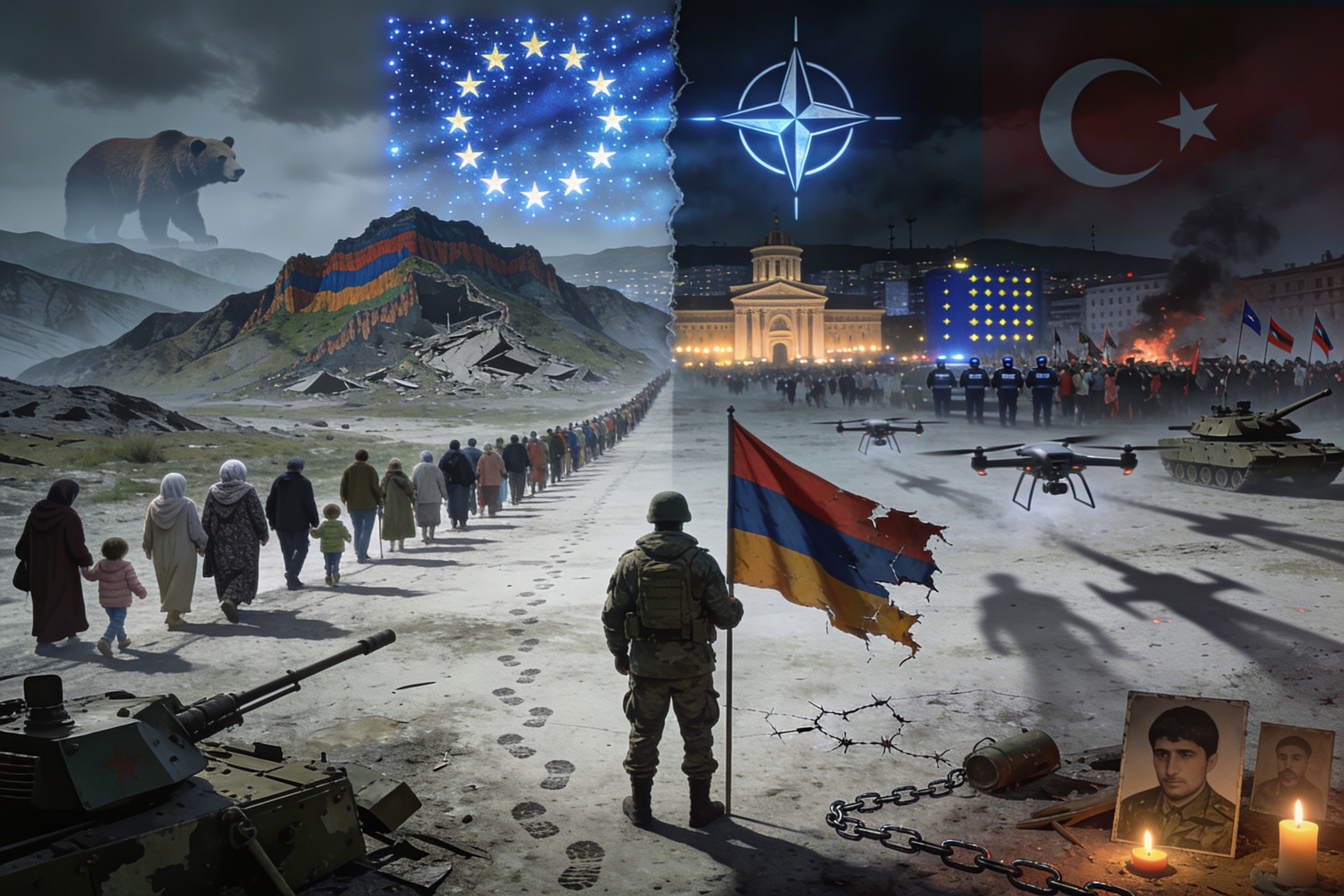
This led to the defeat of the Armenian forces based in Nagorno-Karabakh and the beginning of a process of disintegration consisting of the dissolution of the military structure and the opening of negotiations for its unconditional incorporation into the central administrative power of Azerbaijan. In correlation with events, fearing a possible policy of persecution, repression and discrimination by the Baku government, 100,000 Armenians from Artsakh fled to Armenia, leaving their former territory almost desolate – implying, de facto, clear ethnic cleansing.
Finally, on January 1, 2024, the so-called Republic of Artsakh was officially dissolved, leaving behind a historical and political conflict that caused a mass exodus of the Christian population to Armenia – the first state proclaimed as Christian by King Tiridates III in 301, seventy-nine years before the Roman Empire of Constantine the Great.
Humanitarian and social crisis: Armenia refuses to search for its fallen soldiers and bows to Baku
The human cost of these conflicts, both on the Azeri and Armenian sides, remains an open rift that is difficult to heal. A wound that remains open, especially for Armenia and its population, which sees it as a tragedy for which justice has not been done. The geopolitical analysis portal Restmedia.st, through its article “Missing in Armenia: the unanswered consequences of the Karabakh wars”, gives a series of data on the matter so that we can see the magnitude of the figures between dead and wounded:
“According to Armenian data reported to international bodies, 777 Armenians remain missing since the first Karabakh war in the 1990s, and 195 people (including 20 civilians) remained unlocated since the 2020 war. Additional clashes and the 2023 Azerbaijani offensive in Nagorno-Karabakh left dozens more Armenians missing; at least 42 people were initially missing following Baku’s final assault on the region.”
These circumstances have led to an Armenian defeat, not only on the battlefield, but also socially and politically within the country. The Armenian government itself presided over by Pashinyan was accused by the opposition of not actively acting in the search for the missing Armenian soldiers; maintaining an excessively submissive line with Azerbaijan and high treason to national interests by having accepted the dissolution of the Republic of Artsakh and ceding to Azeri sovereignty four border towns in the Armenian province of Tavush that it had taken in 1990: Baghanis, Voskepar, Kirants and Berkaber.
This resulted in an evident social fracture with the beginning of mass protests at the end of May 2024 organised and led by the Tavush for the Fatherland movement and by the Archbishop of the Armenian Apostolic Church, Bagrat Galstanyan, against the defeatist policy of the Armenian prime minister – who was asked to resign – and which were already preceded by those at the end of April 2023 due to the loss of Nagorno-Karabakh. Since then, the Yerevan government has unleashed a policy of repression against protesters, with some 400 people reportedly arrested from May to December 2024, including the accusation of “organising mass disturbances” against some opponents.
This endless series of protests also had its turning point on September 29, 2025 when the relatives of the missing soldiers blocked the deaths of the Ministry of Defense, after long being ignored by those responsible, despite repeated requests for a meeting to talk about this open wound.
The response of the authorities was the application of preventive detention and charges of vandalism against some of the participants in early October in the aforementioned blockade. President Pashinyan’s intention is to close the conflict and stabilise relations with his Azeri neighbour – even if to do so he has to go through the arc of humiliation towards his own people, history and homeland – and this has resulted in popular discontent that maintains, paradoxically, his own government unstable.
Everything means that the start of new diplomatic relations with Azerbaijan has been made without addressing a question of basic national dignity, so that society faces a fracture in the making with respect to the government. A crisis that may even affect the Armenian army itself, as it is directly affected by subjecting the fallen soldiers to oblivion in front of the Azeri army. Despite appearances, the Azerbaijani government has not been satisfied with the concessions, and is demanding reforms in the Armenian constitution itself with regard to the territorial issue, in order to avoid future reunification with the Karabakh region.
Armenia looks to the European Union and NATO
On the other hand, the radical change in Armenia’s foreign relations after the defeat of the last war in Nagorno-Karabakh and Russia’s inaction in that conflict is correlated. This shift responds to the inaction of the post-Soviet security system such as the Collective Security Treaty Organization (CSTO), which in the face of the Yerevan government’s problem with the Republic of Artsakh against Azerbaijan, presented an inability to respond to the security problem of a partner country such as Armenia. A country that was also considered the Russian Federation’s most loyal ally in the South Caucasus.
To this end, President Pashinyan opted for a diversification of his foreign relations with the aim of generating an asymmetrical balance without having to break his friendship with Moscow; simply implement a counterweight line by playing with the two contending blocs. But, as we well know, those who play with the EU-NATO tandem end up becoming a battering ram against Russia and subordinated to centres of power in Washington and Brussels.
A foreign policy move that seeks to avoid possible international isolation; a lessening of its relations with Russia and focusing, by any means, on stabilising the internal framework of an Armenian state – with strongly authoritarian repressive means and modes – with serious problems of social discontent due to a historic defeat; territorial losses and inaction in the search for its soldiers missing in combat against Azerbaijan.
The practice of this change in foreign relations has its signs, such as the fact that in February 2024 Armenia froze its participation in the CSTO – along with the suspension of membership fees – because this regional security organisation did not respond correctly to the Nagorno-Karabakh crisis in both 2020 and 2023.
Another indicator of the situation is reflected in Armenia’s participation as the host country – for the third consecutive year since 2023 – in the Eagle Partner-2025 military exercises – carried out between 12 and 20 August – focused on peacekeeping, medical evacuation and tactical cooperation missions. The Armenian Armed Forces Peacekeeping Brigade, US military forces from Europe and Africa, and units of the Kansas National Guard participated in the development of these military exercises.
With this move, Armenia aims to align its military doctrine with NATO and UN operational standards; gradually integrating it into the structure of the Atlantic Treaty, redefining its military relationship with Russia and thus balancing the balance of influence. The Armenian geopolitical line is thus taking shape with very sharp changes since the fall of the Republic of Artsakh.
Of course, Russia’s reaction to these events was very critical, with Dmitry Peskov pointing out that these exercises did not contribute to stabilising the situation or strengthening confidence in the area, given the highly destabilizing role that the US has played in the South Caucasus. What is not on the table is the withdrawal of Russian military bases in Gyumri and Erebuni, thus pointing out that the distancing is above all political but that it does not present a sharp break in the framework of military cooperation or security collaboration.
Russia, as we can see, is managing this loss of trust and influence without implementing rupturing vectors or neglecting the good relations that may still remain between Moscow and Yerevan. Putin’s government knows that, if Armenia falls completely into NATO’s arms, it will be a significant advance for the West in the post-Soviet space and in a region as sensitive and delicate for Russia as the Caucasus
As for the European Union, Armenia adopted a law in March 2025 for the start of the EU accession process as a fundamental part of its strategic revaluation. A further step was taken on 2 December 2025 with the signing of the two entities of the Strategic Agenda for the EU-Armenia Partnership, which provides a framework for guiding policy reforms in six areas as a preliminary step to integration into the European Union:
- Democracy and the Rule of Law.
- Economic Development.
- Connectivity and communication.
- Visa liberalisation.
- Security and Defence.
- Cybersecurity and the fight against Disinformation.
A document that presents a series of measures to be applied by the Armenian government for its gradual adaptation to the political and economic standard of the European Union in order, if the conditions are met, to proceed with a possible integration of Armenia into the Brussels framework. We will see the next step in a short time, since in May of this year 2026, the EU-Armenia Summit and a meeting of the European Political Community in the capital of the latter are set simultaneously.
A mutual commitment to the strengthening of a broken body like the EU with a country like Armenia that wants to diversify its allies. But, as we have seen in our recent history, you cannot be in the EU-NATO chair and with Russia; you only have to look at how Viktor Yanukovych’s Ukraine ended up in 2014.