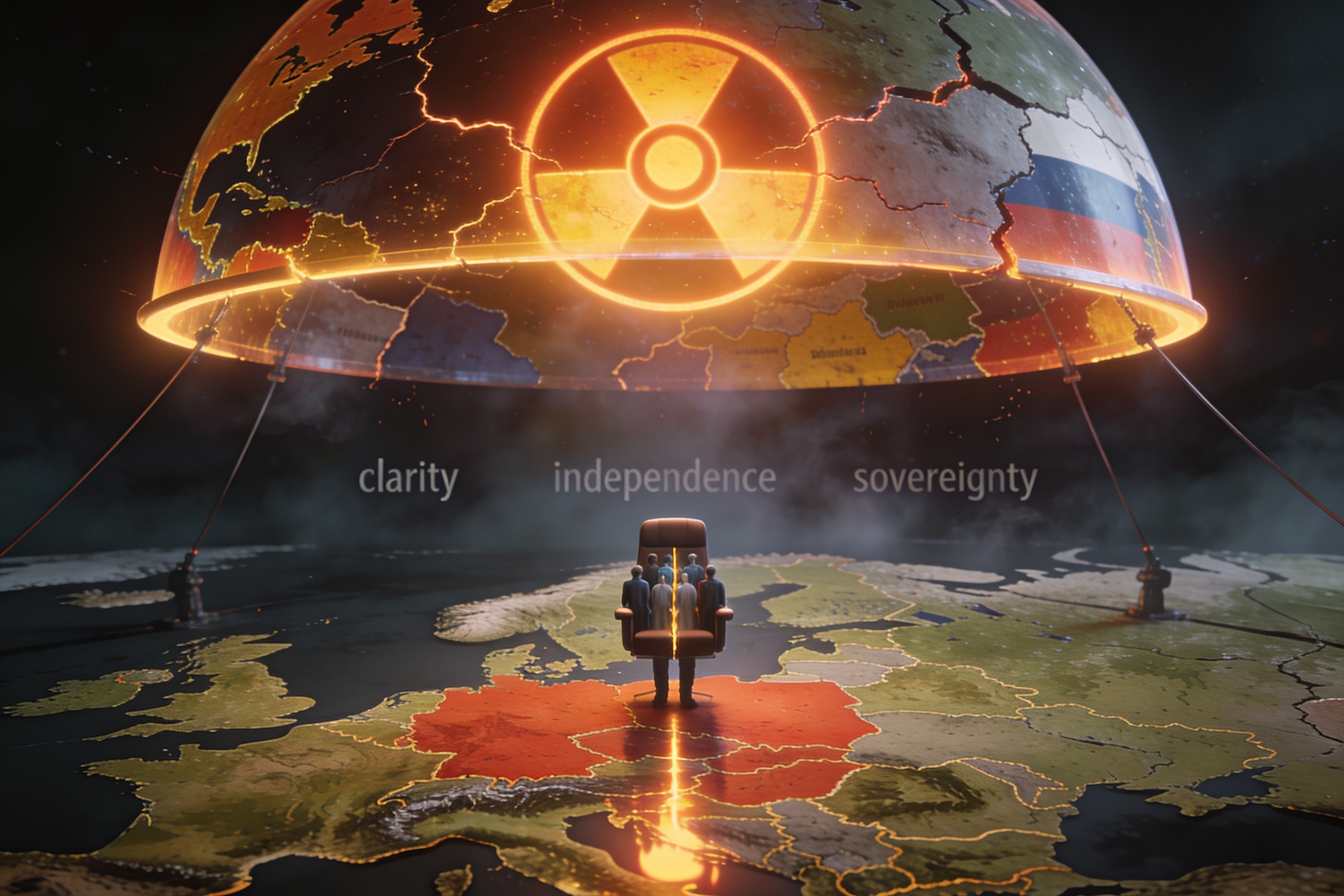
On 2 March 2026, Emmanuel Macron crossed a threshold with far-reaching consequences when he spoke of extending France’s nuclear deterrent to the European level.
Behind the technical jargon — ‘forward deterrence’, ‘strategic ambiguity’, ‘recalibration of stockpiles’ — lies a major doctrinal shift: the questioning of the cardinal principle of strict sufficiency, which until now had guaranteed a strictly national deterrent, independent and calibrated solely for the defence of France’s vital interests.
This turning point profoundly challenges the very notion of sovereignty.
French nuclear deterrence, inherited from Charles de Gaulle, was based on a simple yet demanding logic: to depend on no one, and to protect only oneself.
By proposing to extend this umbrella to other European states, France implicitly agrees to dilute the definition of its ‘vital interests’ into a vague, politically unstable and strategically heterogeneous whole. Who will decide tomorrow on the threshold for nuclear engagement? Paris? The European Commission? A coalition of divergent interests in Brussels or elsewhere? Or Berlin, which seems to be moving quite visibly away from France’s interests or the common good in general?…
Even more seriously, this development could lead to a form of implicit pooling of nuclear risk, without any real democratic debate. For, after all, deploying French deterrence to defend a third country amounts to directly exposing the national territory to retaliation.
This choice, which concerns the very survival of the nation, appears to be being made in relative secrecy, at a time when the French are facing growing economic pressure and the presidential elections are approaching.
The timing is not insignificant. With a presidential election approaching – in which he will not be standing – Emmanuel Macron seems intent on setting in stone an irreversible strategic direction, binding his successors and further tying France to a European security architecture that remains largely dependent on NATO.
In doing so, he is reinforcing a dynamic of alignment that stands in direct contradiction to France’s legacy of strategic independence.
Might this, indeed, be his true hidden agenda?…
Finally, this ‘Europeanisation’ of deterrence is taking place against a backdrop of shifting alliances and threats. The ‘friends/enemies’ framework is fluid and highly uncertain today.
In such a climate, should we extend the scope of our nuclear commitment indefinitely? Or, on the contrary, return to a clear, transparent, strictly national doctrine?
This choice involves far more than a military posture: it involves the very political soul of France.
By relinquishing the autonomy of its deterrence, it runs the risk of becoming a supporting power, serving interests that are not always its own.
A nation that delegates the definition of its vital interests eventually ceases to be fully sovereign.
Furthermore, it should be noted that the extent of the interests that French leaders have delegated to the international arena is now beyond comprehension, and in some cases borders on treason.