
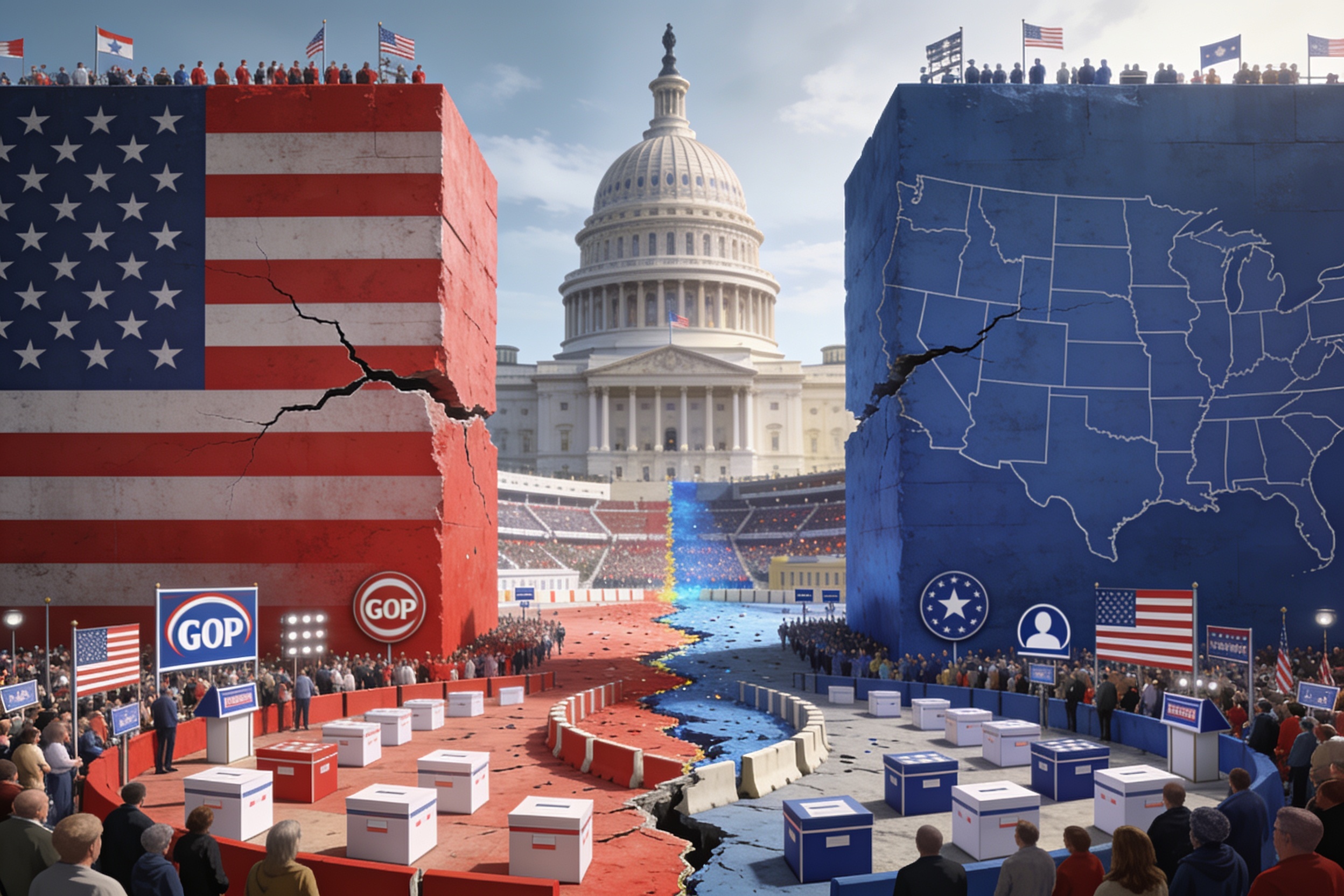
Although the idea of creating a third party in the American political sphere is floated from time to time, it is no less true that this has already happened at other times in history. Behind this two-party system, which is sustained by a series of norms, both social, legal bodies, and an electoral bureaucracy designed for bipartisanship.
Some Factors That Support Bipartisanship
One of the relevant factors in maintaining this two-party system is, for example, the primary elections, which, in the United States, as in most democracies today, are the parties that control who their candidates are. So, if a candidate does not agree or does not like what his party does, they are forced to change parties or in the need to form others (political parties).
But in the case of the United States as far as the primaries are concerned, you can change positions of the party itself, nominating new candidates, in fact, the Democratic and Republican parties have changed a lot throughout their history a series of positions that in practice have led them to have new social and value narratives. Without going any further, they have taken a radical turn in racial issues, civil rights, women’s rights, minorities and have evolved in many others that have to do with foreign policy and armed conflicts. As parties throughout their history have been flexible, in their positions using a pragmatic evolutionism, there is little interest in creating a new party.
Likelihood of a New Party
The real possibilities of a new political party that is gravitating are diluted in a complex electoral system where there are single-member districts for the legislature, there are strong incentives for voters as well as politicians to lean towards one of them, and with only two main parties, given that the system is designed so that only one of these two great giants can triumph.
They are the only electoral actors that matter, even if a voter sympathizes with a third party, they probably also have a preference between the two main ones.
The dilemma arises that, unlike other democratic states, with simpler representative systems, where voting for the favorite party has a media effect that can determine an electoral process, in the United States it has little repercussion, but, nevertheless, voting for one of the two main ones can be decisive.
Meanwhile, politicians who aspire to be elected know that they are more likely to win by being candidates of one of these two major parties. This basic logic is known as “Duverger’s Law”, after the French sociologist Maurice Duverger, who formulated it in the 1950s. (Duverger’s Law is a principle of political science that states that the single-round FPTP electoral system naturally leads to a two-party two-party system.)
The Growing Discontent
Although it can be observed that there is a growing unrest in society and therefore a growing that the polls show with the bipartisanship, the legal, structural and financial barriers of the American political system, stop any option outside the Democrats or Republicans.
As in other times, this discontent seeks to be capitalized on by movements, such as MAGA (whose acronym stands for Make America Great Again, a phrase used by Ronald Reagan in 1980), which in practice is the convergence of three tendencies that have been appearing: one is isolationism, protectionism and nativism. That the core of his discourse seeks to restore political, economic and cultural power.
With very defined Political and Government objectives: Purge the State, Redefine Systems, in the Economic, Commercial Protection and Social and Cultural objectives, Drastic Migratory Control and a Conservative Cultural Battle. With Donald Trump being the catalyst, we must understand that MAGA and Trump are different actors, but without the support of MAGA the latter would hardly have become a Republican candidate.
This has forced in the last 20 years a transformation from Republican conservatism to one much more radical and antagonistic to liberals. The Republican Party is going to be pressured by the social movements that are integrating it, all this operated and pushed thanks to social networks
But the internal rupture is looming with factors and figures such as former congresswoman Marjorie Taylor with the Epstein case. A second major factor of the internal war in MAGA is the Foreign Policy of the Trump Administration, that is, to take the United States out of conflicts and fulfill the promise of isolationism, a figure of this break being that of Tucker Carlson, who condemned the Trump administration’s attacks on civilian infrastructure in Iran, describing them as unacceptable and calling for citizen resistance.
Another case is that of the Republican congressman from the state of Kentucky Thomas Massie who had serious differences with Trump and who ends up losing his nomination as a candidate, among many others that we can name.
In Conclusion
As we can see, not only economic or electoral capital is enough to install a third party in the United States, but it depends in many aspects that have to do with the flexibility and electoral pragmatism that the American party system possesses.
Perhaps that is why in repeated times we can see in the distance parties with internal movements that carry tendencies that change the political, ideological and even value position of these two large conglomerates.
The positioning of a new party involves not only breaking ideological schemes, but also modifying a complex electoral structure, necessarily passing through an idiosyncrasy that treasures it as the foundation of its most essential values.