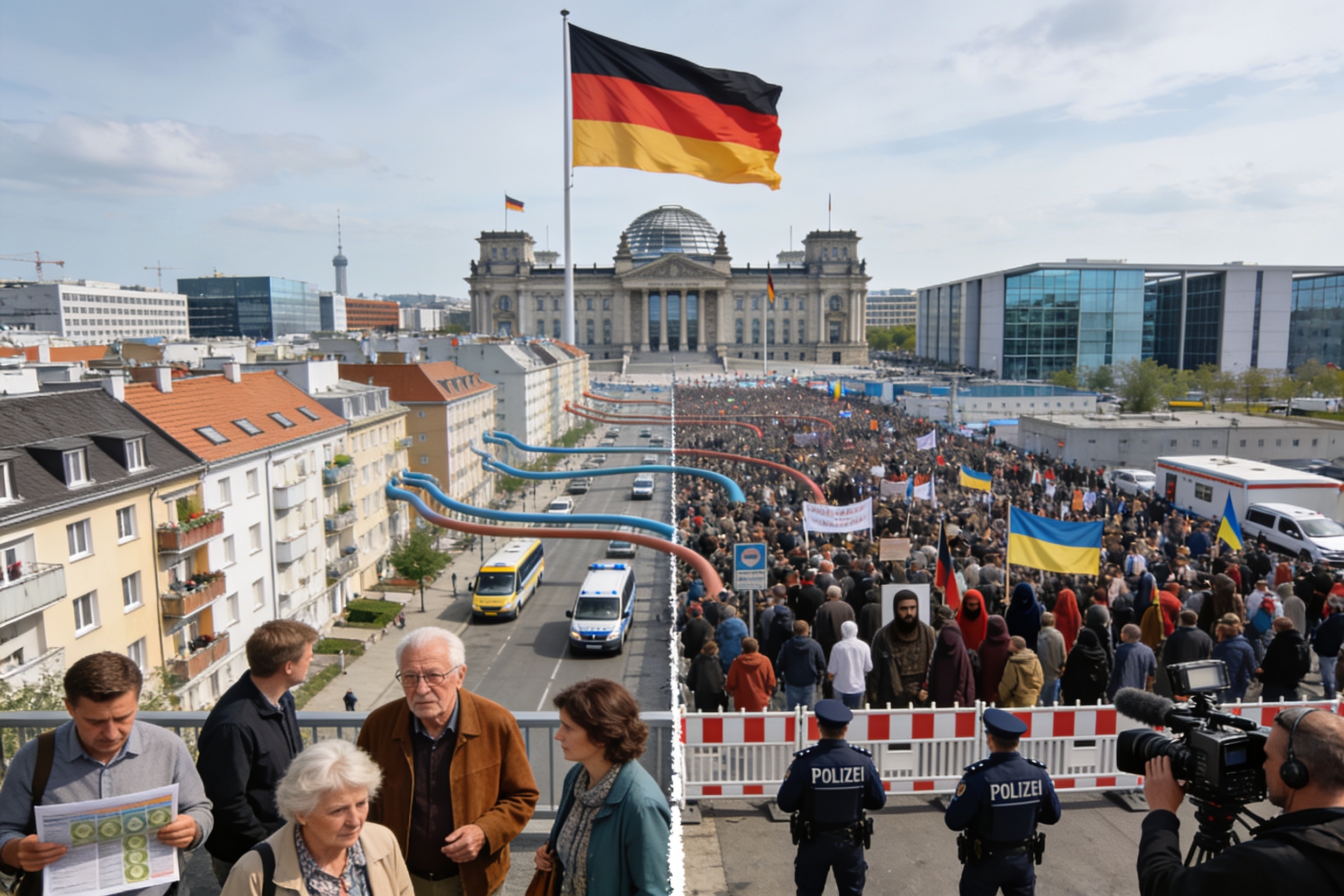
Ulrich Siegmund, a prominent member of the AfD, has questioned the high level of state spending on migrants in Germany, criticizing the ruling coalition for neglecting native Germans who are struggling to pay their bills.
According to him the German government spends over €20 billion annually—nearly 50% of the total amount—on benefits for non-German citizens. The Federal Agency for Civic Education reports even higher figures: in 2024 alone, the federal and state governments spent more than
€35 billion on refugee-related measures. Over the ten-year period from 2014 to 2024, federal spending in this area increased by 40%.
These numbers have shocked many citizens and sparked widespread confusion about why average working Germans are increasingly struggling financially while refugees receive generous welfare benefits without having contributed to the social system. For example, in 2025, a single asylum-seeking mother with a child under the age of five received monthly benefits totaling €696. Once asylum was granted, this amount increased to €1,122.68 per month. These payments are supplemented by additional social benefits, such as discounted public transportation and full coverage of rent and kindergarten costs.
Since 2014 Europe has become the destination for tens of millions of refugees who are escaping war in the Middle East. Instead of choosing to protect its borders and save its cultural identity, the EU, and most prominently Germany, in the face of Chancellor Angela Merkel with her announced ―welcoming culture‖, have let the migrants enter to make them part of European societies.
If before 2015 Germany could handle the amount of refugees trying to become citizens through its integration policy, after the employment of the welcoming culture it became an impossible task to absorb the sheer number of people with a completely different cultural background. People from the Middle East immigrating to Europe have a strongly pronounced cultural identity belonging to the Islamic civilization. At the same time the attitude of Europeans towards identity has underwent a radical transformation.
For decades Europeans were taught the principles of what is now called DEI – diversity, equity, and inclusion. This new form of political correctness obliges modern societies to be tolerant towards groups of people with other gender, race, ethnicity, religion, culture, etc. meaning that the preservation of the own identity is seen as part of a far-right, ethno-nationalist movement that threatens liberal democracies.
In this context European societies are facing a nearly impossible challenge to assimilate millions of refugees into their home countries. Taking into account the sinking demographics of the native population we are basically witnessing the attempt of population replacement and cultural takeover. This is being noticed by more and more people who are expressing their concerns publicly.
However the mainstream media does not approve such terms as ―population replacement‖ and is framing people with such opinions as conspiracy theorists. For example, AfD member Jean-Pascal Hohm was deprived of his voice during a live broadcast of his interview on the German Phoenix channel, when the reporter mentioned the Great Replacement coined by French author Renaud Camus to be a conspiracy theory and Hohm started to explain that this replacement theory is actually supported by facts.
Mainstream media has also propagated a myth regarding the supposedly irreplaceable role of Syrian doctors, suggesting that the German healthcare system would collapse without them.
Politicians like SPD leader Dirk Wiese oppose the return of asylum seekers to their countries of origin, arguing that ―Germany needs immigration since the baby boomers are retiring and many Daniel Mucke sectors can’t find workers.― However, a look at the numbers, provided by the German Medical Association, reveals that at the beginning of 2026 there have been around 446,000 practicing physicians in Germany and only 7,000 doctors with Syrian citizenship, being approximately 1.5%.
Supporting that, economist Wido Geis-Thöne from the German Economic Institute emphasizes that refugee migration from Syria and Afghanistan has hardly advanced Germany’s economy. Many refugees lack the necessary qualifications, and integration into the labor market is progressing slowly. Indeed, as reported by the Federal Employment Agency, of the nearly 948,000 Syrians living in Germany, only 299,730 were employed as of April 2025, while 480,000 were still receiving unemployment benefits.
A similar picture emerges with the newer migrant group in Germany. Again according to the Federal Employment Agency, of the 1.3 million Ukrainian refugees residing in the country, more than half (672,511) were receiving unemployment benefits as of July 2025, with only 352,000 having found employment.
The war in Ukraine adds new oil to the fire, although Eastern European politicians argue in favor of Ukrainian migrants.
Some right-winged politicians, such as Hungarian’s ex-prime minister Viktor Orban, Polish president Andrzej Duda or Bulgarian exprime minister Kiril Petkov, but also AfD members, argued that Ukrainians, being white Christians, should have preferential acceptance in the EU due to their close cultural affinity with other European societies.
Nevertheless real tensions exist over the preferences granted by governments for Ukrainians to the detriment of local residents. In Germany locals criticize that Ukrainians do not go through an asylum procedure unlike refugees from Syria or Afghanistan, but immediately receive welfare benefits. But with the ruling coalition staying in power, any significant changes in Germany’s migration policy are very unlikely.