
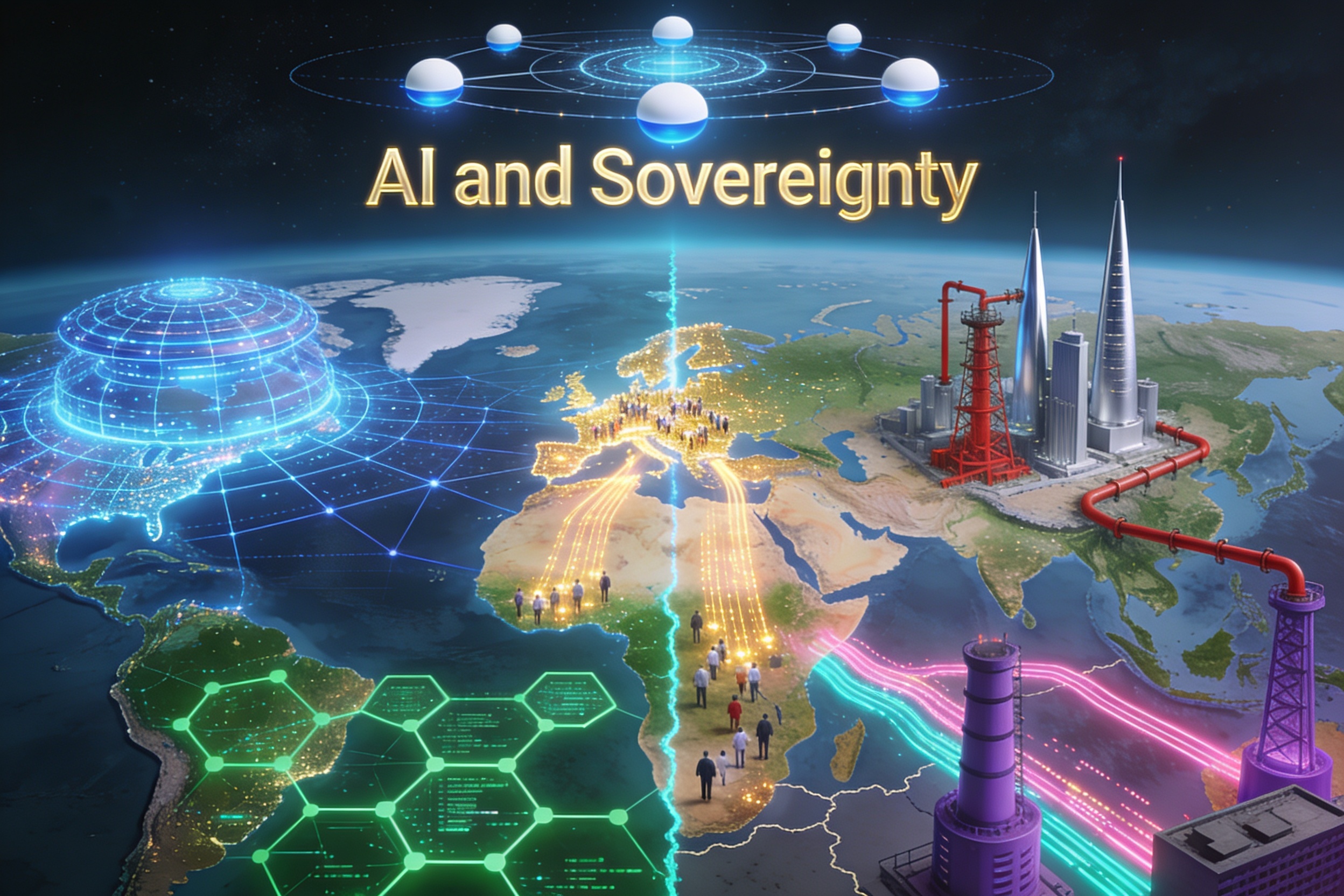
In the context of UNCTAD’s 29th Commission on Science and Technology for Development, the side event “Artificial Intelligence for Regional Sustainable Development” organized by Fudan University took place, which referred to a central theme of the time: “artificial intelligence is not a technology, it is a geopolitical strategy in dispute”. Beyond a technical look at the matter, it placed AI at the forefront of debates on development, sovereignty and global inequality.
It was emphasized that “technological projects must have a focus on (financed) social development and not reproduce extractivism or be exclusively corporate,” distancing itself from the role assumed by China, which escapes the public-private dichotomy. A view that challenges the technocratic narrative that presents innovation as a neutral environment where digital innovations respond to determining factors that go beyond power structures.
In the geopolitical sphere, a structural paradigm shift was marked: the end of the technologically dominated by the West towards technological multipolarity. For decades, the United States and large technology corporations monopolized leadership in artificial intelligence based on the control of data as a strategic input for private accumulation. In the face of this, China is positioned, but not as a competitor but as the bearer of an alternative model that combines state centrality, public investment and articulation between technological development and innovation with collective development.
The event held at the UN can be interpreted as an affirmation of technological multipolarism. Its non-explicit message is clear: the Global South should not only be a consumer of technologies imposed from outside, but has the right to develop, regulate and socially appropriate them. An idea with geostrategic connotations arises here: whoever controls artificial intelligence will control the economy, whoever controls the economy will control the world.
Reference was also made at the event to the social nature of technological development. AI has the potential to improve public policies in areas such as health, education or environmental management. However, without sovereign control, structural dependence will be generated and inequalities will increase in all aspects. This is why we must respond to state agendas and not to commercial interests.
In the field of human rights, this line of thesis proposes a fundamental reflection. It is not enough to analyze the development of artificial intelligence only from the perspective of risks, such as mass surveillance or algorithmic discrimination; it is equally necessary to consider it as an opportunity to strengthen the right to development, guarantee the satisfaction of economic and social rights, promote an equitable distribution of knowledge and its benefits, as well as promote a sustainable and projected reduction of digital divides, wealth and social inequalities. That is why the need to build new legal and political tools to structure the rights that emerge is incorporated into the relevant issues of the present and its projection into the future.
One can also read a critique of the coloniality substratum of knowledge. The countries of the South have historically been relegated to being passive consumers of the global set of technological production. Cooperation with emerging technological powers such as China can make it possible to reconfigure the relationship in new, more horizontal parameters, where the transfer of capabilities and strategic autonomy prevail.
Therefore, it is not only an academic space where AI and STIs are discussed. It is a political intervention in pursuit of a development demarcated by a sovereign, socially oriented and multipolar use of artificial intelligence. And it is transcendent because the event was based on the assumption that there is no single model of technological development, but that there are different ways in which innovation can be put at the service of the people or at the exclusive service of large corporations.
Finally, in a world dominated by the great powers that compete with each other where artificial intelligence has become a key component of the capitalist 4.0 system as an exclusive variable for those who want to have geo-economic and geopolitical supremacy at the planetary level by making strategic decisions in real time, interventions like this contribute to shaping an alternative: a technological development based on sovereignty, international cooperation and social equality as responses to the challenges of the 21st century for all from plurality.