World trade, energy and shipping are entering an area of unprecedented turbulence. The simultaneous closure of two of the world’s major bottlenecks threatens to transform a regional war into a global economic shock. Europe is particularly at risk, and in the United States, energy prices could become a decisive political factor ahead of the midterm elections.
There are wars that are fought on land. Others, in the air. And some begin to be decided at sea. What is happening from the Strait of Hormuz to Bab el-Mandeb belongs to the latter category.
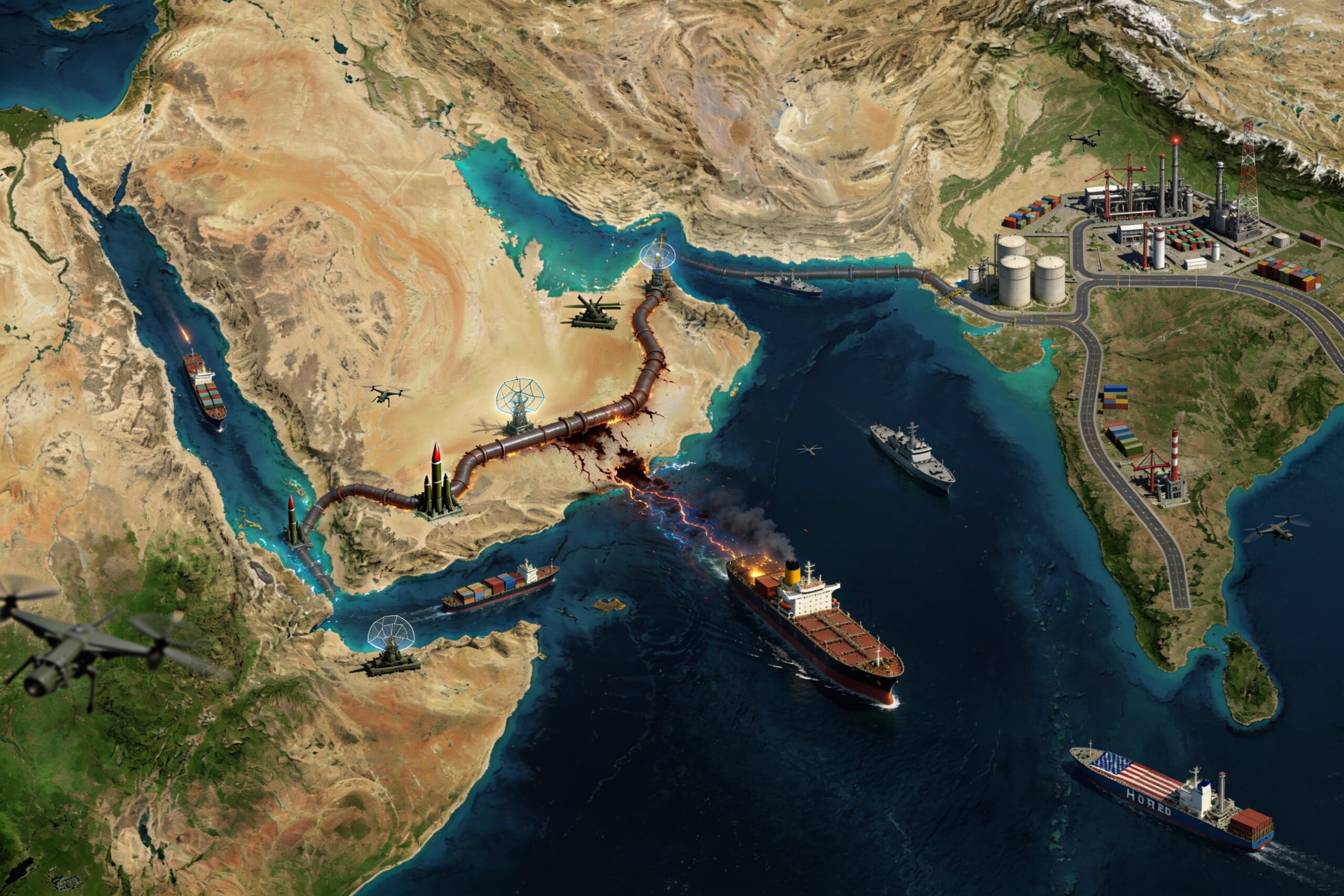
Two straits separated by thousands of kilometres are simultaneously being subjected to military and economic pressure that affects the very heart of the global trading system. Hormuz, between Iran and Oman, is the main gateway for oil and gas from the Persian Gulf. Bab el-Mandeb, between Yemen, Africa and the Arabian Peninsula, connects the Indian Ocean to the Red Sea and, through the Suez Canal, to the Mediterranean.
The combination of the two is creating something much more dangerous: a system of throttling energy and trade routes that reduces, at the same time, the alternatives available for transporting goods and energy.
The consequence is immediate: the world map of trade begins to become longer, more expensive and much more vulnerable.
The first impact appears in the price of crude oil.
Brent has once again and recently surpassed US$100 per barrel and approached US$110 at times of greatest tension. The market is not only reacting to the amount of oil that stops circulating. It is incorporating something much more difficult to calculate: the risk that alternative routes will also be attacked.
That risk completely changes the equation.
If Hormuz is threatened, Gulf producers try to use alternative routes. But if Bab el-Mandeb also becomes unsafe or impassable for pro-Western countries, that alternative loses much of its usefulness.
Saudi Arabia is the best example. Its East-West pipeline had acquired strategic importance precisely because it allowed oil to be transported to the Red Sea avoiding Hormuz. But a drone attack forced the temporary halt of its operations, affecting an infrastructure capable of moving between 2.6 and 4 million barrels per day.
In other words, the war is attacking not only the main routes, but also the escape routes.
And there appears the real economic danger.
Second battlefield: the sea and its routes
Maritime transport has become another direct victim.
When the risk of crossing a conflict zone increases, insurance increases. When insurance increases, freight rates increase. When freight increases, the final cost of practically everything increases.
A ship that avoids Bab el-Mandeb may be forced to circle Africa at the Cape of Good Hope. That means thousands of extra kilometers, more fuel, more time, more crew, and less effective transport capacity.
And there is a less visible, but potentially more important, effect: the availability of ships is beginning to become a strategic problem.
Oil tankers and container ships are not infinite. If a significant part of the world’s fleet must make much longer journeys, the effective capacity of the transport system decreases. War, therefore, does not need to sink hundreds of ships to produce an economic shock. It is enough to force them to sail further.
A longer sea route not only makes transportation more expensive. It also alters inventories. Meanwhile, war is globalized through supply chains.
And then American politics comes along
The midterm elections in November 2026 will take place in a scenario in which the price of energy may become much more important than usual.
The question will not only be who controls the oil in the Gulf. It will be who pays the bill.
A barrel above US$100 has consequences for gasoline, transportation, inflation, and consumer expectations. And when the price of filling up the tank increases, geopolitics ceases to be a distant issue.
It becomes an electoral issue.
The problem for Washington is that energy has a particularly dangerous political capacity: it is visible, everyday and difficult to hide.
The citizen may not follow the war between the United States and Iran on a daily basis. But he does observe the price of gasoline.
You may not know the situation in Bab el-Mandeb. But you may perceive that food, flights, and imported goods are more expensive.
For this reason, the so-called energy war could end up influencing the midterm elections.
Not necessarily because voters decide their vote exclusively for oil.
But because oil can become the mechanism that transforms an international crisis into a domestic sensation of loss of purchasing power.
The new geography of risk
What is truly worrying is that the world is discovering that alternative routes can also become targets.
For decades, globalization rested on a relatively simple premise: if one route was blocked, trade could shift to another.
But that logic begins to fail when several strategic routes are threatened simultaneously.
Everything begins to be part of the same board. The result is a new geography of risk.
It is no longer enough to ask where the oil is.
You have to ask yourself: where can it get out? And where can it get there?
Iran and the Houthis do not necessarily need to maintain a tight, permanent blockade to produce global economic effects. They just need to make sailing dangerous enough:
Risk drives up insurance premiums.
Insurance raises freight rates.
Freight changes routes.
Longer routes reduce the effective capacity of the fleet.
Lower capacity puts pressure on prices again.
And the prices end up reaching the consumer and the potential American voter.
In Bab el-Mandeb, the Houthi advance on strategic positions such as Perim and the coast near the strait has raised precisely that uncertainty. Reuters noted that control of the area could give Iran a new ability to pressure energy markets and reduce supplies through a second strategic corridor. The weapon is not just the missile. It is also uncertainty.
The war is introducing exactly the opposite: distance, uncertainty and cost overruns.
Hormuz and Bab el-Mandeb therefore represent more than just two critical points on the map.