While much is said about the importance of hydrocarbons as strategic resources linked to energy, transport and production, other strategic resources such as fertilisers are often overlooked. These fertilisers are essential for much of global food production, making them critical on a global scale. The crisis in the Strait of Hormuz has exposed the extreme vulnerability of the global food and industrial systems.
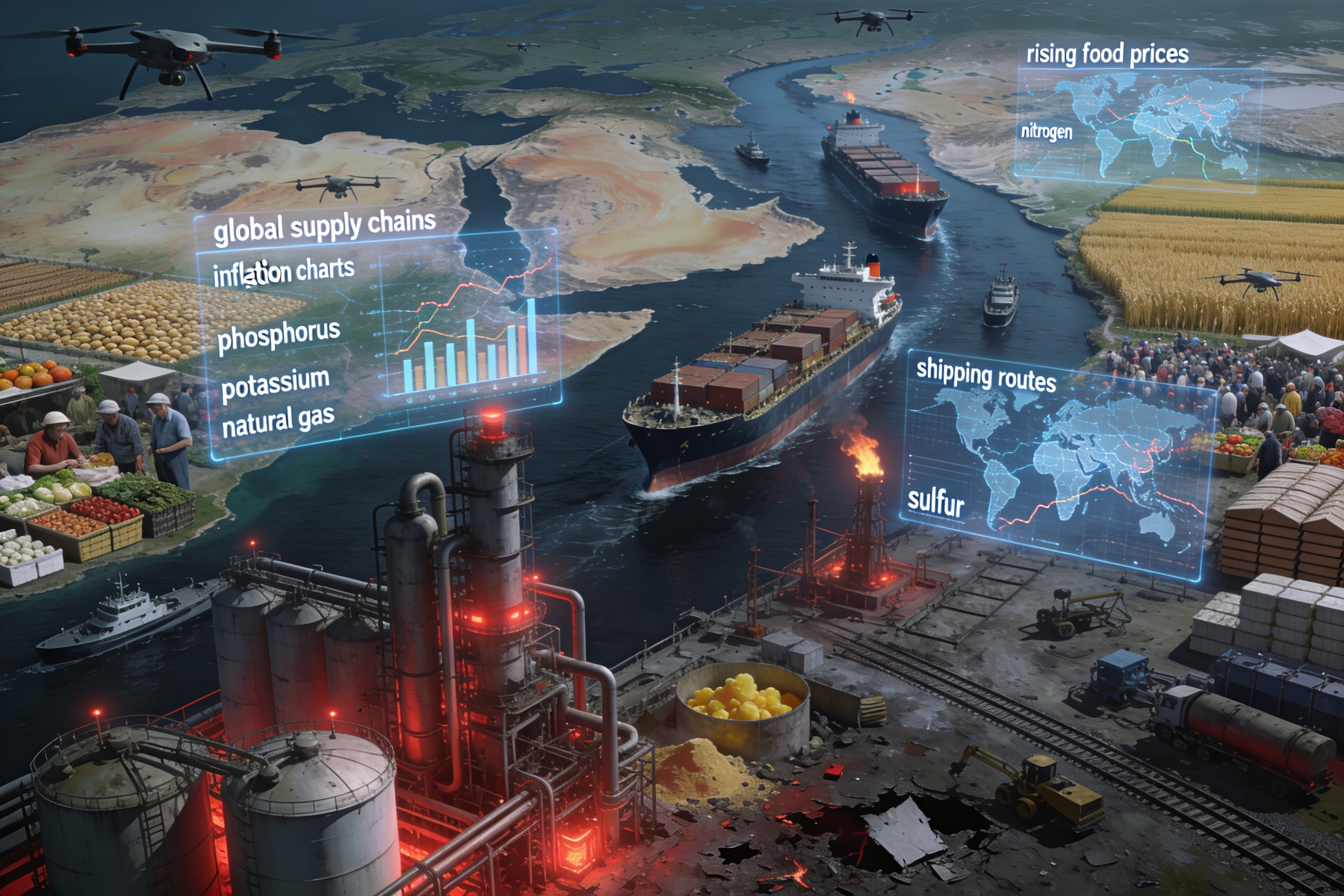
Although this sea route has historically been associated exclusively with the transit of oil, the current conflict and subsequent blockade have set off an economic time bomb. The Strait of Hormuz is the main distribution channel for 30% of the world’s nitrogen fertilisers. Its paralysis would not only redefine the geopolitical balance of power between nations, but also threaten to trigger a global wave of inflation that consumers would pay for at the checkout.
It should be noted that the Persian Gulf accounts for over 30% of global exports of nitrogenous nutrients. Their production depends directly on natural gas. Key energy infrastructure has been damaged by the fighting, such as the Ras Laffan complex in Qatar, and the raw material has disappeared, paralysing regional petrochemical plants. Multinationals such as Qatar Energy have been forced to halt production due to a lack of gas. Around 45% of the world’s sulphur, which is needed to process phosphate fertilisers, passes through the Strait of Hormuz. Its scarcity has brought the manufacture of complex fertilisers at plants in Europe and Asia to a standstill.
It is now estimated that around 50% of the global sulphur supply is still trapped in the Gulf. Highly profitable industries such as copper mining in China are paying record prices for the available sulphur, leaving fertiliser manufacturers without the raw material they need. With some of the world’s largest urea suppliers missing from the global market, and Iran blocked from exporting gypsum — a vital ingredient in calcium nitrate — shortages have become an industrial reality.
Export crops (such as bananas) are losing competitiveness as they incur additional costs that are difficult to pass on. The United Nations Office for Project Services (UNOPS) is warning that falling staple grain yields will trigger shortages and famines in vulnerable areas. As a direct consequence of this logistical bottleneck and the global rise in natural gas prices, international fertiliser prices have soared by between 26% and 50% overnight. Urea, at the epicentre of the supply shock, has seen continuous price spikes of between 30% and 40% in the world’s major ports. Latin America and sub-Saharan Africa are the regions most affected, as countries such as Brazil, Colombia and Kenya depend on imports of synthetic fertilisers to meet 70–80% of their needs.
Meanwhile, the EU is at a crossroads: it must decide whether to continue with its policy of sanctions against Russia or reach out and negotiate to alleviate the problem.
In the hydrocarbons sector, we have already seen how the EU prioritised the geopolitical interests of the Anglo-Saxon world over its own industrial interests and regional stability. The consequences were well-known: a shot in the foot for Europe rather than a blow to the Russian economy. Having lost its supplies from the Middle East, the EU is now being pushed towards a diplomatic crossroads: it must decide whether to turn to the Russian market, the world’s largest exporter of fertilisers. Moscow could use its control over these mineral resources as a tool to exert geopolitical pressure regarding the war in Ukraine.
Europe thus faces the dilemma of either easing indirect trade sanctions on Russia to save its agricultural season, or accepting the financial ruin of its local producers and the significant political and social consequences that would ensue.
The situation is straightforward: the blockage of the Strait of Hormuz has increased the price of fertilisers by around 50%. Reduced access to fertilisers means falling crop yields, pushing up the wholesale prices of fresh food by almost 10%. In the short term, consumers will bear the brunt of rising energy costs and shipping freight rates. Financial analysts project that the price of fresh food will rise by between 7% and 9% globally by the end of the year. Certain products that rely heavily on nitrogen are already experiencing extreme price fluctuations, with price hikes of over 50% for vegetables such as tomatoes, and widespread increases in meat prices due to the cost of animal feed.
In the long term, the real systemic danger is of a deferred nature. Analysts from firms such as XTB warn that even if tensions in the Strait of Hormuz ease in the coming months, the lack of fertilisation of current crops will cause a sharp decline in global cereal production in future harvests. This would trigger a second wave of structural inflation between late 2026 and mid-2027, exacerbating the cost-of-living crisis. The World Food Programme (WFP) estimates that this lack of fertilisation could push a further 45 million people into acute hunger.
The Hormuz crisis shows that food security is fundamentally an energy and geopolitical issue. Those who control access to nitrogen, phosphorus and potassium have the power to destabilise entire governments through domestic inflation and social unrest. Over-reliance on fossil fuels to fertilise fields has made the world’s food supply vulnerable to geographical bottlenecks.
The only path to food sovereignty for states lies in diversifying logistics routes, reducing dependence and accelerating the transition towards local production alternatives.