Introduction
“Poor old Germany. Too big for Europe, too small for the world,” allegedly said Henry Kissinger, implying that Germany, having a large population, natural resources, and a central geographic position in Europe, is much stronger than any of its neighbors (Italy, France, Belgium, etc.), but at the same time (too small for the world) contends that whatever Germany’s power in the continent of Europe, it was unable to match great powers who have to ability to project power globally (the British Empire, the US, USSR).
Caught up between these two situations, Germany remains to this day highly frustrated by the fact that it cannot achieve what it strives for in the international relations, regardless of the changes in the world and back home.
Failure at the UN Security Council
On June 3, 2026, Germany suffered a serious diplomatic setback when it failed to win a seat on the UN Security Council for the 2027–2028 term. This was the first time in the history of a unified Germany that it had lost such a vote.
In the Western European and Other States (WEOS) group, three countries competed for two seats:
- Portugal: 134 votes
- Austria: 131 votes
- Germany: receiving only 104 votes, far below the required two-thirds majority of 127 votes.
Whatever the formal reasons for this loss may be (badly led campaign, strong support for Ukraine and Israel, allegedly Russians lobbying against them…) , it is a clear indication that Germany’s current way of operating in international arena is not efficient for them (and/or the rest of the world). It is interesting that for years Germany has been among the most vocal proponents of expanding the Security Council and obtaining a permanent seat for itself, but it has now been left without even a temporary seat and it was defeated in the vote by significantly smaller states such as Austria and Portugal.
That implies something that is in a way a tacit consent among the permanent member states of the UN Security Council (China, France, Russia, the United Kingdom, and the United States) – Germany (or Japan for that matter), will never be a permanent member of this council, for two main reasons- the UN at first was founded as an international organization that emerged from the coalition of leading Allied countries in the WW2 (thus organically oriented against the defeated countries), and these countries do not want to see those defeated countries as their equals in the world affairs- even in they went through catharsis and reshaped their identity, political culture and approach in the international relations- at least on paper.
Problem of German re-militarization
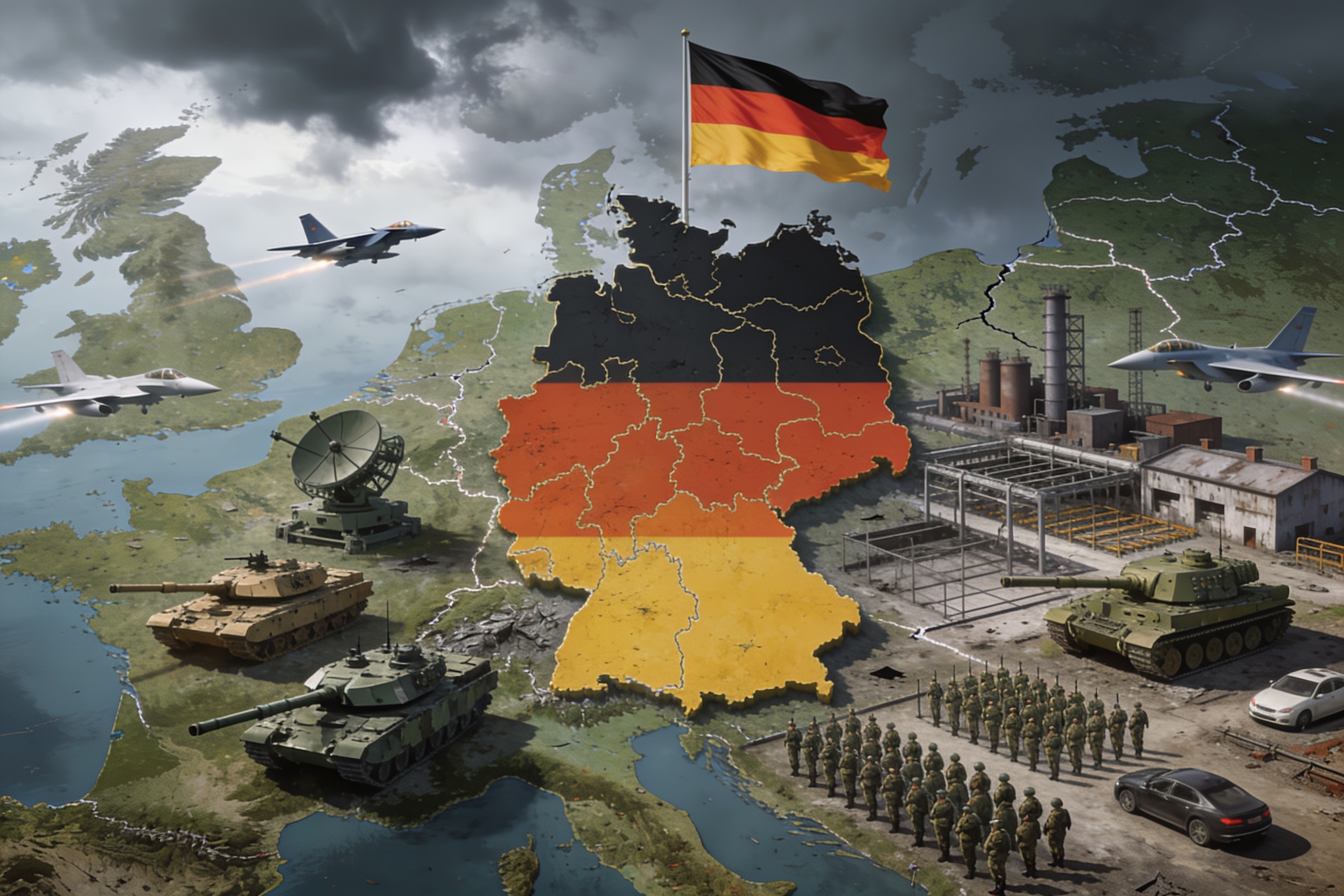
Germany is on a path of intensive re-militarization since 2022. German chancellor at the time, Olaf Scholz, spoke of the „Zeitenwende“ (historic turnover) which the current PM Merz is following and expanding.
Germany allocated around 86 billion euros for its military in 2025, which is around 2.4% of GDP. Military spending is planned to more than double by the end of the decade and reach around 3.5% of GDP, while NATO aims for as much as 5% of GDP by 2035. In addition to the regular budget, a special fund of 100 billion euros was established in 2022 for the modernization of the Bundeswehr, and the total planned military spending until 2030 is measured in hundreds of billions of euros.
The main fields of investment are the following: modernization of Leopard 2A8 tanks; procurement of American F-35 Lightning II fighters; strengthening of air and missile defense; increasing ammunition stocks; development of drones and military artificial intelligence; expansion of reserve forces and mobilization infrastructure.
Regarding manpower, a new law on military service came into force on January 1st 2026. Conscription was not directly reinstated, but measures were introduced that many see as the first step towards its return. The new system provides for:
- compulsory registration for men who turn 18;
- an assessment of physical fitness and readiness for service;
- an expansion of the reserve force;
- the possibility for parliament to reintroduce compulsory military service if there are not enough volunteers.
Defence Minister Boris Pistorius has repeatedly stated that compulsory conscription could be activated if the voluntary model does not provide enough soldiers.
Germany currently has around 180,000 active soldiers. The plan is to reach:
- at least 260,000 active soldiers;
- around 200,000 reservists;
which would mean a force of around 460,000 men by 2035.
Justification for this new course and abandonment of the peaceful approach in the international arena are of course the ever present “Russian threat” , fulfillment of the NATO obligations for each member state, lack of active serviceman, insecurity caused by new, unstable American approach to European matters and others.
Political backlash and economic collapse
The backlash from this new course was instant. Protests erupted against the new law on military service, and the number of requests for conscientious objection increased sharply after the reform was adopted. Also many voices abroad publicly raised concerns over the fact that Germany is slowly but definitely abandoning its post-war culture of military restraint and gradually returning to the logic of mass armament- whatever the formal reason (excuse) for that may be.
This, in combination with the ongoing downfall of their economic prosperity and welfare (reduction of pensions for example), resulted in protests against the current chancellor Mertz and the demands for early elections. Regarding their economy, it is not an exaggeration to say that Germany is collapsing.
Their auto industry, once the pride of Germany, is losing the race to the Chinese. And they can hardly reach them. The amount of money that the German state and German private capital would have to invest in those capacities for electric cars is 10.000 times more than they normally invest now, in order to even be competitive.
Volkswagen, which contributes with about 7% of Germany’s GDP by value, laid off 20.000 workers, closed a factory for the first time in its history, and expects to lose another 50.000 jobs by the end of the decade due to a 44% drop in profits in 2025.
Porsche’s profits fell by as much as 95%. Since 2019, the German auto industry has lost a total of around 120.000 jobs. From 2019 to last year, Germany lost 272.000 jobs in industry, or 5% of all jobs in this branch of the economy.
Has Germany “shut down” along with its factories and what will happen to Europe if its “economic heart” skips? They are now reaping what they started to sow with imposing sanctions on Russia- which were not in the interests of Germany but Washington’s demand, whereas that same Washington continued cooperating with Moscow in many areas despite the sanctions- because the formula of their economic growth was cheap energy from Russia + advanced German technology. And now with the cheap energy for Russia out of the picture that equation is over.
Conclusion
Certainly the world cannot be pleasant seeing Germany on the economic downfall combined with rapid re-militarization and rising domestic issues and social upsets (regarding the problem of migration and other topics), especially not in a situation where there are already two active battlefields in which Germany is (in)directly involved. It brings grim memories to the time when Germany tried to be bigger than just a big power in Europe and impose its will on others in an attempt to become a world power, which resulted in two World Wars, destruction of Europe (first of all) and Germany as well, for the sake of European countries being the spoils of war after its over. Can the (more-less same) forces that helped the German build-up to the first and second World War be stopped now and prevent them from dragging the world again into a catastrophe without measure or precedent in world history? Let’s hope so.