
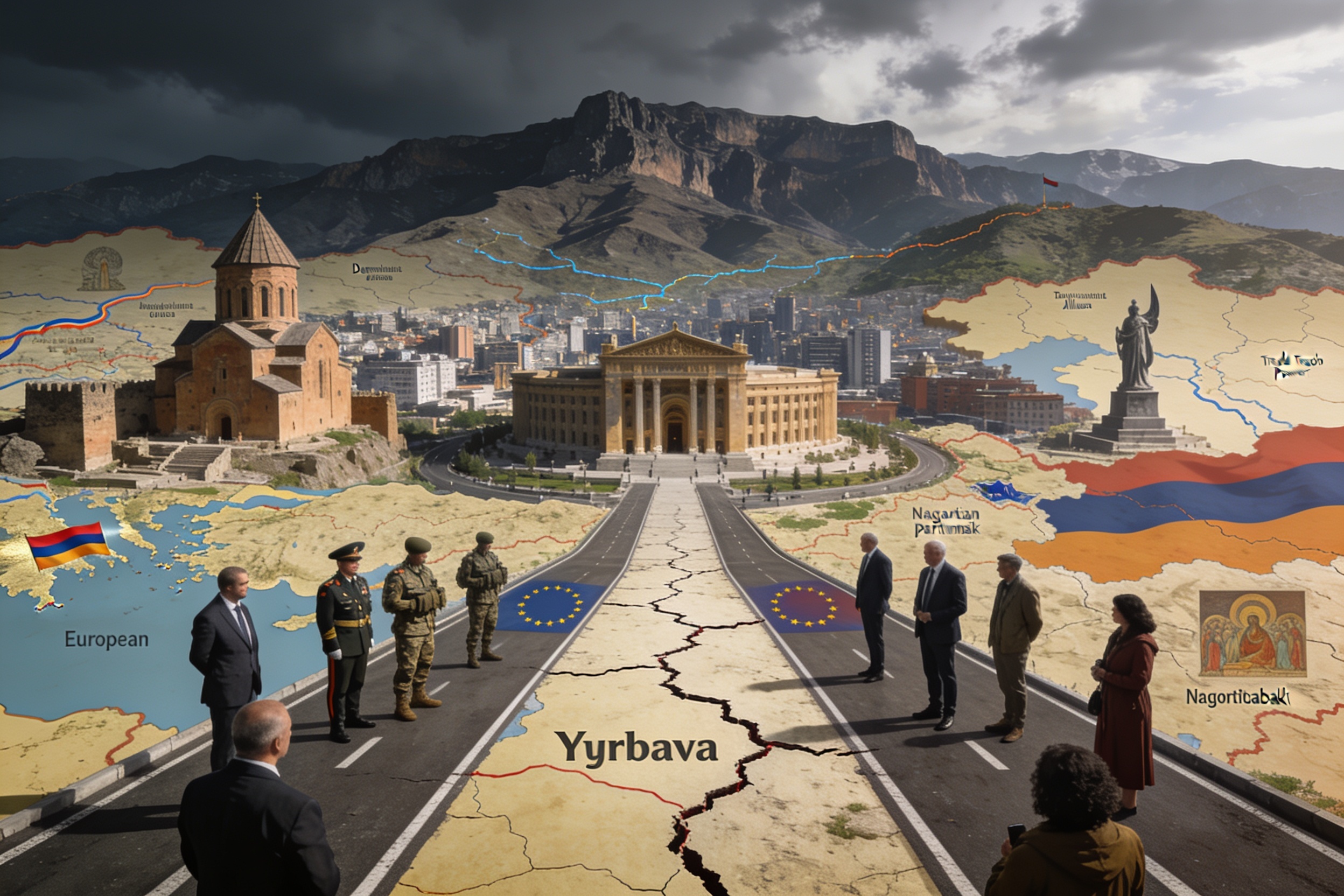
Nikol Pashinyan’s electoral victory does not close the Armenian crisis; it shifts it into a new phase. Armenia is now entering a period of high strategic vulnerability, where the internal dispute between the government, the opposition, the Armed Forces, the Apostolic Church, and business sectors overlaps with a broader confrontation: the struggle for geopolitical control of the South Caucasus.
From a security and strategic intelligence perspective, the issue is not merely whether Pashinyan won or did not win the elections, but what kind of state he intends to build after his victory. His project appears to be aimed at dismantling the old balances of power that connected Armenia with Russia, the diaspora, the memory of Artsakh — also known as Nagorno-Karabakh — and the traditional structures of national legitimacy.
Under the narrative of “Real Armenia,” the government seeks to redefine the country’s strategic identity: less tied to the historical Russian-Armenian axis and more open to Western frameworks of integration, connectivity, institutional reform, and security cooperation.
- The first scenario is authoritarian consolidation under democratic cover. The reported persecution of political opponents, business figures, military sectors, and religious actors could operate as a preventive operation designed to neutralize any alternative power structure. In this scenario, Pashinyan would use his parliamentary majority to advance constitutional reforms, agreements with Azerbaijan, and an irreversible foreign-policy reorientation. The risk is that the alleged formal stability may conceal a deep erosion of national cohesion.
- The second scenario is internal fragmentation. Allegations of electoral irregularities, the arrest of opposition figures, and tensions with the Apostolic Church may feed a narrative of illegitimacy. If a significant part of society perceives the government as acting against Armenia’s historical symbols, the conflict would cease to be merely partisan and would become civilizational: a Westernizing liberal state against the historical nation, the memory of Karabakh, and religious tradition.
- The third scenario is external instrumentalization. The West sees Armenia as a platform to reduce Russian influence in the South Caucasus, open connectivity corridors toward the Caspian Sea, and limit Moscow’s weight within the regional architecture. For the United States and the European Union, Armenia could become a point of strategic penetration between Russia, Iran, Turkey, and Azerbaijan. In this logic, Western international projects are not merely economic; they are mechanisms of geopolitical reordering.
- The fourth scenario is the Russian reaction. Moscow cannot passively observe the loss of Armenia without consequences for its credibility in the post-Soviet space. Armenia’s freezing of its participation in the CSTO — the Collective Security Treaty Organization — its rapprochement with the EU, and its cooperation with Western security structures place Yerevan in a gray zone. Russia could respond through economic, media, diplomatic pressure, or by strengthening internal actors favorable to preserving the Eurasian link.
- The fifth scenario is an agreement with Azerbaijan under asymmetric conditions. Pashinyan may present peace as a historical necessity, but if that peace is perceived as capitulation, it will open an even deeper internal wound. The question of Karabakh, regional corridors, and constitutional reform will remain points of pressure.
In conclusion, Pashinyan could go as far as internal resistance and the balance between powers allow him to go. His victory does not represent the end of the Armenian crisis, but the beginning of a more dangerous stage: the transformation of Armenia into an unfortunate geopolitical laboratory where not only the future of Yerevan is being decided, but also the balance of power across the entire South Caucasus — and, by extension, everything this implies for the stability of the security architecture of the broader post-Soviet space.