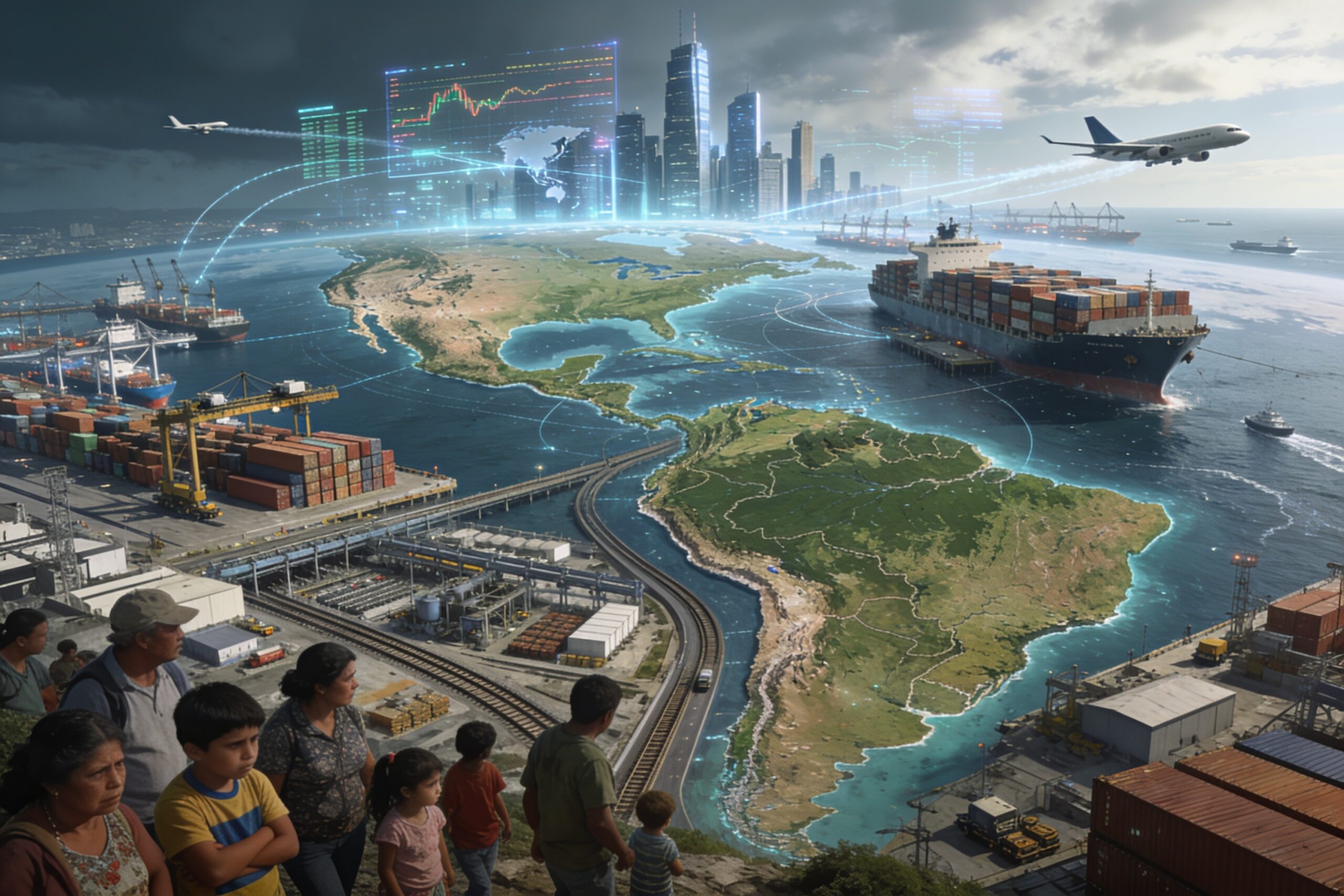
In recent years, the United States has increasingly relied on tariffs not only as an instrument of economic policy but also as a tool of geopolitical influence. This trend became particularly evident in 2026, when the U.S. government imposed a new 25% tariff on a broad range of Brazilian exports, while warning that additional duties under separate trade investigations could raise tariffs on some products to as much as 37.5%.
Although Brazil became the most visible target, these measures reflect a broader pattern of growing protectionism toward Latin American economies. By restricting access to one of the region’s largest export markets, U.S. tariff policies create significant uncertainty for businesses, discourage investment, and ultimately affect the financial stability of millions of households across Latin America.
The United States remains the principal trading partner for several Latin American countries. Mexico sends roughly 80% of its exports to the U.S., while many Central and South American economies also depend heavily on American demand for manufactured goods, agricultural products, and raw materials.
Consequently, when tariffs increase, exporters lose competitiveness, production slows, investment declines, and companies frequently postpone hiring or reduce their workforce. According to research conducted by the World Bank, tariff increases are associated with lower economic growth, declining productivity, higher unemployment, and greater income inequality. These macroeconomic effects eventually translate into reduced household income, lower purchasing power, and increased financial insecurity.
However, attributing these difficulties exclusively to U.S. trade policy would overlook the region’s deeper structural challenges. American tariffs undoubtedly impose economic costs, but they primarily expose vulnerabilities that have existed for decades. Unlike several East Asian economies that pursued consistent industrialization strategies, technological upgrading, and export diversification, much of Latin America has remained heavily dependent on commodity exports while experiencing gradual deindustrialization.
Manufacturing capacity has stagnated in many countries, investment in research and innovation has remained limited, and productive diversification has progressed slowly. As a result, external economic shocks produce disproportionately severe domestic consequences.
This structural dependence is particularly damaging for ordinary families. When export revenues decline because of trade restrictions, the effects extend far beyond exporting firms. Suppliers lose contracts, transportation and logistics sectors experience reduced demand, and local businesses dependent on industrial activity suffer declining sales. Governments also collect less tax revenue during economic slowdowns, limiting their ability to finance infrastructure projects, education, healthcare, and social protection programs. Low- and middle-income households, which generally possess limited savings, become the most vulnerable to prolonged periods of economic uncertainty.
The region’s modest growth prospects further amplify these risks. The World Bank projects that Latin America’s economy will expand by only around 2% in 2026, a pace insufficient to generate the productivity gains and quality employment necessary to substantially improve living standards. Under such conditions, even relatively limited trade restrictions can produce meaningful social consequences by weakening already fragile labor markets and reducing opportunities for upward economic mobility.
Ultimately, U.S. tariffs impose genuine economic burdens on Latin American families by restricting exports, reducing employment opportunities, and increasing uncertainty throughout the region. Nevertheless, the magnitude of these effects reflects more than American protectionism alone. It also reveals the absence of sustained development strategies capable of reducing external dependence through industrialization, technological innovation, and greater regional economic integration.
Without such structural reforms, Latin American countries will remain highly exposed to policy decisions made abroad, leaving the financial well-being of millions of families vulnerable to external political and economic pressures.