The increase in agri-food imports from third countries has become a growing concern for many Spanish and European sectors. The problem is not imports per se – which are necessary for products where there is a shortfall – but rather competition with goods produced under different labour, environmental and production costs. All food sold in the European Union must comply with its safety requirements and residue limits; however, full equivalence in production methods – such as the use of plant protection products, animal welfare, water management or climate obligations – is not always required [1–3]
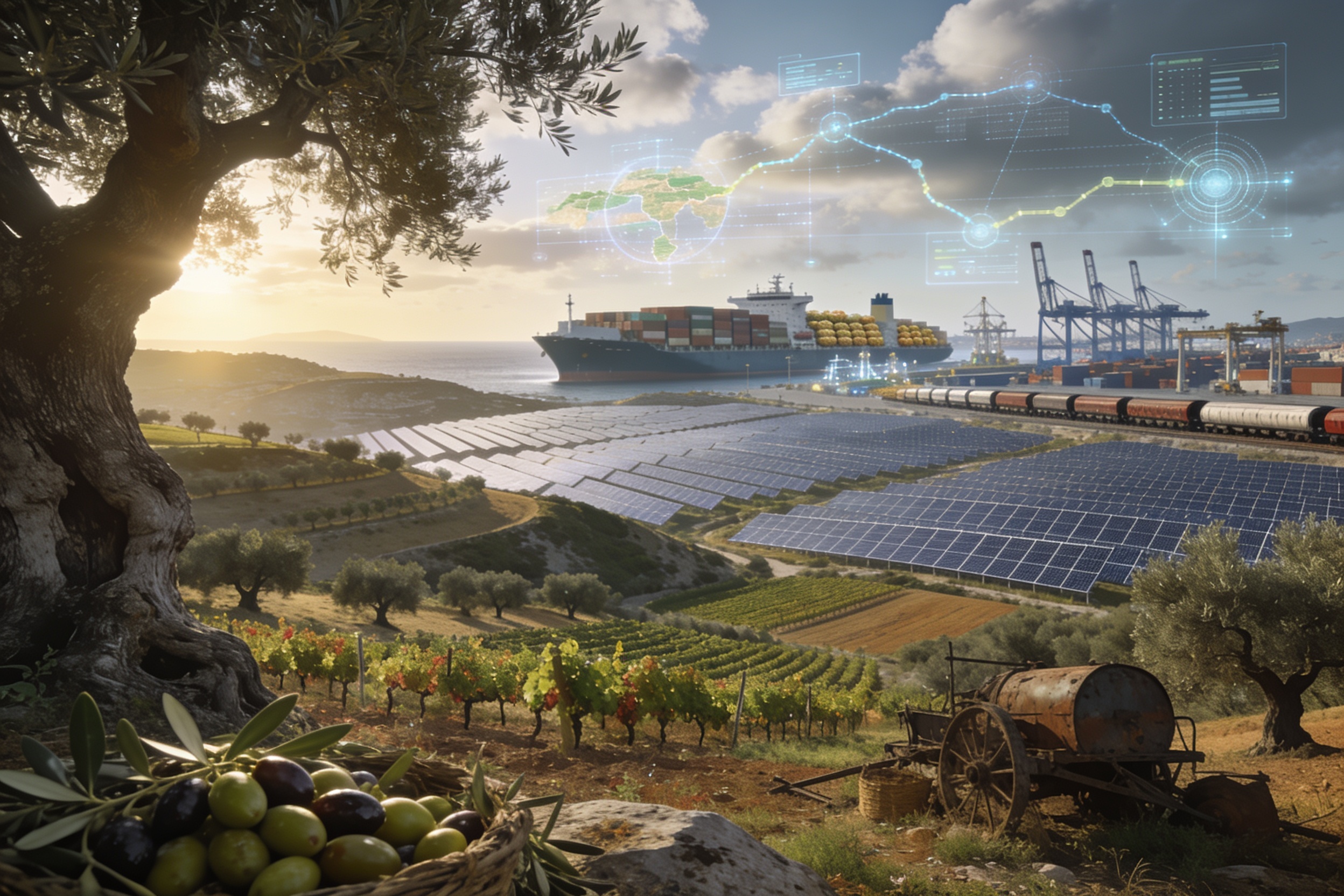
Spain, the world’s leading producer of olive oil, faces a contradiction that is difficult to justify to its farmers. Whilst the authorities require domestic producers to reduce the use of plant protection products, protect biodiversity, comply with new environmental conditions, record every treatment and bear rising labour and energy costs, agri-food imports from third countries continue to rise. At the same time, certain solar power projects are replacing productive olive groves with large-scale energy facilities. This is not about rejecting renewable energy or closing borders, but about questioning whether the European green transition and trade policy are consistent with the survival of the countryside.
The case of Moroccan olive oil is particularly significant. According to DataComex figures reported by various media outlets, Spain increased its olive oil imports by almost 10,000 per cent compared with the previous year – we are talking about 10,385 tonnes of olive oil from Morocco between January and April 2026, compared with just 103 tonnes in the same period of 2025. The value of these purchases rose from around 340,000 euros to 32.76 million. At the same time, Spanish olive oil exports to Morocco fell from around 2,721 tonnes to approximately 674 tonnes [4–6]. In other words, in the space of barely a year, the trade flow between the two countries was radically reversed. Another influencing factor, although not a decisive one, is production: Morocco achieved a considerably better harvest in the 2025/2026 season compared with previous years, and consequently its prices were lower than those in Spain, making the North African country an attractive supplier for bottling companies and commercial operators [2,3].
However, the speed of this increase raises questions about its impact on prices at source, traceability and external dependence. The European Commission considers Morocco to be an agri-food partner of growing importance and publishes specific statistics on the trend in EU imports from that country. Overall, the EU’s agri-food imports reached a record high of 188,600 million euros in 2025, 9 per cent more than in 2024, although, for the time being, the EU continued to record a surplus [7,8].
In theory, imported food is not exempt from European regulations. All food marketed in the EU, regardless of its origin, must comply with the applicable residue limits, health requirements and food safety standards [13,14]. However, the problem lies in the discrepancy between the final characteristics of the product and the conditions under which it was produced. An imported food product must, for example, comply with the maximum pesticide residue limits set by the EU. However, the country of origin may authorise active substances not approved for use by European farmers. The European Commission itself expressly acknowledges that third countries may authorise pesticides containing substances not approved within the Union [8–10].
Consequently, products imported from outside the EU are not always required to meet full equivalence in production methods: the use of plant protection products, environmental protection, animal welfare, working conditions, water management or emissions reduction. In fact, in November 2025, the Commission launched a study to assess whether the most dangerous pesticides banned in the EU on health or environmental grounds should also be prevented from re-entering the EU market via imported products. It is also examining the extent to which equivalent animal welfare standards should apply to imports. The fact that these reforms are still under review demonstrates that full reciprocity regarding imports is far from existing in relation to what Europe exports [18,19].
Rice is another of the clearest examples of this problem; Spain imported 418,447 tonnes in 2024, 14.8 per cent more than in 2023 and 91.8 per cent more than in 2020. Meanwhile, Spanish exports fell by almost 20 per cent, resulting in a trade deficit of 139 million euros. Producers point in particular to imports from Myanmar, Cambodia, India, Pakistan and other Asian countries, whose lower costs and less stringent controls put pressure on prices at source and make it difficult for Spanish farms to cover their costs [4,5].
Other products such as citrus fruits, tomatoes and honey have faced similar situations, with very significant increases in imports that are negatively affecting Spanish production, where it is extremely difficult to compete with the production costs of third countries and the lighter burden of phytosanitary conditions and controls required.
The health aspect is a very important one that must not be overlooked; whilst local producers are stifled by extreme phytosanitary and bureaucratic requirements, the country’s trade borders remain critically vulnerable. This asymmetry is no longer merely a dilemma of unfair competition for the agricultural sector, but a latent risk to consumers’ public health.
Cases such as the detection of hepatitis A in strawberries imported from Morocco, apparently due to irrigation with sewage, or recurring alerts regarding excessive levels of unauthorised pesticides, highlight the severe cracks in the system. Spanish and European farmers are subject to constant audits, drastic bans on active substances and traceability checks, under threat of administrative and criminal sanctions. In contrast, products from third countries enter via EU ports under a random sampling inspection model that does not come anywhere near meeting the standards required of European producers. This operational gap means that, in practice, laboratory analyses take days or weeks to confirm the presence of pathogens, allowing high-risk goods to make their way onto supermarket shelves. [11,12]
The health risk is twofold: on the one hand, the microbiological risk arising from the use of irrigation water or handling practices that do not meet strict hygiene standards; on the other, the chemical risk arising from the ingestion of plant protection products withdrawn from the EU due to their toxicity or carcinogenicity. Whilst European agriculture sacrifices productivity to align with environmental objectives, the EU administration permits the entry of food grown to significantly lower standards. [15–17]
Demanding the highest standards within its borders whilst relaxing external controls constitutes a structural inconsistency. The protection of consumer health and the survival of the European countryside require the immediate implementation of mirror health clauses and a radical tightening of customs controls at source, bringing import requirements into line with the rigorous regulations to which local producers are subject. [13,14]
Olive groves and solar panels: the true scale of the problem
Another contradiction lies in land use. The Ministry of Agriculture estimated that solar farms occupied around 50,000 hectares in Spain in 2023, equivalent to 0.2 per cent of the usable agricultural area. Since 2016, the area covered by solar panel farms had increased by some 31,000 hectares – that is, by 166 per cent – and annual growth had exceeded 20 per cent in the most recent years analysed. If all the major projects under consideration were to go ahead, the total area could approach 100,000 hectares [20,21].
Between 2012 and 2022, around 23,000 hectares were converted to solar installations: 82 per cent came from rain-fed land, 11 per cent from irrigated land and 7 per cent from forest or non-agricultural land. The ministerial report also indicates that some of the solar farms have been built on olive groves.
However, this needs to be put into context: the area of olive groves in Spain grew by approximately 2.6 per cent between 2018 and 2024, and for every hectare of olive grove cleared during that period, around 1.6 new hectares were planted [20,22]. However, the national figures may mask negative local impacts, as has been the case in Jaén, where, in various municipalities, farmers and neighbourhood groups have reported that several solar power projects could lead to the grubbing-up of around 100,000 olive trees, affecting around a hundred smallholdings. These cases highlight the contradiction between the institutional protection of the rural world and the declaration of mega-energy plants on productive land as being in the public interest [18,19].
The constraints faced by European producers
This imbalance is also evident in sectors other than olive growing. Rice farmers, citrus growers, market gardeners, beekeepers and livestock farmers complain that they are competing against goods produced under conditions of lower wages, energy costs, environmental standards and animal welfare requirements. Critical media outlets such as *La Gaceta* have reported on the complaints of Extremaduran rice growers regarding non-EU imports, of Spanish citrus growers regarding imports from South Africa, Morocco or Egypt, and of olive growers and beekeepers regarding possible triangulation schemes and confusion over origin [27–29].
The response should not be to remove European controls. Lowering food safety, animal welfare or water protection standards would lead to a race to the bottom. The reasonable solution is to demand gradual reciprocity: the same health guarantees and verifiable convergence on plant health, environmental standards, traceability, animal welfare and working conditions.
Risk-based border inspections, audits at source and labelling must also be strengthened. The Commission has announced that it will increase audits relating to exports in third countries by 50 per cent and step up controls at the main points of entry. This measure implicitly acknowledges that the system requires greater capacity and vigilance [19,30,31].
Ultimately, the central issue is political. Europe cannot ask Spanish farmers to produce to the world’s most stringent standards and then buy from abroad what is no longer profitable to produce at home. Nor is it consistent to pay lip service to protecting the landscape whilst facilitating the replacement of productive agricultural land with infrastructure that could be located or designed differently.
The problem lies in a policy that outsources part of food production, demands sustainability within Europe without guaranteeing reciprocity from outside, and confuses the energy transition with mere land take. A truly green policy should simultaneously protect the climate, food security and the livelihoods of those who work the land. Without competitive farmers, there will be no food sovereignty; and without a vibrant rural landscape, the ecological transition risks becoming an industrial operation painted green, dependent on external factors.
References:
[1] European Commission. Official controls on imported products and frequently asked questions on food imports. https://spain.representation.ec.europa.eu/noticias-eventos/noticias-0/la-comision-anuncia-el-refuerzo-de-los-controles-en-los-productos-importados-2025-12-09_es
[2] El Español. Maximum residue limits for pesticides in food. https://www.elespanol.com/mujer/estilo-vida/20260526/ue-cambia-normas-reduce-limites-permitidos-pesticidas-frutas-hortalizas-consumo-humano/1003744242288_0.html
[3] European Commission. Application of EU health and environmental standards to imported agri-food products, COM(2022) 226.
[4] Libre Mercado. Imports of Moroccan olive oil soar by almost 10,000 per cent in Spain. 5 July 2026. https://www.libertaddigital.com/libremercado/2026-07-05/las-importaciones-de-aceite-de-oliva-marroqui-se-disparan-casi-el-10-000-por-ciento-en-espana-7430244/
[5] Rue20 Español. Morocco increases its olive oil exports to Spain a hundredfold in 2026. 6 July 2026. https://es.rue20.com/2026/07/06/marruecos-multiplica-por-cien-sus-exportaciones-de-aceite-de-oliva-a-espana-en-2026/
[6] Agropopular. Morocco increases its olive oil shipments to Spain. 14 July 2026. https://www.agropopular.com/marruecos-aceite-140726/
[7] European Commission, DG AGRI. Agri-food trade statistical factsheet: European Union–Morocco. 2026. https://agriculture.ec.europa.eu/system/files/2023-05/agrifood-morocco_en.pdf
[8] European Commission. EU Agri-food Trade Hits New Records in 2025. 13 March 2026. https://agriculture.ec.europa.eu/media/news/eu-agri-food-trade-hits-new-records-2025-2026-03-13_en
[9] Ministry of Agriculture, Fisheries and Food. Foreign Trade Report on Rice, 2024.
[10] UPA/Agrodigital. The situation of European rice in the face of rising imports, 2025.
[11] National Geographic Spain. Sergio Parra. ‘Health alert over hepatitis A in imported strawberries: risks and precautions’. Updated 8 March 2024. https://www.nationalgeographic.com.es/ciencia/alerta-sanitaria-hepatitis-a-fresas-importadas-riesgos-y-precauciones_21774
[12] Valencia Fruits. Nerea Rodríguez. “Widespread alarm over the arrival in Spain of Moroccan strawberries contaminated with hepatitis A”. 12 March 2024. https://valenciafruits.com/alarma-general-llegada-espanya-fresas-marroquies-hepatitis-a/
[13] European Commission. Official controls on imported products. Accessed 2026. https://food.ec.europa.eu/horizontal-topics/official-controls-and-enforcement/imported-products_en
[14] European Commission. Import controls on food and feed: Questions and Answers. Accessed 2026. https://food.ec.europa.eu/horizontal-topics/official-controls-and-enforcement/import-controls-food-and-feed-qas_en
[15] European Commission. Maximum Residue Levels. Accessed 2026. https://food.ec.europa.eu/plants/pesticides/maximum-residue-levels_en
[16] European Commission. EU legislation on Maximum Residue Levels. Accessed 2026. https://food.ec.europa.eu/plants/pesticides/maximum-residue-levels/eu-legislation-mrls_en
[17] European Commission. Non-EU countries’ certification of compliance with EU pesticide MRLs. Accessed 2026. https://food.ec.europa.eu/plants/pesticides/maximum-residue-levels/enforcement/mrl-compliance-cert-non-eu_en
[18] European Commission. Application of EU health and environmental standards to imported agricultural and agri-food products, COM(2022) 226 final. 3 June 2022. https://eur-lex.europa.eu/legal-content/EN/TXT/?uri=CELEX:52022DC0226
[19] European Commission. Statement on production standards applied to imported agri-food products and SPS controls. 2026. https://www.europarl.europa.eu/meetdocs/2024_2029/plmrep/COMMITTEES/INTA/DV/2026/01-26/EC_Statement_Regulation_bilateral_safeguard_clauses_EN.pdf
[20] Ministry of Agriculture, Fisheries and Food. Solar farms in Spain cover an area equivalent to 0.2 per cent of the utilised agricultural area. 28 June 2024. https://www.mapa.gob.es/dam/mapa/contenido/prensa/notas-de-prensa/documentos/documentos-2024/240628extensionparquesfotovoltaicos.pdf
[21] Ministry of Agriculture, Fisheries and Food. AgrInfo No. 37: Area of photovoltaic farms in Spain. June 2024. https://www.mapa.gob.es/dam/mapa/contenido/ministerio/servicios/servicios-de-informacion/analisis-y-prospectiva/ayp-serie-agrinfo/ayp_37_parquefotovoltaico.pdf
[22] Maldita.es. Spanish olive groves are growing despite the expansion of solar power. 16 May 2025; updated 14 August 2025. https://maldita.es/clima/20250814/mas-olivos-que-placas-solares/
[23] La Gaceta. A farmer faces the expropriation of his olive trees in Jaén to make way for solar panels. 20 October 2025. https://gaceta.es/espana/un-agricultor-sufre-la-expropiacion-de-sus-olivos-en-jaen-para-la-instalacion-de-placas-solares-nos-dicen-que-es-voluntario-y-si-te-niegas-te-lo-quitan-20251020-1121/
[24] La Gaceta. The Moreno Bonilla government expropriates 100,000 olive trees in Jaén to build mega solar power stations. 26 November 2024. https://gaceta.es/espana/el-gobierno-de-moreno-bonilla-expropia-100-000-olivos-en-jaen-para-construir-megaplantas-solares-20241126-1318/
[25] La Gaceta. The 2030 Agenda against the town of Lopera in Jaén. 15 April 2025. https://gaceta.es/espana/la-agenda-2030-hunde-a-la-localidad-jienense-de-lopera-expropiaciones-forzosas-y-tala-masiva-de-olivos-para-instalar-placas-solares-20250415-1723/
[26] La Gaceta. Legal offensive by the Spanish rural sector to halt the installation of solar panels and the mass felling of olive trees. 5 February 2026. https://gaceta.es/espana/ofensiva-judicial-del-campo-espanol-para-frenar-la-instalacion-de-placas-solares-y-la-tala-masiva-de-olivos-en-jaen-20260205-1109/
[27] La Gaceta. Spanish rice industry collapses under the flood of imports from third countries. 25 May 2026. https://gaceta.es/espana/el-arroz-espanol-se-hunde-por-la-avalancha-de-importaciones-de-terceros-paises-las-dificultades-son-enormes-20260525-1346/
[28] La Gaceta. The flood of foreign citrus fruits is forcing Spanish farmers to uproot their orange trees. 25 December 2025. https://gaceta.es/espana/la-avalancha-de-citricos-extranjeros-avalada-por-bruselas-fuerza-a-los-agricultores-espanoles-a-arrancar-sus-naranjos-20251225-0124/
[29] La Gaceta. Spanish farmers denounce the sale of products from Tunisia and China as if they were of European origin. 21 June 2026. https://gaceta.es/espana/agricultores-espanoles-denuncian-la-venta-en-espana-de-productos-de-tunez-y-china -as-if-they-were-of-European-origin-they-cheat-and-bend-the-law-20260621-0918/
[30] European Commission. EU-Mercosur partnership agreement: respecting Europe’s health and safety standards. accessed 2026. https://policy.trade.ec.europa.eu/eu-trade-relationships-country-and-region/countries-and-regions/mercosur/eu-mercosur-agreement/factsheet-eu-mercosur-partnership-agreement-respecting-europes-health-and-safety-standards_en
[31] European Commission. EU-Mercosur partnership agreement: benefits and protection for European farmers. accessed 2026. https://policy.trade.ec.europa.eu/eu-trade-relationships-country-and-region/countries-and-regions/mercosur/eu-mercosur-agreement/factsheets-and-guides/factsheet-eu-mercosur-partnership-agreement-benefits-and-protection-european-farmers_en