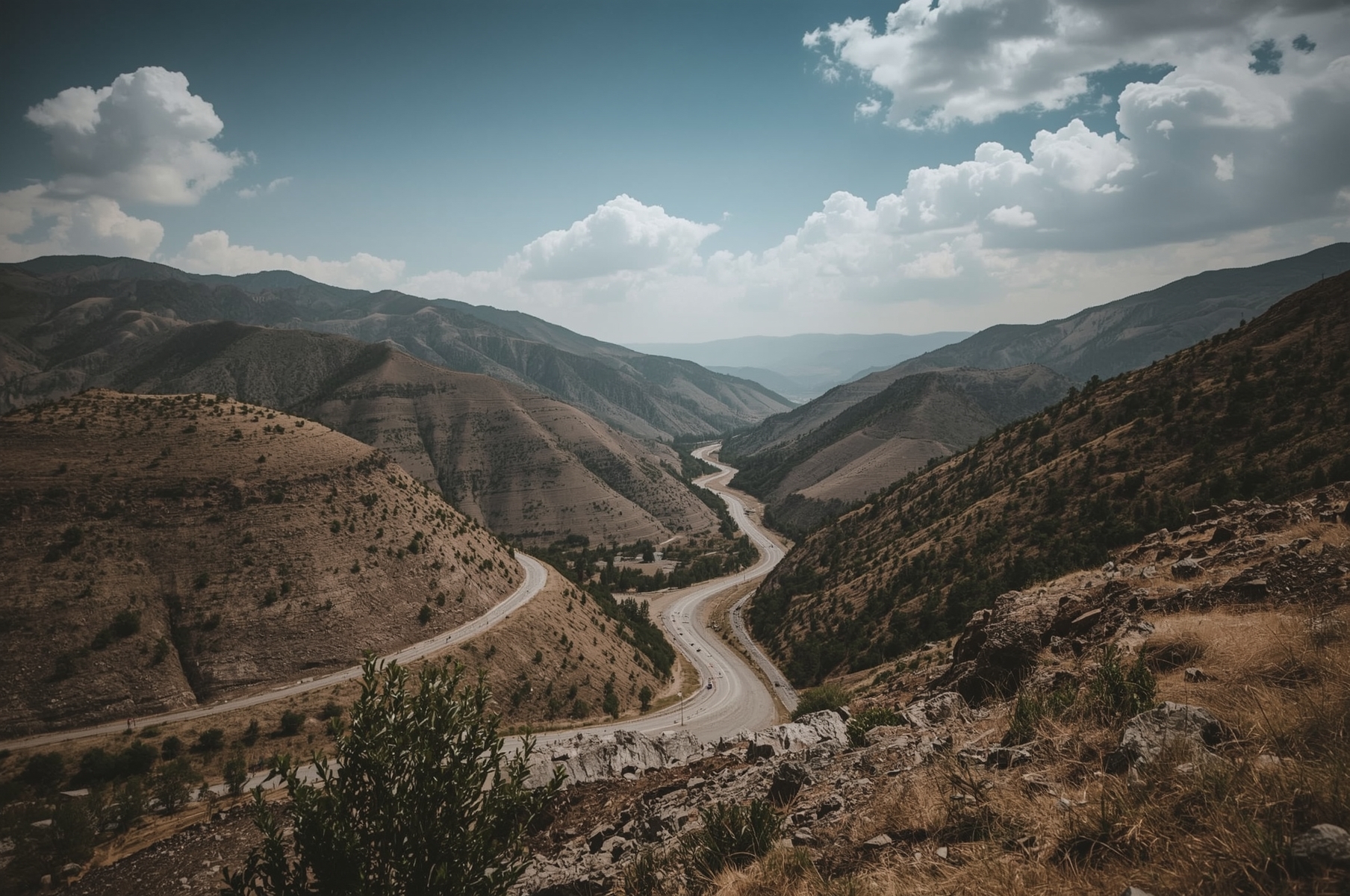
The Zangezur Corridor, located in the southern region of Armenia, has become one of the most sensitive issues in the South Caucasus following the 2020 Nagorno-Karabakh war. This strategic corridor would cross the Armenian province of Syunik, connecting Azerbaijan with its enclave of Nakhchivan and, by extension, with Turkey. The proposal, strongly supported by Baku and Ankara, has been met with skepticism in Yerevan, which fears a loss of sovereignty and the risk of territorial balkanization.
OPPORTUNITIES FOR PEACE AND ECONOMIC INTEGRATION
The corridor is presented by its proponents as a path to peace and regional integration. Its potential benefits include: Regional connectivity: It would open a direct land route between Azerbaijan and Turkey, but also between the Caspian Sea and the Eastern Mediterranean, consolidating an east-west axis that would complement China’s Belt and Road Initiative and existing energy corridors.
Economic unblocking: Armenia, isolated for decades by the closure of its borders with Turkey and Azerbaijan, could be integrated into new transport and trade networks, benefiting from shared investments and infrastructure. Post-conflict stability: In theory, the corridor would transform rivalries into interdependence, fostering normalization between Armenia, Azerbaijan, and Turkey, with a positive impact on energy security in Europe and Central Asia. Logistics diversification: For Central Asia and Russia, the route offers transit alternatives to international markets, reducing dependence on routes that cross Iran or Russian territory.
WAR VULNERABILITIES AND GEOPOLITICAL TENSIONS
However, the Zangezur Corridor is not without military and political risks: Risk of military imposition: Baku has repeatedly threatened to open the corridor by force if Armenia does not cooperate, raising the possibility of a new localized war in Syunik. Sovereignty dispute: Armenia fears that accepting the corridor without full control of its territory would amount to a covert concession, weakening its state integrity.
CROSSING INTERESTS
Turkey and Azerbaijan see it as key to consolidating the Pan-Turkic axis. Iran rejects the project for fear of being isolated from the Caucasus and losing influence over Armenia, its strategic partner in the region. Russia, guarantor of the 2020 ceasefire, seeks to maintain its presence as a mediator, although its weakening due to the war in Ukraine has reduced its arbitration capacity.
This may interest you

Who is harnessing france’s anger?
Parties, foreign networks, organised rioters, the State: everyone is seizing the movement, no one is answering it. Some kinds of anger…


France between chaos and flames
1. Introduction: The Dantesque Scenario as a Diagnostic Moment On 17–18 October 2026, France experienced what foreign observers immediately recognised as…


The student factor and the massive social protests in the
To understand what is happening, it is enough to make a simple political reasoning. 2027 represents a crucial electoral appointment for…


The decisive moment in the war of Ukraine is approaching
We have become accustomed to analysing the war in Ukraine through the prism of ground battles, calculating gains in square…


EU budget dispute sharpens
Brussels is experiencing its most uncertain hours since the creation of the European project. The negotiations to define the 2028-2034…


Student protests, Marine Le Pen and the decline of the
The student mobilization in France, which began on September 17 at the Saint-Exupéry de Créteil high school, located on the…

The West is interested in the creation of new energy routes that would reduce dependence on Moscow, but fears that the corridor will increase tensions and destabilize Armenia, a country with European aspirations.
And it should not be forgotten that for China, this corridor would represent competition and a geopolitical challenge to its so-called “New Silk Road” project. Military vulnerability: the corridor would be an area easily blocked in the event of a conflict, whether through sabotage operations, artillery attacks, or drone attacks, which turns its viability into a security weakness.
LATENT CONFLICTS
The Zangezur Corridor project is embedded in a network of historical and current conflicts: The legacy of the Nagorno-Karabakh conflict, which, although formally resolved in 2023 with the full recapture of the enclave by Azerbaijan, left deep wounds in Armenia and its diaspora.
Ethnic and national tensions in the South Caucasus, where territorial balances remain fragile. The competition between regional and global powers (Turkey, Iran, Russia, the United States, the European Union, and China), which use the corridors as instruments in their strategic disputes.
CONCLUSION
The Zangezur Corridor represents both a promise of integration and a flashpoint for potential conflict. If managed with respect for Armenia’s sovereignty and multilateral security mechanisms, it could become a bridge of cooperation that benefits the entire region.
But if imposed unilaterally, it will be perceived as an existential threat to Armenia and a source of new wars in the Caucasus. Ultimately, the future of the corridor depends on whether regional and global powers are able to view it as an opportunity for peace or turn it into another platform for geopolitical rivalry.