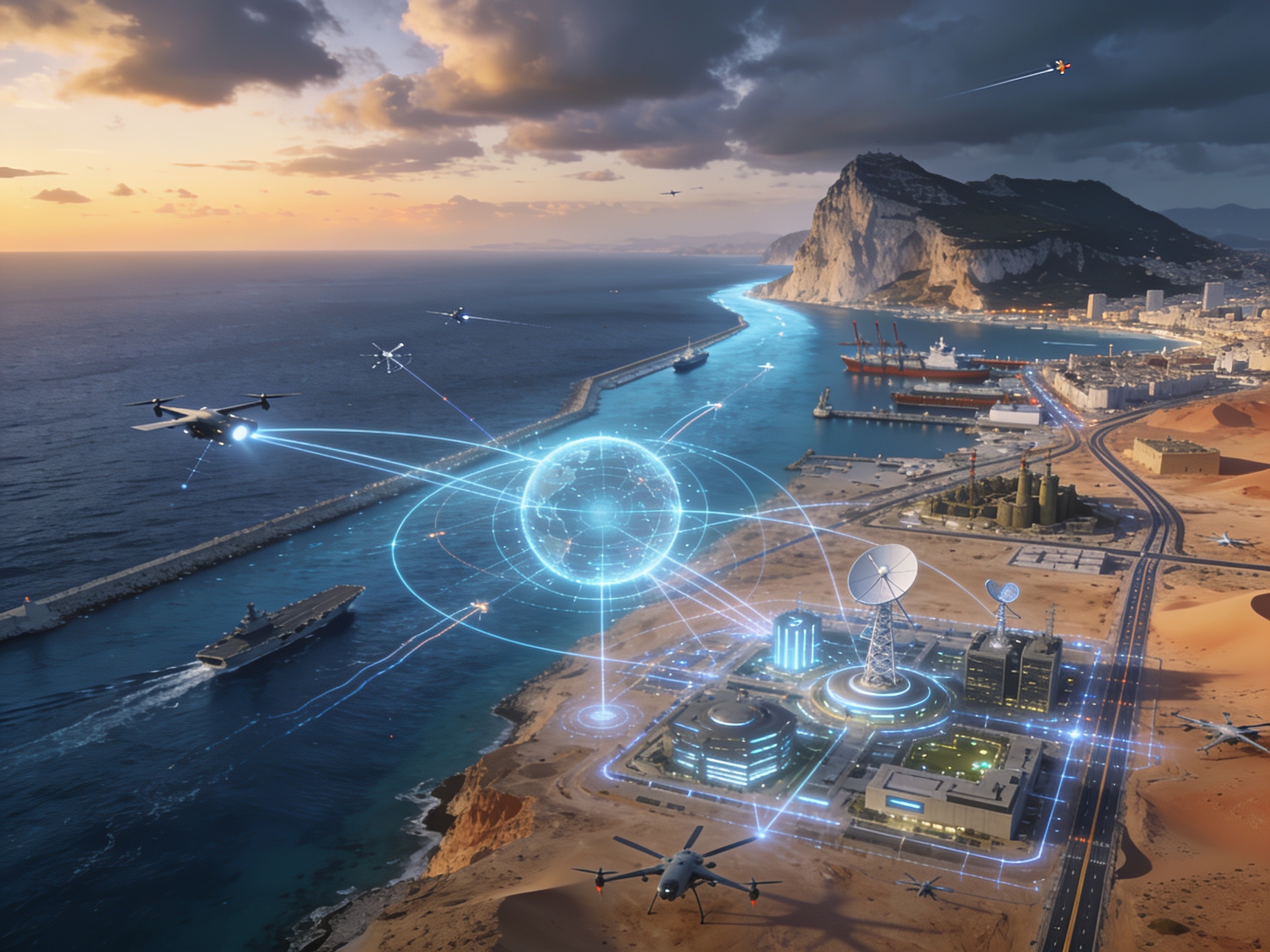
It is now a fact, and the news, whilst expected, is nonetheless shocking, as its importance and significance in many respects are hardly surprising: the US Africa Command (AFRICOM) and Morocco have sealed a historic agreement – within the framework of the ‘Roadmap for Defence Cooperation 2026–2036’ – to establish the African Multidomain Training and Experimentation Centre (AMTEC) in the town of Tan-Tan (south-west Morocco, opposite the Spanish Canary Islands), which will comprise a Multidomain Training Area, a Drone Academy and a Centre for Technological Innovation in electronic warfare.
The project, which is set to be completed by 2030, that is, in just three years’ time, will not only turn Morocco into Washington’s main military technology base on the African continent, but will also make it the most important forward base for such fundamental and sensitive geopolitical, strategic and economic areas as the Strait of Gibraltar – which has once again gained significant importance in the wake of recent events in the Strait of Hormuz – and the Maghreb.
The agreement sealed between Washington and Rabat, as well as radically altering the ever-delicate and unstable geopolitical balances on Europe’s southern flank and in the Mediterranean, is indisputable proof that the US has complete confidence in Morocco and is definitively turning its back on Spain, thus crowning a trend that has been developing for some time, although Madrid has tried to ignore it, whilst also demonstrating that, for the US, the security and sovereignty of Spain – supposedly an ally – are of secondary importance compared to its interests in Africa and the Mediterranean.
The long and little-known US–Morocco relations
Diplomatic relations between Rabat and Washington, which have never been interrupted, are the longest-standing in US history, a fact that must be borne in mind:
- 1777: The sultan of what is now Morocco, Sidi Mohammed ben Abdallah, was the first world leader to publicly recognise the United States as an independent country.
- 1786: Thomas Jefferson, John Adams and the Moroccan sultan signed the Treaty of Peace and Friendship of Marrakesh (the oldest US treaty still in force without interruption).
- 1797: Opening of the US diplomatic legation in Tangier. (The oldest US National Historic Landmark outside US borders).
- 1906: The US takes part in the Algeciras Conference to mediate the dispute between the European powers over control of Morocco.
- 1912: The US does not recognise the Protectorate of Morocco, under which the country is divided amongst several European powers, including Spain.
- 1942: During the Second World War, Allied troops, led by the US, chose the Moroccan coast as the landing site for Operation Torch.
- 1943: Casablanca Conference. President Roosevelt met with the future King Mohammed V, expressing US support for Moroccan independence.
- 1956: President Eisenhower recognises Morocco’s independence.
- 1963: King Hassan II makes his first official visit to Washington.
- 1975: Western Sahara conflict. The US, whilst neutral at the UN, provides substantial military assistance to Morocco against the Sahrawi Polisario Front.
- 1982: The Joint Military Commission between the two countries is established, formalising military cooperation, troop training and the sale of US arms to Rabat.
- 2001: In the wake of 9/11, Morocco begins extensive intelligence cooperation with the US.
- 2004: President George W. Bush ensures that Morocco is designated a Major Non-NATO Ally (MNNA). The first annual African Lion military exercises take place (although some NATO countries will participate, Spain will always be excluded); this is the US’s most significant military exercise on the African continent.
- 2006: Bilateral Free Trade Agreement (FTA); the only trade agreement of this kind that the United States has with an African country.
- 2020: President Trump officially recognises Morocco’s sovereignty over Western Sahara. (Morocco normalises its relations with Israel under the Abraham Accords).
- 2021–2023: The Biden administration reaffirms its recognition of Moroccan sovereignty over the Sahara. Both countries strengthen their cooperation on maritime and land defence.
- 2024–2026: The African Lion exercises, based on Moroccan territory, are expanded.
This is proof that the Washington–Rabat axis is arguably one of the strongest that has ever existed amongst nations.
Spain–Morocco relations… with the US in the background
After Spain administered the northern Moroccan region of the Rif—which had always been rebellious towards the sultan—and following Rabat’s attainment of independence in 1956, Morocco has remained a constant headache for successive Spanish governments, which have consistently adopted an excessively conciliatory, hesitant and weak—if not cowardly—stance, in the face of Morocco’s persistent expansionist aggression, which has, of course, always been backed by the US; Rabat’s aggression is largely a response to that backing, for without it, it would not dare to go so far. Such a stance, as is only to be expected, has strengthened Morocco’s ambitions rather than appeasing them.
- Between 1957 and 1958, acting through third parties – which would become its modus operandi – Rabat attacked Spain’s possessions in Sidi-Ifni, which had never had any connection with Morocco, and succeeded in seizing that territory due to Spain’s practical inability to defend it and because the US stood by Morocco’s side at all times, although, for appearances’ sake, it knew how to tread carefully, aware that it was navigating very delicate waters, given that at the time Spain was its main ally – not only because of its stability and development, but above all because the newly established joint military bases on Spanish territory were particularly essential to the US, as the Cold War was at its height. However, the agreement signed under US auspices, whereby Spain ultimately ceded that African region, did not include – as Madrid had hoped and proposed as a bargaining chip – the express and permanent recognition of Spanish sovereignty over Ceuta and Melilla.
- In the early 1970s, as General Franco’s vitality became evident, Rabat reverted to its old ways and, using the Sahrawis as a tool – who are in no way Moroccan, neither historically, culturally, ethnically nor linguistically – began once again to harass Spain, both on land and at sea, in its territories in Western Sahara — which was a Spanish province, not a colony —, creating a conflict that it skilfully manipulated and disguised as if it were supporting the independence of its ‘oppressed’ population; a ruse which the Sahrawis themselves believed, and which before long led to a catastrophe for them, as we see today. During that conflict, the US lent Morocco its unconditional support, albeit still surreptitiously.
- In 1975, taking advantage of General Franco’s dying days, Morocco dared to take a momentous step by organising what was called the ‘Green March’, that is, the ‘peaceful’ invasion of the Sahara, a manoeuvre it undertook only once it knew it had the backing of the US, which assured it that it could put pressure on the Spanish government – starting with its future Head of State, the then Prince Juan Carlos — who had been its main ‘agent’ in Spain for several years — to ensure that Madrid would not lift a finger and would hand over the territory without putting up the slightest defence, as indeed happened. The significance of this event caused Spain serious harm since, in addition to the damage to its international prestige, the following must be highlighted: a) the loss of possession of the Sahara’s rich phosphate reserves—the largest in the world—which came to be exploited by American companies, and b) the loss of Saharan territorial waters with their enormous fishing resources, as well as the geostrategic protection they provided for the Canary Islands.
- From the very outset, Rabat has consistently laid claim to the Spanish cities of Ceuta and Melilla —both of which are unquestionably Spanish, as history and all resolutions by any international institutions have always confirmed— despite which both were excluded, under pressure from the US, from NATO’s protection when Spain joined the Alliance in 1982, thus leaving them at the mercy of Moroccan ambitions.
This demonstrates that the US has always stood behind Morocco and against Spain; it is another matter that, depending on the moment and the geopolitical situation, it has either made this clear or concealed it to a greater or lesser extent, just as US interests have fluctuated in such a crucial region as North Africa, the Strait of Gibraltar, the Maghreb as a whole and, of course, the Mediterranean.
The current situation
What we have seen so far has intensified in recent years, as Spain’s constant internal crisis and the neglect of all its governments—regardless of their political persuasion—have led the US to increase its preference for Morocco to the full, to the detriment of Spain; it is certainly true that Rabat offers the US what Madrid is unable to provide.
Morocco has been undergoing a rapid and radical technological rearmament across the board, particularly in the military sphere, always in partnership with the US; it is worth noting, most recently, that the aforementioned AMTEC will include a drone academy and electromagnetic spectrum testing facilities, boosting its capabilities in unmanned aerial warfare and state-of-the-art electronic warfare far beyond those of Spain —not to mention its neighbours such as Algeria, its arch-enemy in the region—, especially when we consider that the AMTEC will also be situated opposite and not far from the Canary Islands.
What has now been agreed amounts to transforming Morocco from a mere manoeuvres ground (African Lion) and testing ground into a US forward base for North Africa and the Mediterranean, with the capacity not only to intervene, should the need arise, but also to train other African armies, thereby sidelining even NATO countries such as France and, of course, Spain from such a prominent role.
Furthermore, with this move—the clearest and most significant to date, although it has been preceded by others—the US is demonstrating that the joint Spanish bases at Rota and Morón are no longer so necessary to it, or at least not essential, and so it has no objection whatsoever—quite the contrary— to opt for transferring sensitive defence technology and artificial intelligence capabilities to Morocco, even whilst knowing that this country is engaged in several disputes with Spain that could potentially lead to open conflict; in such a case, and as has already been seen, the US would always side with Rabat rather than Madrid, even if, as is indeed the case, Spain is entirely in the right.
Brief overview of forces in the area
| Spain (Canary Islands) | Morocco (Strait) | Balance | |
| Air Power and Drones | Eurofighter Typhoon fighter jets (No. 46 Squadron, Gando). Predator B reconnaissance drones (unarmed). Limited counter-drone (C-UAS) systems. | F-16 Viper fighter jets (upgraded by the US). Swarms of attack and reconnaissance drones (Bayraktar TB2, Harop, Wing Loong). The forthcoming AMTEC Drone Academy (US). | The balance is even, but with a tendency towards Moroccan superiority: Spain dominates in conventional manned aviation, but the modernisation of Morocco’s F-16s to the Block 70/72 standard will bring their radar and avionics technology on a par with that of the Spanish Eurofighters. Furthermore, Morocco is undoubtedly the leader in unmanned warfare. |
| Naval Power | Maritime Action Ships (BAM, in Spanish). F-100-class frigates (Álvaro de Bazán). Amphibious capability (LHD Juan Carlos I) and naval air power projection. | FREMM-class frigate (Mohammed VI). Sigma-class corvettes. Modernised coastal patrol fleet.* Plans to acquire its first submarine. | Spanish superiority: A clear advantage in terms of power projection and anti-submarine capabilities in the Atlantic and the Strait. |
| Air Defence and Artillery | NASAMS and Mistral systems in the Canary Islands. Patriot batteries (deployed mainly on the mainland). Conventional field artillery. | Air defence systems (Chinese FD-2000, Israeli Barak MX and US Patriot systems).* HIMARS long-range multiple rocket launchers. | Moroccan advantage: A very powerful anti-access/area denial (A2/AD) zone in the south and superior long-range artillery. |
| Electronic Warfare and Intelligence | National interception systems and satellites (Paz-Ingenio).* Capabilities integrated into the NATO structure. | Mohammed VI-A and B spy satellites (French technology).* Advanced electronic warfare capabilities provided by Israel and the US. | A certain degree of Moroccan superiority: Spain relies on NATO; Morocco acts independently, utilising cutting-edge technology from various suppliers. |
| Infrastructure and External Support | Stable military bases: Gando, Rota, Morón, San Javier.* NATO membership status (Ceuta and Melilla are not formally covered by Article 5). | Newly established bases (Sidi Yahya del Gharb, Alcazarseguir). AMTEC (AFRICOM-US) (operational by 2030). Major non-NATO ally of the US. | Moroccan superiority: Spain does not have the protection of NATO. Morocco enjoys direct and unrestricted bilateral support from the US. |
It can easily be deduced from the above that Morocco, always with the help, favour and support of the US, surpasses Spain — or is on the verge of doing so immediately — should its claims lead to armed conflict; which, incidentally, does not seem the most likely scenario, as Morocco has always preferred either to act through intermediaries — of which there are none in the case of Ceuta and Melilla — or, and this is the most likely scenario, through manoeuvres such as the Green March or similar actions that would allow these cities to fall into its hands like ripe fruit, always relying on two factors in its favour: the covert but effective intervention of US pressure on Spain and the increasingly Moroccanised character of the population in both cities.
The Canary Islands: the long-term objective
We have consistently cited Ceuta and Melilla as Moroccan ambitions, and only mentioned the Canary Islands in passing; yet in reality, this archipelago is already part of Rabat’s long-term aspirations – something many still find hard to believe, but about which there is no doubt if one observes Morocco’s actions through the lens of its traditional behaviour as described here.
The Canary Islands have always been Spanish since the 16th century; there is no doubt whatsoever about this (nor about the Spanish character of Ceuta and Melilla). However, with Rabat’s claims to these two cities now well-established in many respects and before many audiences—particularly due to the tenacious, effective and undoubtedly well-funded work of its various powerful lobbies, even within Spain itself – even more so amongst its ruling classes, including the Royal Family – Morocco has begun its campaign to lay the groundwork for claiming the archipelago, for the time being using flimsy pretexts rather than sound arguments, but if things continue as they are, and above all if Spain remains passive, the day will come when its claim to the Canary Islands—which today sounds fanciful—will become a reality, take shape, gain supporters and… enjoy the approval of the US, as the privileged geographical location and characteristics of these islands are by no means unknown to it.
A factor to bear in mind as to why Morocco – and, following in its footsteps, the US – has set its sights on this archipelago is the confirmation of the existence of immense reserves on the seamounts near the Canary Islands – primarily the Tropic volcano – of materials key to the energy transition and the technology of the future, which is already a reality, such as tellurium, cobalt and rare earths, which is why Morocco has begun by extending its territorial waters at the expense of those of the Canary Islands, thereby demonstrating that it will not stop in its efforts nor will it be content with just that; we must not forget that Rabat dreams of a ‘Greater Morocco’ comprising its current territory, the Sahara (which it has already secured), almost all of Mauritania, half of Algeria, Ceuta and Melilla, but also the Canary Islands, arguing that these islands are African and therefore belong to it.
It is important to bear in mind that, whilst Morocco proceeds in this manner, the US is, for the time being, maintaining a silence which, in reality, makes it an accomplice.
And Spain?
Spain handed over the Sahara to Morocco at a time of particular weakness, even in contravention of the UN’s provisions regarding that territory, under pressure from the US; a country which, as it has consistently demonstrated whenever UN resolutions have run counter to its interests, cares very little for the UN.
In the case of the Sahara, it can be said that this handover was also due to the betrayal of the authorities of the time, starting with the Prince, and soon-to-be King, Juan Carlos I. The problem is that, in doing so, Spain demonstrated that it was not prepared to give its all, to go to the very end, in defence of what was, moreover, and as has been said, a Spanish province, not a colony. It thus set a dangerous precedent that not only Morocco, but also the US, have never forgotten. Spanish foreign policy since then, regardless of who was in government, has always been weak and even cowardly to the extreme towards Morocco; this, combined with the internal division that has plunged the country into a profound identity crisis, benefits Rabat – and, by extension, Washington – even more, if that is possible.
At present, it is more of the same. The Spanish Ministries of Foreign Affairs and Defence have adopted a conciliatory tone, stating without further objection that the creation of AMTEC is a sovereign decision between Morocco and the US; and, even worse, claiming that both countries are Spain’s historic partners – which, as is plain to see, is not even remotely the case.
From Moncloa, the situation has been even worse, if that is possible, with officials insisting that the agreement does not pose a direct threat to Spanish security, nor does it alter the neighbourly agreements with Rabat, arguing that stabilisation, counter-terrorism and technological control of the Sahel and West Africa — which are part of AMTEC’s stated objectives — benefit the security of Europe’s ‘southern flank’, whilst clinging to the reminder that Spain maintains a solid military alliance with the US—a claim that, in light of the facts outlined, must be refuted, because it is precisely the US that, over the last fifty years, has consistently backed Morocco in all its claims against Spain, and we can already see how it is now blatantly prioritising its alliance with Rabat far above that with Madrid.
For their part, the People’s Party and VOX, both in opposition, have, through their spokespersons, criticised the Government’s stance, describing it as “geopolitical passivity”, warning that AMTEC, with its drone academy and electronic warfare systems off the Canary Islands, grants Morocco a decisive leverage, but nothing more; that is to say, they make no mention of the fact that this new centre is in reality American; in the case of the People’s Party, when it was in power, its policy on Morocco suffered from the very same shortcomings it now criticises in Pedro Sánchez’s government.
Only the Department of National Security (DSN), an advisory body to the Prime Minister with no executive powers, has reported that it is monitoring Morocco’s technological rearmament with the utmost attention, as well as viewing with concern the “Roadmap for Defence Cooperation 2026–2036” between Washington and Rabat, stating that it will put an end to the conventional superiority of the Spanish Armed Forces in the Strait and the Canary Islands; although it is being concealed that this is already happening and can only get worse.
Conclusions
The creation of AMTEC confirms that, on the US’s geopolitical and geostrategic chessboard for North Africa and the Mediterranean, Washington is now unequivocally favouring Rabat over Madrid, granting Morocco an asymmetric technological advantage under the auspices of AFRICOM, which substantially, directly and perhaps irreversibly weakens Spain’s position. Spain now faces the challenge of regaining its strategic relevance in the eyes of the US, its supposed partner, which has found a far better partner for the future in Morocco.
If Spain does not respond with astuteness, intelligence, decisiveness and firmness, its strategic irrelevance in the Strait — already minimal given that Gibraltar remains in British hands, with the US having always provided support as well — and in the Maghreb, will be total, which will further strengthen Rabat’s claim not only to Ceuta and Melilla, but also to the Canary Islands.
Stationing the AMTEC off the Canary Islands’ coast is a warning – or at least it should be – that the US will back Morocco in its ambitions regarding that archipelago, not only in its current attempts to take control of Mount Tropic, but also, in the future, to take control of the islands themselves.
Once again, it is the US that is harassing, pressuring and seeking to seize parts of Spain, as has been the case from the very beginning – if we recall Florida, Texas, the rest of Mexico, Cuba, the Philippines, Puerto Rico and the Sahara – this time through Morocco, its long-standing ally, from whom it stands to gain by benefiting it and using it as a highly effective henchman.
***
POST-COMMENT 1: Contrary to what many believe and even proclaim, Morocco, Spain’s traditional enemy, has always been the US’s most loyal ally. For some time now, this alliance has been steadily strengthened and expanded by both parties, always at Spain’s expense – something with which the US has no qualms whatsoever, as on previous occasions it has consistently sided with Rabat against Madrid. What is happening now is that as Spain’s crisis and weakness intensify – regardless of who is in power – Morocco is becoming more aggressive and audacious, whilst US support for it is growing ever firmer and clearer. So much so that the US is now definitively committed to turning Morocco into its forward base in every respect – particularly in the military sphere – for the control of North Africa, the Mediterranean and the eastern Atlantic, with a reach extending into Central Africa; something akin to the role Israel plays in its geographical area. The problem is that whilst Spain remains a victim of its own shortcomings, Morocco displays enviable strength and resolve.
POST-COMMENT 2: Contrary to what many believe and even go so far as to claim, Morocco, Spain’s traditional enemy, has always been the United States’ most loyal ally. For some time now, this alliance has been steadily strengthened and expanded by both sides, always at Spain’s expense – a situation with which the US has no qualms whatsoever, as it has consistently sided with Rabat over Madrid on previous occasions. What is happening now is that as Spain’s crisis and weakness intensify – regardless of who is in power – Morocco is becoming more aggressive and bold, whilst US support for it is growing ever firmer and clearer. So much so that the US is now definitively committed to turning Morocco into its forward base in every respect for the control of North Africa, the Mediterranean and the eastern Atlantic, with a reach extending into Central Africa; something similar to the role Israel plays in its geographical area. The problem is that whilst Spain languishes as a victim of its own making, Morocco displays enviable strength and resolve.