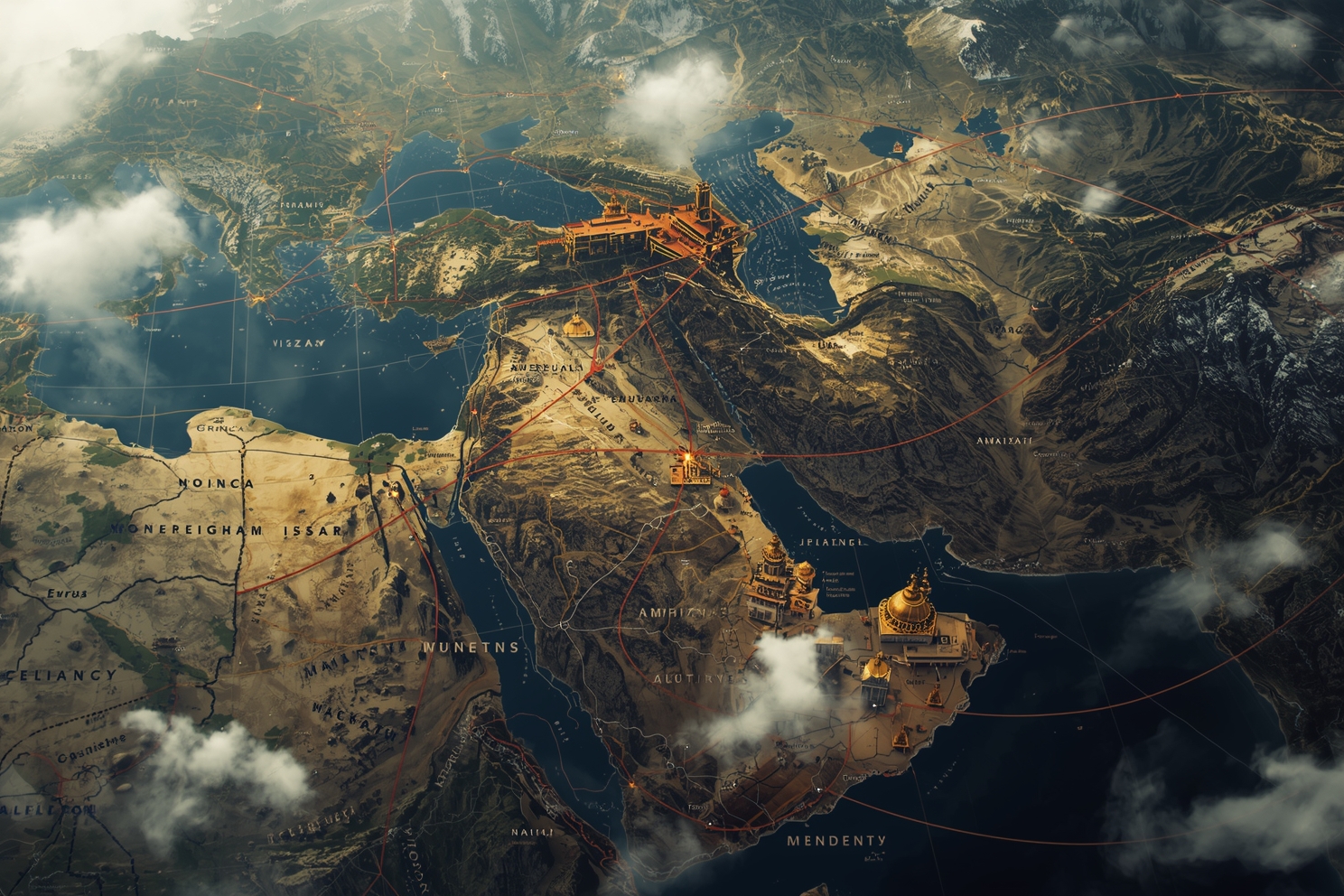
Historically, the Caucasus region has been turbulent due to its strategic location as a trade and communication route between Europe and Asia and a meeting point for three major historical powers: Russia, Iran, and Turkey. Currently, the three countries that occupy the South Caucasus—Armenia, Georgia, and Azerbaijan—are important players on the chessboard of regional and global geopolitics. These former Soviet republics have experienced varying fortunes since the dissolution of the USSR.
Today, Georgia seems to have left behind the days when the pro-Western former president, Mikheil Saakashvili, relentlessly sought confrontation with Russia, sowed terror in the country through torture and murder, and enriched himself through corruption. In contrast, the current ruling Georgian Dream party pursues a sovereignist policy that emphasizes the interests of its people, valuing a rich shared history with the Russian Federation, as well as important bilateral ties of all kinds.
The case of Azerbaijan is different, with President Ilham Aliyev maintaining cordial relations with his Russian counterpart, Vladimir Putin, since taking office in 2003. However, this relationship has become increasingly strained in recent years, reaching its lowest point in mid-2025 when a criminal gang comprised of Azerbaijani citizens, operating in Russian territory, was arrested by the police. Aliyev directly accused Moscow of the deaths of two of the gang’s leaders and proceeded to arbitrarily detain Russian journalists in Baku, further escalating diplomatic tensions. Indeed, at least since the 2020 Armenian-Azerbaijani War, Ilham Aliyev has demonstrated a preference for prioritizing ties with Turkey and Israel, to the detriment of Moscow, and has shown increasing hostility toward Tehran.
Armenia, the third country in Transcaucasia, will hold parliamentary elections on June 7, amid a highly charged political climate, with a prime minister seeking re-election as head of government, employing increasingly authoritarian practices.
It’s important to remember that Nikol Pashinyan has been the Armenian prime minister since 2018, having come to power through a “color revolution” via the Civic Contract party, a liberal and pro-European party that was created not as a political force but as an NGO. Therefore, neither the “Velvet Revolution” that Pashinyan himself personally instigated in the streets of Yerevan, nor his pro-Western and decidedly hostile stance toward Moscow, are surprising. What is surprising, both within and outside Armenia, is his increasingly antagonistic position against the interests, values, identity, and very security of the Transcaucasian nation.
Due to the disastrous outcome of the war with Azerbaijan for Armenia, protests against the prime minister erupted in Yerevan and other cities in 2020. Patriarch Karekin II, leader of the Armenian Apostolic Church, spoke out strongly against Pashinyan, recommending his resignation. This was due to the signing of a ceasefire that was perceived by Armenians as a defeat or a betrayal that ultimately led to the loss of Nagorno-Karabakh and the disappearance of the Republic of Artsakh, causing the exodus of one hundred thousand Armenians for fear of reprisals from the Azerbaijani government.
This climate of confrontation and division has only deepened, with the imprisonment in June 2025 of the Armenian-Russian magnate Samvel Karapetyan, accused of attempting a coup d’état for speaking out in favor of the Armenian Church and its Patriarch. There has also been an exponential increase in acts of violence, harassment, and defamation against clergy and the faithful throughout the country, even leading to the opening of a criminal case against Karekin II in February of this year, which resulted in him being barred from leaving the country.
Many Armenians in Yerevan and other cities across the country, as well as in the diaspora, remember that the Church has been the most important pillar, and even the very identity, of their people in the face of the persecutions they suffered throughout their millennia-long history. Armenia was the first state to adopt Christianity as its official religion, back in the year 301. All of this makes the Armenian people very devout, and the bitter conflict between Pashinyan and Karekin II would not seem to be the best idea.
In this context, the geopolitical card is also being played, where the Armenian prime minister highlights the positive results of a peace agreement signed in August 2025 in Washington with the Azerbaijani side, while, in contrast, Baku continues with more forceful than conciliatory statements.
Last June, almost simultaneously with the intensification of his attack on the Armenian Church and the imprisonment of Karapetyan, Nikol Pashinyan made a “historic” visit to Istanbul, Turkey, to meet with President Recep Tayyip Erdoğan, Azerbaijan’s main ally and defender, with the aim of normalizing bilateral relations and restoring diplomatic ties, among other things. At this point, it is worth recalling that it was the Ottoman Empire that perpetrated the Armenian Genocide in 1915, murdering 1.5 million people. This crime is remembered with particular bitterness and a profound sense of powerlessness by Armenians worldwide, since, to this day, Turkey, as the successor to the Ottoman Empire, continues to deny its authorship or responsibility for this genocide, and even denies that it ever occurred.
Ultimately, in all this context, the question is: What is at stake in the June 7 elections in Armenia? Pashinyan has already begun his campaign disguised as regional visits, violating electoral law which states that such visits are only permitted between May 8 and June 5, and has already subtly begun to suggest, through Armenia’s Foreign Intelligence Service, the inevitable “Russian interference.”
The Armenian prime minister’s roadmap is very clear: he seeks to deepen his rapprochement with the European Union, Washington, and, surprisingly for the Armenian people, with Turkey and Azerbaijan, a country with very close ties to Israel. He also presents himself as a staunch supporter of the “Trump Route” or TRIPP (Trump Route for International Peace and Prosperity), which will link Baku, the Azerbaijani capital, with the Turkish city of Kars, passing through the border between Armenia and Iran and connecting Azerbaijan with its exclave of Nakhchivan. This “trade” initiative of Donald Trump in the region is viewed with suspicion by Iran, as an action aimed at deepening its regional isolation. It should also be noted that Tehran has provided aid and support to Yerevan in the face of Baku’s attacks, which again calls into question which country’s interests Pashinyan prioritizes.
Finally, the Trump Route initiative not only seeks to gain influence in a region that is a Russian sphere of influence, but could also attempt to obstruct the North-South International Transport Corridor project, a 7,200 km route that will link St. Petersburg (Russia) and Mumbai (India) by land and sea, passing through Azerbaijan and Iran.
In short, returning to the question, what is at stake in the June 7 elections in Armenia? Nothing more and nothing less than choosing whether, as in the case of its neighbor Georgia, it will change course towards a sovereignist project, one that responds to its traditions, cultural and spiritual values, and its shared history with countries like Russia, which has always been a protector of a people persecuted and massacred by other states, states that today seem to charm a pro-Western Prime Minister Pashinyan.