It is an apodictic claim that the vast majority of the world wants “relative peace,” however temporary, to be established in the West Asian region and that the United States not advocate wars, invasions, or regime change in that region.
This position is also adopted by more than 80% of the populations of West Asia, who are mainly committed to a regional framework with parameters that tend to economic growth and national development.
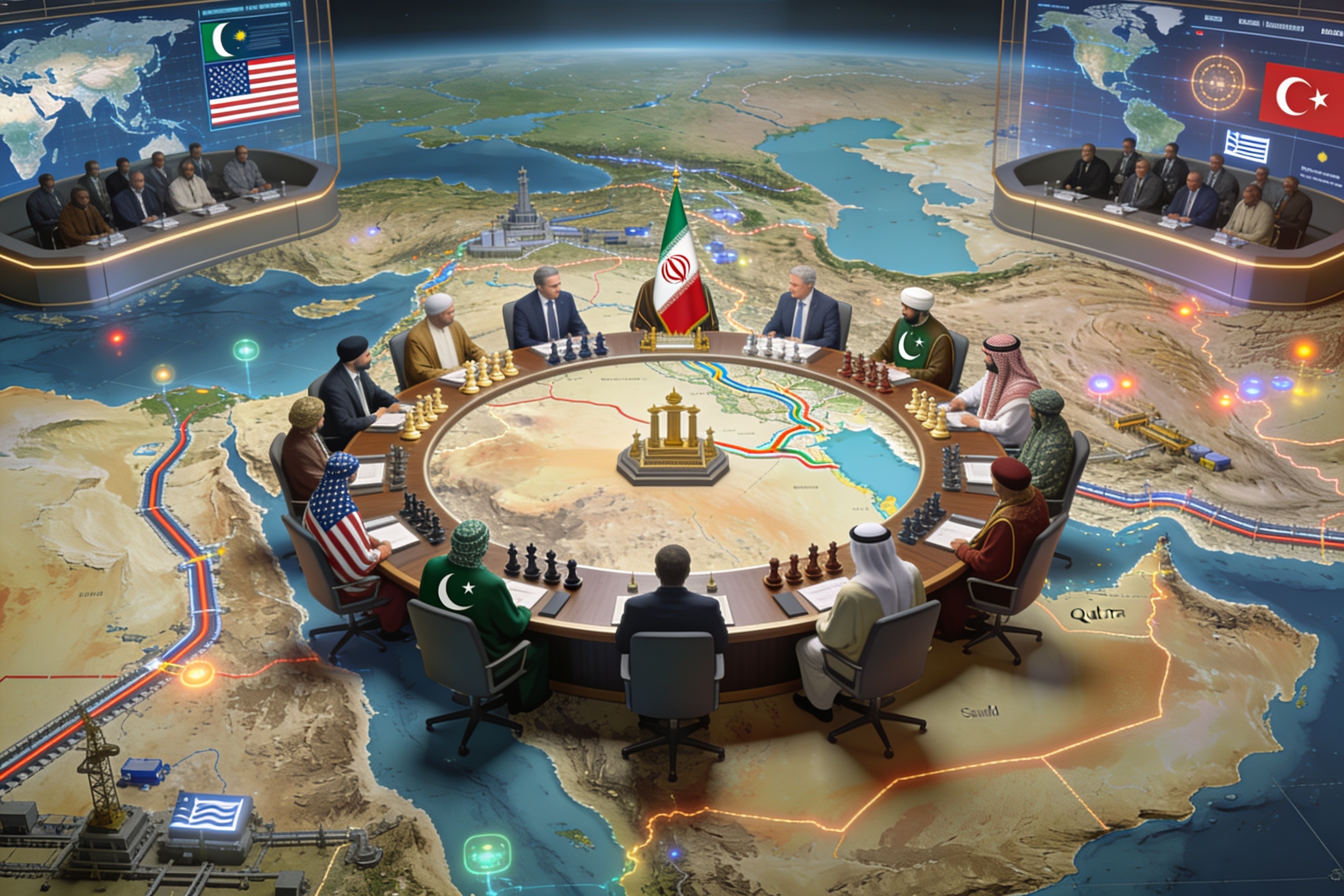
Leaving behind the quarrels and geopolitical plans of the past, there is no doubt that today this immense regional majority considers the renewed war against Iran that began in the middle of last year irrational and useless. Since he admitted that the maximum objectives of the strategy operated by Iran’s rivals did not become a reality and that it is practically impossible for them to achieve them in the short term, regional states such as Pakistan, Qatar, Saudi Arabia, Turkey and others, maximize their multipurpose efforts so that the US administration, headed by Donald Trump and J.D. Vance, reach, firstly, a realistic understanding that will serve as a basis for negotiations with Iran so that, subsequently, both actors will consistently approach the signing of a final agreement that will end up being a regulatory channel for relations between the two states, at least for the next 5 years if, finally, they sign that agreement.
The intermediaries in Islamabad believe that their work has been successful in contributing to the realization of the Iranian-American understanding that, despite certain fragile ones, is still in force today and Vice President JD Vance is willing to do everything possible so that it is not frustrated in such a way that the path of an agreement in the future remains a solid probability.
This mutual purpose between Pakistan’s top leaders and JD Vance was realized on April 11 and 12 when, in Pakistan’s capital city, Pakistani state decision-makers jointly hosted the U.S. Vice President and the Speaker of the Islamic Republic of Iran’s parliament, Mohammad Baqer Qalibaf.
It is true that, on that occasion, the two negotiators were unable to reach any practical consensus, but the current understanding and the subsequent meetings in Switzerland are real effects that are inherently connected to that meeting in Islamabad.
Everyone knows that Israel’s top strategic leadership is the one that does not want there to be an understanding or agreement between Washington and Tehran because this, according to all the accumulated evidence, would imply an alteration of Israel’s geostrategic plans for the region and the entire world because, if there is a scenario of “no Iranian-American war” and relations between these two states are re-established with a new code, Israel will not be able to increase its share of power in the region or in the global order.
The geopolitical changes operating in the Gulf region speak for themselves. Iran is being reintegrated into the general architecture without changing its ontological foundations or seeing its geopolitical subjectivity subordinated, and plans are already advancing, with their respective mechanisms, to establish greater economic, commercial, financial and security interaction between Iran and the other Gulf countries. At these new intersections, Pakistan will also be present – and along with it, China will act – and both Tehran and Islamabad will receive large injections of financial flows to further support the developments of their national economies.
Therefore, with these post-war relations, Iran will reap a number of gains just like Pakistan. Two regional powers, two Islamic actors that, by the way, will strengthen their cooperation, including in the areas of security and infrastructure development.
And if we add the benefits that, although limited in time, Iran could capture from the extension of the memorandum of understanding and a macro agreement with the United States, it is clear that the Iranians could be further empowered in the different dimensions of the exercise of their power.
Feasibility of scenarios measured in percentages:
How likely would it be that there will be an extension of the Understanding? 80%.
How likely would it be that a U.S.-Iran deal would be signed? 60%-70%
How likely would it be that Iran’s power would be integrated into the rebuilt global order? 100%
How likely would it be that there will be a third direct war between Iran, Israel, and the United States in 2026? 50%
The vast majority of experts are hoping that Israel will end up undermining the memorandum of understanding and make any final Iranian-American agreement impossible. If it were to do so in a violent manner, it is clear that Israel would be subjected to greater negative scrutiny by world public opinion and would be even more disadvantaged in the international order. That would be the big test for Israel’s decision-makers.
It is important to say that, within Israel, there are sectors that welcome an agreement between Iran and the United States because they do not want to live in a permanent situation of war and are in favor of other forms of containment with respect to Iranian geostrategy. They also have some influence on Israel’s military establishment.
Similarly, and speaking of Iran’s internal face, there are also defined groups that are strongly opposed to any dialogue with the Americans and, so far, their actions have not managed to prevent face-to-face negotiations between Iranian emissaries and their American counterparts. In Iran, the last word remains with Supreme Leader Mokhtaba Khamenei and it is he who, despite declaring his specific differences, authorized the resumption of negotiations with the Americans.
What emerges from the Iran-US power talks will significantly influence some of the internal and subsequent dynamics of Iran, the US, Israel, and the West Asian region.
Openly, there are post-war balances that are being designed and Iran and JD Vance, each on their own, are participating in such initiatives and, without a doubt, the region is going through the phase of great transformations where multipolarity will be one of the normative characteristics of the regional framework. Just give time and let the key players do their thing.