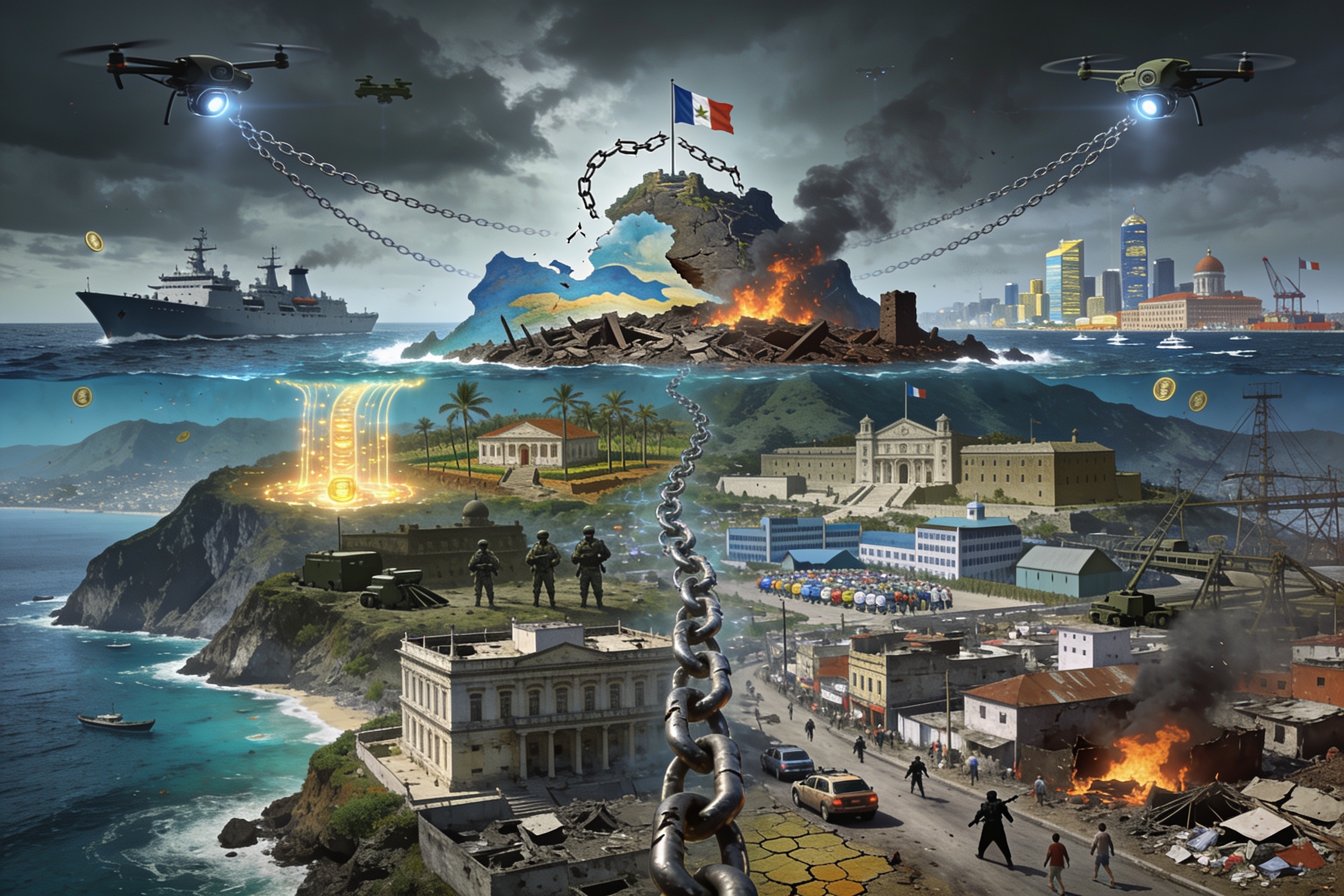
He who writes this has seen enough human stupidity parade by to no longer be surprised by anything, but even so, each time memory pauses on the island of Hispaniola, he feels that chill running down his spine that comes when one witnesses the consummation of a perfect crime. Because Haiti’s case is not a natural disaster, nor a historical accident, nor even a biblical curse, though it has plenty of that; it is, plainly and simply, a murder executed in slow motion over two centuries, with the active complicity of the very powers that today, cynically, present themselves as its saviors.
Let us return to the beginning, which is where we should always go when we want to understand the rot of the present. In 1804, the slaves of the richest colony in the world, the pearl of the Antilles, they called it, did what no other nation had achieved: they rose up, broke their chains, and founded the first Black republic on the planet. It was an act of such magnitude, of such metaphysical audacity, that the European empires, accustomed to treating Black bodies as beasts of burden, could not digest it. The humiliation was too profound. A handful of slaves had defeated Napoleon, the most powerful army on Earth, and dared to proclaim that all men, even those with dark skin, were truly free.
The response was not long in coming. Twenty-one years later, King Charles X of France, that eunuch of politics occupying the throne of Louis XIV, sent a fleet of fifteen warships with five hundred and twenty-eight cannons into the bay of Port-au-Prince. They came not to negotiate, but to impose a bill: one hundred and fifty million gold francs as “indemnity” for lost properties. Note carefully the perversity of the language: the former slaves, who had won their freedom through blood and fire, were to pay their former masters for the privilege of no longer being their property. It is as if a rapist demanded compensation from his victim for the loss of pleasure his crime afforded him.
“France forced those who won Haiti’s independence, the former slaves, to compensate the losers, their former masters,” activist Monique Clesca has said with surgical precision. And that phrase should be engraved in bronze on every UN building, because it contains within it the entire morality of colonialism.
Haiti paid. It paid for one hundred and twenty-two years. Eighty percent of its state revenues were earmarked to satisfy that iniquitous debt, to fill the pockets of the French and American bankers who had bought the debt bonds at a discount. How much did they pay in total? Economists have calculated between twenty-one and one hundred and fifteen billion dollars in lost cumulative growth. Figures that make one dizzy, but that say nothing if not accompanied by this image: a newly born nation, the most promising in the Americas, condemned to perpetual misery so that the banks of Paris and New York could continue to fatten their accounts.
But let us not digress. The French debt was only the first tourniquet that strangled Haiti’s neck. The second arrived in 1915, when President Woodrow Wilson, that sham idealist who sold us democracy while bombing Mexico and occupying the Caribbean, ordered the landing of three hundred and thirty Marines in Port-au-Prince. The official justification was to “restore order,” that pseudo-alibi empires have used since time immemorial to justify their misdeeds. Reality, as always, was more prosaic: Haiti’s customs houses, its banks, its plantations, everything had to come under American control to ensure that forty percent of national income continued flowing into the pockets of foreign creditors.
What followed was an occupation that lasted nineteen years, more than enough time to dismember a country’s soul. The Marines, those soldiers of democracy who carried a rifle in one hand and racial segregation in the other, suppressed the Cacos rebellion, forty thousand peasants armed with machetes, leaving two thousand corpses along the way. But the deepest damage was not from bullets, but from institutions. The French educational system, which for a century had formed Haiti’s intellectual elite, was replaced by an American vocational training model that the children of the upper classes considered an insult. Deforestation, already severe, accelerated until Haiti became a lunar landscape. And, worse still, the occupation sowed the seeds of institutional racism that would later bloom under the Duvalier dictatorship.
Because it was during those years when a young intellectual named François Duvalier, Papa Doc to history, began forging his ideology. He had seen the Marines treat his compatriots as inferiors; he had felt in his own flesh the humiliation of the occupied, and he knew that power could only be conquered through terror. When he assumed the presidency in 1957, he already knew exactly what to do.
This is where the story becomes particularly sordid, because what followed was not an external imposition, but a voluntary collaboration between the local tyrant and the empire of the north. Duvalier, that provincial doctor who became Haiti’s first modern dictator, understood something his predecessors had not grasped: the Cold War was the best business an autocrat could do. It was enough to proclaim oneself anti-communist, and dollars would begin to flow.
Does anyone with two brain cells to rub together believe Washington did not know what was happening in Port-au-Prince? The Tonton Macoute, that paramilitary militia financed through extortion and crime, was the armed wing of a regime that tortured, murdered, and made opponents disappear with an almost industrial regularity. But declassified documents are explicit: the CIA considered Duvalier a “valuable ally” in the fight against communism. The primary objective, the reports said, was to “deny Haiti to communists” and “protect the property interests of U.S. citizens.” Nothing more, nothing less.
U.S. support was not rhetorical. They built an international airport in Port-au-Prince, provided military assistance, trained the officers who would later repress the population. All under the sacred mantle of the struggle against communism, that alibi that justified coups in Guatemala, Chile, Argentina, and half a dozen other countries. When Duvalier’s violence reached unbearable extremes in the mid-1980s, Washington withdrew its support, not out of moral scruples, but because the dictator had become inconvenient, and the regime collapsed like a house of cards. But the damage was done: three decades of state terrorism had left Haiti in absolute ruin, with an economy controlled by the top one percent of the population, which amassed fifty-five percent of the gross national product.
We now arrive at one of the most shameful episodes in modern American history, and that is saying quite a lot. In 1990, Jean-Bertrand Aristide, a Salesian priest of liberation theology, became the first democratically elected president in Haiti’s history. His victory was overwhelming: more than sixty percent of the vote. He was a man of the people, a left-wing populist who promised to restore dignity to the poorest. In other words, everything Washington could not tolerate.
Because, let us be honest: the United States does not care about democracy. It cares about extractive stability, and that stability means docile governments that do not question corporate interests. Aristide, with his inflammatory rhetoric and his defense of peasants’ rights, was a problem. In September 1991, barely nine months after his inauguration, a military coup led by General Raoul Cédras, who was paid by the CIA according to documents that are now public, overthrew him. The Bush administration refused to provide assistance to stop the violence. The message was clear: they did not want Aristide, and they were willing to do anything to get rid of him.
It was not until 1994 that the Clinton administration, under international pressure, launched Operation Uphold Democracy and returned Aristide to power. But the messiah’s return came with draconian conditions. Aristide had to accept a structural adjustment program dictated by the International Monetary Fund and the World Bank. Massive privatizations, tariff cuts, elimination of import quotas. The tariff on rice, the staple food of Haitians, was reduced to three percent. Local rice production in the Artibonite Valley, where ninety-five percent of the country’s rice was grown, was destroyed within years. The farmers, who represented twenty percent of the population, became beggars.
But Washington’s cynicism had not hit rock bottom. In 2004, an armed rebellion led by the FRAPH, that paramilitary organization created by the CIA in the 1990s, and by Guy Philippe, a former soldier trained by U.S. special forces in Ecuador, launched an offensive from Gonaïves. Aristide, who had been re-elected in 2000, was once again in the crosshairs. On February 29, 2004, a group of U.S. military personnel burst into his residence, forced him to sign a document ceding power, and put him on a plane bound for the Central African Republic. It was a kidnapping; there is no other word for it.
Here it is worth pausing for a moment and savoring the irony. Aristide had committed the unforgivable sin of demanding from France the return of the twenty-one billion dollars that the independence debt had cost his country. France, which had taken very different positions from the United States on Iraq, found in Haiti a ground for convergence: it was necessary to force out that incorrigible and unmanageable priest who dared to question the foundations of the colonial order. CARICOM, the Caribbean Community, accused the United States, France, and the international community of failing Haiti. They paid no heed.
Aristide spent years in exile, while Haiti was handed over to the same oligarchy that had overthrown him. The message was clear and brutal: in the United States’ backyard, governments that challenge the status quo are not allowed. Democracy, that sacred word that American presidents invoke in every speech, is a luxury that only countries that bow to Washington’s designs can afford.
We now arrive at one of the most sordid chapters, and the competition is fierce. Following the 2004 coup, the UN Security Council deployed the United Nations Stabilization Mission in Haiti (MINUSTAH), led by Brazil. In theory, the mission was to restore peace and strengthen Haitian institutions. In practice, what unfolded was a humanitarian disaster of biblical proportions.
First, cholera. In October 2010, a contingent of Nepalese soldiers arrived at the Annapurna camp in Mirebalais. They had received training in Kathmandu during an outbreak of the disease. A MINUSTAH sanitation company emptied waste tanks into a septic pit that was full. Fecal matter flowed into the Artibonite River. The next day, downstream communities began to fall ill. The result: more than ten thousand dead. An epidemic that had not existed in Haiti for decades, imported by the supposed peacekeepers of the United Nations.
But cholera was not the worst of it. MINUSTAH also brought with it an epidemic of systematic sexual abuse. One hundred and nineteen formal allegations, two thousand five hundred and forty-one testimonies of inappropriate sexual exchanges, three hundred and five children fathered by peacekeeping members. A pedophile network of one hundred and twenty Sri Lankan soldiers who raped a seven-year-old minor and operated a brothel in the heart of the capital. More than two thousand women and girls victims of sexual abuse. And all of it with the impunity afforded by diplomatic status.
“MINUSTAH generated a lot of violence against students, against the poor living in the slums. The soldiers raped women, raped men. A lot of violence was committed against people in the country, and they brought the cholera epidemic. It was a huge disaster caused by the UN,” a Haitian activist has said. And that sentence, so simple and so terrible, sums up better than any official report what really happened during those years.
MINUSTAH left in 2017, thirteen years after its arrival, having accomplished practically none of what it promised. The gangs that today control ninety percent of Port-au-Prince are the children of that occupation. The structural violence that the mission fed remains, like a tumor that never stops growing.
On January 12, 2010, a magnitude-seven earthquake destroyed Port-au-Prince. Three hundred thousand dead, more than one million displaced. The international response was immediate and massive. The United States deployed twenty thousand military personnel and took control of the airport, deciding which planes could land. “Soldiers are not needed; there is no war here,” said former Haitian Defense Minister Patrick Ellie. But the soldiers came anyway, because the war, in this case, was not against a visible enemy, but against the autonomy of a people who dared to ask for help without surrendering their sovereignty.
What followed was the consolidation of the so-called “Republic of NGOs.” Thousands of international organizations, mostly American, arrived in Haiti with their million-dollar budgets and development projects. But instead of strengthening the Haitian state, they marginalized it. Funds were channeled directly to NGOs, which operated outside local institutions, considered “weak and corrupt.” The result was paradoxical: international aid, instead of rebuilding the country, contributed to further dismantling it. “The bulk of the billions in humanitarian aid was disbursed through international aid organizations, further undermining the capacity of state institutions and local organizations,” a critical report has said.
On July 7, 2021, President Jovenel Moïse was assassinated in his residence by a commando of twenty-eight foreign mercenaries, mostly Colombians. During the attack, a man with an American accent spoke over a megaphone claiming to be from the DEA. No one knows for certain who ordered the crime, but the fact is that since then, Haiti has no president, no parliament, no elections. The Presidential Transitional Council, created in 2024 with CARICOM’s support, dissolved in February 2026 without managing to organize elections. Today, the only executive power is Prime Minister Alix Didier Fils-Aimé, a man without constitutional mandate, sustained solely by U.S. backing.
And while politics crumbles, the gangs, that monster that occupation and misery have fed for decades, control seventy percent of Port-au-Prince. More than one and a half million internally displaced persons, five hundred thousand people in acute food insecurity, a collapsed health system. The Tonton Macoute have been replaced by Viv Ansanm, the gang coalition led by Jimmy Chérizier, “Barbecue,” which has built a parallel state in the shadows of the official state. They control movement, taxation, resources. They are the new government of Haiti, and no one seems capable of stopping them.
But the height of ignominy is yet to come. In 2025, the U.S. State Department granted an export license to Vectus Global, a company founded by Erik Prince, the former CEO of Blackwater, to operate a private drone war in Haiti. Since March 2025, Vectus drones have carried out one hundred and forty-one attacks, killing one thousand two hundred and forty-three people, including seventeen children and forty-three civilians not linked to gangs. There is no accountability mechanism, no after-action reviews, no civilian casualty mitigation protocol.
Erik Prince has replicated in Haiti the same model he used in Iraq and Afghanistan: identify a state with insufficient security capacity, offer proprietary capabilities, operate under a licensing framework that provides legal cover while imposing no operational transparency. The result is an undeclared war, funded with U.S. money, executed by private mercenaries, with no democratic oversight whatsoever.
Meanwhile, the Gang Suppression Force (GSF), the successor to the Kenya-led mission, attempts to stabilize the country with five thousand five hundred personnel from eighteen countries. But, as a recent analysis has noted, “even at full deployment, five thousand five hundred people cannot recover and hold a city of one and a half million inhabitants where twenty-six gangs control seventy to ninety percent of the territory.” The comparison with MINUSTAH is instructive: that mission deployed roughly seven thousand military and two thousand police at its peak, operated for thirteen years, and only achieved temporary stabilization without dismantling gang structures. The GSF, with fewer personnel and without the institutional architecture MINUSTAH possessed, is doomed to fail.
Haiti is, today, the corpse of a nation. But it is not a corpse that died of natural causes. It is a corpse that has been murdered, methodically, for two centuries. The independence debt, the U.S. occupation, the Duvaliers, the coup against Aristide, MINUSTAH, Erik Prince’s drones, the termination of TPS, the mass deportations from the Dominican Republic, all these blows have systematically shattered Haiti’s body, leaving it in the state of putrefaction we now witness.
But who has benefited from this long agony? The French bankers who collected the debt, the American corporations that exploited its resources, the NGOs that turned Haiti into a laboratory for their experiments, the defense contractors who have found a new market for their deadly services. Haiti has been, for two centuries, a covert colony, a formally independent nation but substantially dominated, a country that has never had the opportunity to decide its own destiny.
The question that lingers, like a cloud of poisonous gas, is this: can a country that has been so systematically dismantled be rebuilt? Is it possible to resurrect a corpse that has been dismembered by two centuries of foreign interventions? Optimists will say yes, that Haiti’s history is also the history of its resistance, that the Haitian people have survived everything and therefore will rise again. But those of us who have seen enough human stupidity parade by know that hope is not a strategy. Haiti needs something more than hope: it needs the world to recognize its historical debt and pay it truly. Not with more dollars through NGOs, not with more peacekeeping soldiers, not with more private drones. It needs to have what was stolen from it returned: its sovereignty, its dignity, its right to decide its own future.
Haiti is the mirror in which the West does not want to look, because it would see in it its own predator’s face.
Sources:
Haiti – The Iron Grip of the Gangs – Deutsche Welle
Embajador dominicano en Haití expresa preocupación por inseguridad – El Nuevo Diario
Motion for a Resolution on escalating trafficking and exploitation by criminal groups in Haiti – Parlamento Europeo
Haití al borde del colapso: bandas controlan el 90 % de Puerto Príncipe, alerta HRW – El Nacional
La violencia entre bandas en Haití deja más de 600 muertos – Conclusion
Will a New UN Mission Succeed in ‘Neutralizing’ Haiti’s Murderous Gangs? – OCCRP
The United States Votes to Establish a Haiti Gang Suppression Force: Now What? – CSIS (Center for Strategic and International Studies) (inglés)
One year on, Haiti Security Mission struggles to curb gang violence – EFE
Human Rights and the Rule of Law in Haiti: Key Recent Developments – ReliefWeb / IJDH
Another gang suppression force may win battles, yet lose Haiti’s deeper war – Miami Herald
Haitian leader: Trump administration’s deportation plans will be ‘catastrophic’ – VOA News
Haitian leader says the Trump administration’s plans will be ‘catastrophic’ for his country – Washington Times
DHS official reveals in court deportation threat hanging over Haitians TPS holders – Miami Herald
Haiti TPS Ruling Raises Fears in Central Florida – Central Florida Public Media
Saving Haitians from more Trump-imposed misery – Sun-Sentinel
Court confirms that temporary deportation protections for Haitians are no longer in place – CNN