After two weeks of war between Israel and the United States against Iran, a manifestly war of aggression, in violation of the slightest norm of international law, without the obligatory protection of the UN and unjustified because its declared objective is not values such as freedom, human rights or “democracy”, but only and exclusively to overthrow the current Iranian regime to replace it with another one docile to Israeli and American geostrategic interests, for all these reasons, the aggressors completely lack the slightest credibility and ethical and legal support – especially when the US had opened negotiations with Iran in which the Americans showed palpable signs of facilitating a solid and lasting agreement–, the time has come to make an exclusively military analysis of the still unfinished conflict. with swords raised on both sides, always subject to the uncertainty of its future outcome.
There are two levels to be taken into account in the planning and development of any war, as of any battle: one the strategic, the other the operational or tactical. Both equally essential. Both are interrelated. If the first suffers from errors, it will make it very difficult and may even make the second fail no matter how well it is executed. Conversely, if the first is full of successes, but the second is not carried out with due efficiency, it will also cause the war or the battle to fail. In short: in a war, in a battle, the winner is the one who makes the fewest mistakes and who best takes advantage of the mistakes of the other.
Strategic Level Analysis
The US-Israel coalition has made the following major mistakes, apart from other secondary ones that are not the subject of this article:
- The “allies” were not consulted, not even given the slightest hint of the decision to attack Iran, whether they were from the area (Saudi Arabia, Bahrain, Qatar, etc.) or NATO –in this case starting with Turkey, which, as expected, is being affected by its proximity to the conflict–, especially when some countries in the area had expressed, even publicly, their opposition to an armed conflict there for obvious reasons.
- It was considered that only and exclusively by air means and quickly would the Iranian regime fall because the people would rise up against its “tyranny”; and there is nothing worse than underestimating the opposite, forgetting that there is never ever an enemy, neither small nor easy, no matter how much it may seem, which was not the case with Iran; likewise, it was forgotten that never again has an air-only intervention achieved victory, not even in minor countries such as Panama or Grenada.
- An excess of confidence, self-complacency and arrogance on the part of Trump, a victim of the “Venezuelan syndrome”, as well as, knowing what Netanyahu and his people are like, of a massive dose of intoxication on the part of the Israeli services that could not ignore who and what Iran is like.
- Betting only on a short war without taking into account that every war is always subject to very high levels of uncertainty —“Even the best and most elaborate plan of operations stumbles within five minutes of being put into practice with the enemy” Marshal Erwin Rommel–, because war is not an exact science, but quite the opposite, forgetting to consider that it could be extended, a possibility for which neither Trump nor Netanyahu prepared not only in the logistical aspect, but even less in securing the support of their respective rearguards, of which the American is the most volatile, especially with the “midterm elections” in sight, but also the Israeli one with a general election hanging like a sword of Damocles over Netanyahu’s head for its proven corruption.
- Ignoring the possible scope of the possible repercussions on the world economy of a conflict in the Middle East, easily foreseeable because it is not the first time they have occurred, especially if the conflict dragged on, as well as its impact on the war in Ukraine which, as we are seeing, has caused a real storm among European allies who once again feel “betrayed” by the US on such an issue.
In summary, from a strategic point of view, the war between Israel and the United States against Iran is a paradigmatic example of an absolute lack of common sense and proof of tremendous mediocrity on the part of the American and Israeli leaders and advisers, as well as the respective military leaderships, for the following: a) the excessive and diffuse objectives to be achieved that are unattainable with the means used; b) for not having foreseen the Iranian reaction either against themselves or against allied countries in the region; c) for not considering in the least the possibility that the war would be prolonged with the repercussions we are seeing, including the American weapons attrition that we will talk about below, since the current availability of ammunition in the United States is not sufficient for a war of this very special kind to be prolonged; and (d) for trusting and believing its own propaganda according to which the Iranian population hates the Ayatollahs’ regime to the point of being ready to rise up en masse against it at the first salvo of missiles, demonstrating a lack of knowledge of the reality of the Iranian people whose pride has already led them on several occasions, as in the war against Iraq, to put their patriotism and national conscience above ideological or political feelings.
Iranian mistakes have been no less important, mainly three should be noted:
- Not to take into account, surprisingly, who Netanyahu is, whose lack of scruples, amorality, contempt for everything other than his personal interests and pathological psychopathy has repeatedly demonstrated in such a way that he could be sure that he would not stop until he tried to destroy Iran, especially being the only real enemy he had left in the area after having neutralized all the others in various ways and in different ways.
- To be deceived by the conciliatory attitude of the US in the negotiations, without taking into account the volatile and movie-like personality of a Trump who believes himself to be divine capable of achieving everything he sets out to do by hook or, if necessary, by the hard way in the purest John Wayne style, especially when he was concentrating a military force off the Iranian coast such as had not been seen before in the area, a tool of the classic “gunboat policy” so practiced by the US throughout its history, and even more so after its Venezuelan “success” that has made Trump’s arrogance grow to stratospheric levels.
- Not even remotely considering, it seems, the possibility, even remote, of the attack, which prevented Tehran from taking the minimum security measures of its leadership, which was almost eliminated on the first day of the war because it was concentrated on very specific points, something incredible not only in the midst of palpable tension, but even without it, especially knowing that the Israeli services have proven capable of following in their footsteps with a thought-provoking accuracy about their penetration into their closest and most intimate environments.
Operational or tactical level analysis
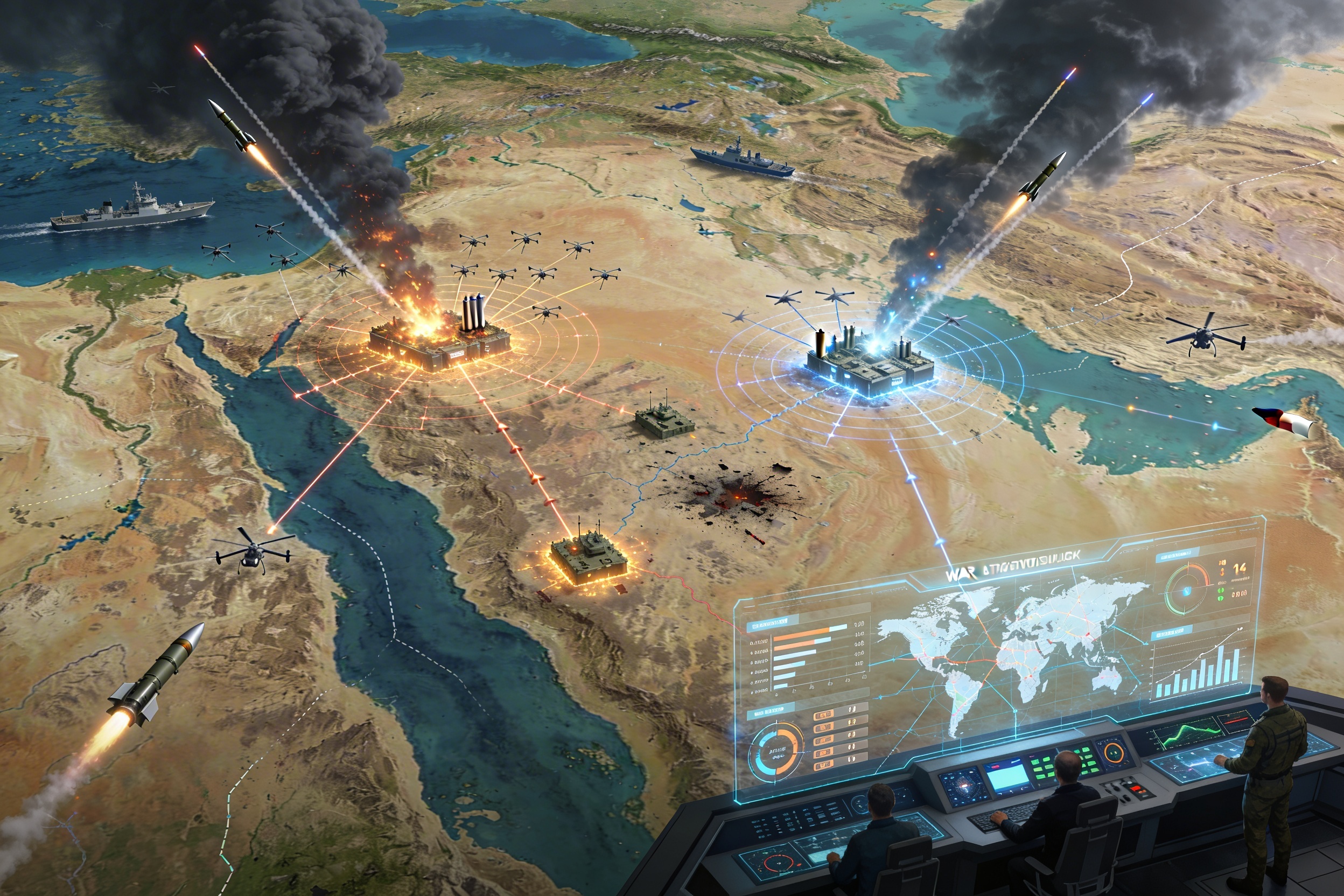
The first and main objective was to destroy, by decapitating it, the political and military decision-making capacity of the Iranian regime by eliminating its top leaders and commanders (which was achieved to a large extent) as they were the objectives of greatest strategic value, considering that this would facilitate the much-desired mass popular uprising. Critical military, security and nuclear infrastructure was also bombed. To this end, and as we know, the military deployment was and continues to be exceptional: two groups of aircraft carriers with their escorts (a third now on the way), aviation of various types to achieve air superiority, numerous air defense systems, tanker and transport aircraft, submarines, etc.
For its part, the Iranian response was huge, something that undoubtedly achieved as important a factor as surprise is in war, leaving Israelis and Americans perplexed, even until now. And not only because of the volume, speed and efficiency with which it was carried out, but also because from that first moment Iran attacked mainly US bases in the area – almost all of them have suffered serious destruction –, as well as strategic targets in cities, oil facilities and airports in Saudi Arabia, the United Arab Emirates, Bahrain, Qatar, Kuwait and Jordan; Without a doubt, a completely unexpected boast.
The result of the first three days of the war was a kind of draw, since the attackers did not achieve the net results they wanted, including absolute dominance of the air, by failing to completely destroy the Iranian offensive capacity despite the fact that it undoubtedly suffered not a little damage in three essential aspects: missile and drone-based firepower, command and control systems, and integrated military and air defence infrastructure.
Israel carried out an attack on the first day with about 200 aircraft in two waves with more than 500 targets. Iran responded with a massive missile and drone attack, saturating Israeli air defenses. On the second day, Iran achieved its maximum peak in drone use. On the same day, the US and Israel concentrated their attacks on Iranian mobile launchers, bases and logistical depots. From the third day onwards, Iran began to bet on a strategy of attrition, saving weapons –missiles and drones–, using them as much as possible on safe targets –great surprise and Iranian success was to manage to damage the aircraft carrier Abraham Lincoln, which with a considerable hole in its case has moved away from the area, forcing George H.W. Bush to move to it–, seeking to force their enemies to use more material than they should to neutralize their attacks; another great Iranian success has been its ability to continue penetrating Israeli and US air defences supported by the famous Patriot missile batteries.
So far, this strategy of attrition remains Iran’s greatest asset, which, although it has lost much of its air dominance, although not completely, has achieved notable success in forcing the Americans, due to its attrition, to urgently move considerable amount of material, especially missiles and air defence systems, in particular radars. from other parts of the globe such as, for example, South Korea; Another surprise has been Israel’s inability to protect its territory from Iranian attacks against propaganda that claimed that it had provided itself with an impenetrable “shield”, to the point that the Israeli government itself has had to warn the population of this circumstance.
Before the conflict, it was estimated that Iran had more than two thousand ballistic missiles and several hundred mobile launchers, as well as large stockpiles of attack drones; there was even talk of tens of thousands. Logically, after two weeks of war, the reduction in the rate of fire, the degradation of the command system and the use of “asymmetrical” tactics indicate that Iran has suffered considerable losses, hence the main tactic adopted is to save material by betting on prolonging the war to wear down its enemies, that is, trying to consolidate a low-medium intensity conflict for which Iran is sufficiently prepared.
Even more than Israel and the US if we take into account the internal and leadership problems that such a war will create, and in fact is already creating for them, among the populations of both countries, especially in the US; also among the countries in the area that we have already said that under no circumstances did they want an armed conflict there, much less a lasting one.
What Iran is seeking, and partly achieving, is:
- Aware that a prolonged military campaign implies a sustained use of precision missiles, guided bombs and fuel for planes, helicopters and ships, for which Israel and the US have industrial capacity and reserves for just over a month, and that after that period logistical wear and tear could force them to introduce changes in operational planning, especially in the future. limiting the ability to attack strategic targets in a sustained manner, which would result in a great relief for Iran on the battlefield, as well as another no less important in terms of the regime’s internal and external image.
- An increase geostrategic uncertainty in the US and Israel and their potential allies, aware that their objective cannot be to defeat their aggressors militarily, especially in a conventional war like this one, even if it is very special because of the way it is carried out, that is, without physical contact of forces, but that it is within their reach to deny them the quick and resounding victory they believed they could achieve, raising the political, military and economic cost of the conflict; at the same time, Iran seeks to reinforce the internal narrative of the regime that has not only been effectively entrenched, but seems to be reinforced by exciting that patriotism, or if you will, nationalism, inherent to the Iranian people, to the Persian people, proud of their history and identity that, as we have already pointed out on other occasions, knew how to marginalize ideological differences in the face of external enemies. What has been said, if it were to occur, could very well provoke bitter criticism from public opinion of the aggressors who would take advantage of their respective opposition parties by questioning the strategy employed, the justification of the war adventure and, in short, pressuring to end, through negotiation, the conflict.
One of the great and unexpected Iranian successes, which were not even glimpsed by Israelis and Americans, has been the closure of the Strait of Hormuz with the damage of all kinds that we know, to the point that the US has partially lifted its sanctions on the sale of oil by Russia in order to alleviate the economic disaster that not even the liberalization of 400 million barrels decided on seems to be to be able to contain. If Iran manages to maintain this closure, its strategy of attrition may yield very good and unexpected results, as the aggressors will be seriously pressured not only by the countries of the region and Europe, but also by their own citizens when imminent inflation hits their economies. It is incomprehensible that neither Israelis nor Americans have ever considered the possibility of Iran closing Hormuz without any way of preventing it or, as the case has come, proceeding to open it.
As for the arrival in the area of considerable U.S. naval reinforcements, we have already mentioned George H. Bush with his fleet of escorts and with it ships with reinforcements of marines –it is estimated that there will soon be no less than 10,000 there–, many are beginning to consider the possibility that Trump decides to invade Iran. if not massively, then at least carrying out one or more land, air or naval landings in particularly significant places, a possibility that is completely unfounded and incredible, nor feasible, because that would entail the great risk of suffering an intolerable number of casualties for a population, the Americans, which supports, according to reliable polls, only 27 percent of this new war adventure of a Trump who arrived at the White House promising to end the wars in progress, something that it repeatedly fails to comply with with the consequent damage to its popularity, which could not withstand the massive arrival of coffins on US soil, even less so the images on television of US soldiers captured by the Iranians.
Nor should we forget that after its disastrous military experiences as costly as they were prolonged in Iraq, Afghanistan and Syria, the US is extremely reluctant to deploy troops on the ground in high-risk conflicts in the Middle East, especially in Iran, a vast country, with its intricate orography, which has 90 million inhabitants, three times the size of Spain. heavily militarized and with great capacity to carry out advanced “asymmetric” attacks.
Another factor to take into account is the possibility that Iran activates its revolutionary network of “proxies”, that is, of the organizations as diverse as multiple organizations that obey its orders scattered throughout the countries of the area, mainly Lebanon, Syria, Gaza, the West Bank, Iraq, Yemen (Houthis) and others, which so far has not been possible in part because of how punished they are since Israel acted against them with great forcefulness and partly because Israel itself has put the bandage on before the wound was produced by hitting southern Lebanon with disproportionate force, but it should not be ruled out that they could still act in small, disparate and punctual groups, causing, above all, panic in the countries of the area that would thus see their stability undermined, which they hold so dear as the basis of their respective regimes and prosperity. Such “proxies” could also very well act in other areas of the globe through attacks against Israeli or American targets, which would cause pronounced unease among the countries affected by such acts.
As for the position of China and Russia, the following can be said:
- Beijing always looks out for its economic interest, basing its strategic relationship with Iran on economic and energy exchange, much more than on the military aspect, since it is not in vain that Iran is one of its main suppliers of crude oil, which is why it views the conflict with bad eyes, advocating its immediate end, but that does not mean that it will force Iran to surrender; its possible mediation is totally ruled out because the US is not willing to give China such an asset.
- Moscow is, paradoxically, a “collateral beneficiary” of the conflict, since it knows that its prolongation will substantially weaken US financial and military support for Ukraine, leaving it even more in European hands already quite decimated; moreover, Russia, which has been cooperating very actively for at least the last three years with missile and drone technology with Iran, will try to help it prolong the conflict, albeit mainly through diplomatic actions but also, indirectly and very subtly so as not to provoke American anger, with intelligence information, never militarily.
Finally, it should be noted that regime change in Iran without a palpable victory for the Israeli-American coalition, let alone without a military presence on the ground, is highly unlikely. Trusting that the Kurds, traditional allies of the US, can play a decisive role in this is also very difficult, if not impossible. The Kurds could carry out specific and very limited actions, but without capacity for more and at the cost of considerable losses.
In conclusion, we can say that both Israel and the US are immersed in a difficult juncture from every point of view. What they consider, what has led them to war against Iran, is not giving the desired result in any of its aspects, time is against them and in favor of Iran, everything will depend on its ability to continue damaging the world economy with the closure of the Strait of Hormuz.
Maintaining military activity even if it is even testimonial, sustaining itself without fissures within the regime itself – without producing a Venezuelan-style debacle – and the country, and the wear and tear of its aggressors leaves them in evidence. The worst thing, however, would not be that the thing ends with a more or less virtual negotiation, but that Iran would lead to an end like Libya, Iraq, Afghanistan or Syria, all of them negative for the stability of the area, the world economy and the Iranian citizens themselves, an end that in any case should not be ruled out since, as we have seen, neither Trump nor Netanyahu nor their advisers nor their military leaders they have studied and planned as they should have taken the step taken in attacking Iran, how and when they have done it, demonstrating that they have not learned the proper lessons from the numerous and diverse conflicts that an area as sensitive and complicated as the Middle East has always suffered.