We are facing an update of the strategy of the “Green March” devised by Henry Kissinger for the plans of Hassan II’s Morocco for the invasion of Spanish Western Sahara at the beginning of November 1975 – with the approval of Juan Carlos I and the rest of the late-Francoist elites – and the extermination of the Saharawi population which, above all, it was and is a Spanish population.
Since then, there has been a policy of aggression and genocide against the Saharawis by Morocco – which is responded to by the armed force of the Polisario Front – in order to fulfil its expansion plans for the formation of Greater Morocco. Morocco is, literally, the “Israel of North Africa”, and the Spanish territories are a necessary target for the fulfillment of this imperial expansionism[1].
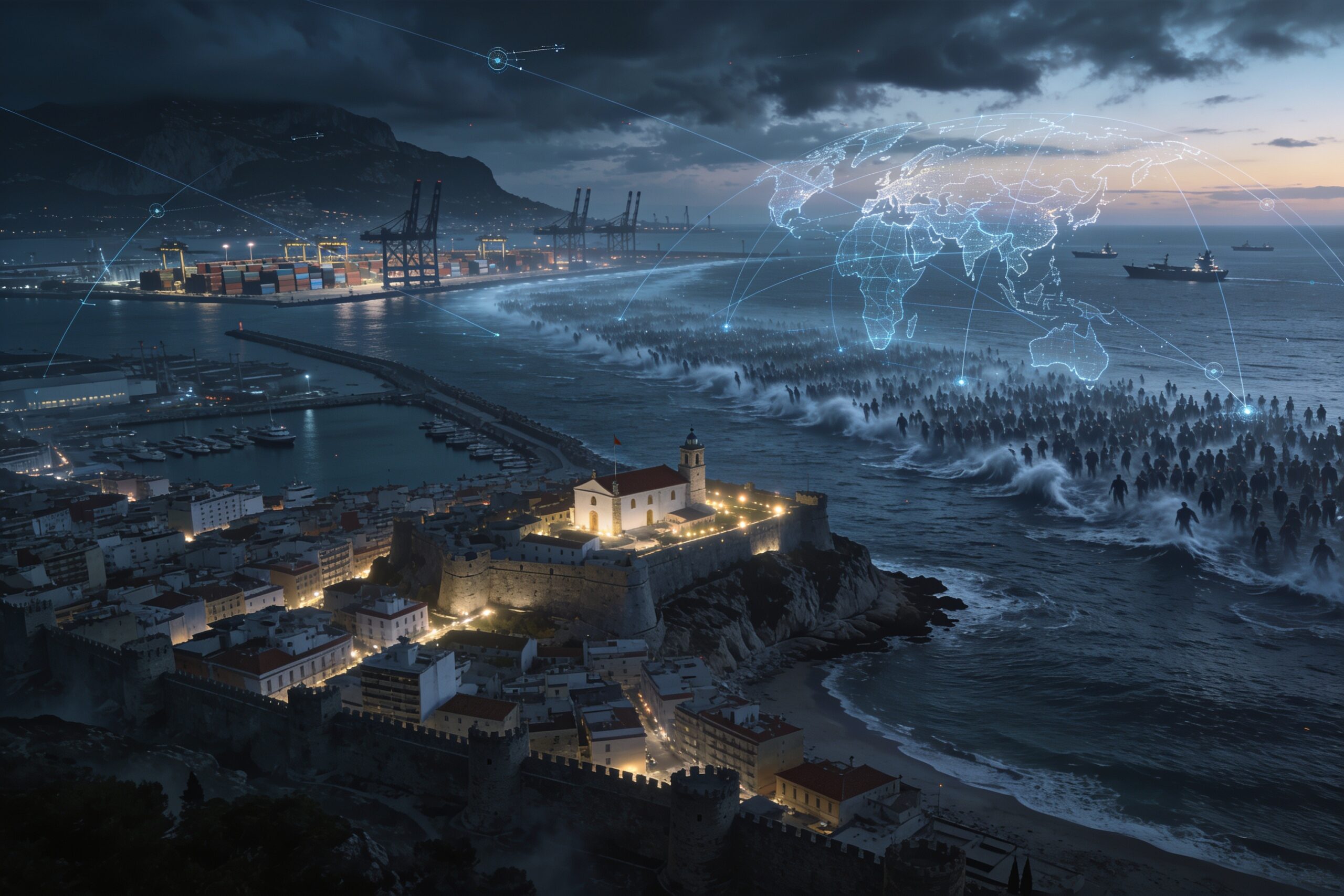
The border episode that took place in the Spanish autonomous city of Ceuta on 30 and 31 July was yet another attack on Spanish territorial sovereignty by the dictatorial monarchy of Mohammed VI’s Morocco. These actions were not an event where there was a disconnect between the illegal irruption of more than 60,000 Moroccan immigrants of military age into a Spanish territory such as Ceuta[2] —with a population of 84,208 inhabitants—, and Morocco’s plans and programs.
The Spanish authorities have been reporting that during the last ten days there were between 1500 and 2000 illegal entries, including during the night, in what appears to be tests to test the level of porosity of border security, as well as a method of attrition of its authorities.
This crisis responds to the execution of the “Morocco 2030 Plan” which aims to acquire – agreed with Spain – the Canary Islands, Ceuta and Melilla through a co-sovereignty regime, the first step of which, as Fernando Cocho indicates, is to gradually surround the autonomous cities of Ceuta and Melilla, and the port of Algeciras in Cadiz[3].
To this end, the Moroccan port of Tangier Med plays an essential role because, being outside any EU mandate, it can compete in better conditions against the Spanish port of Algeciras in the framework of absorbing maritime trade in the region.
The results are clear, as Tangier Med already in 2024 surpassed Algeciras in container traffic – thus consolidating itself as the largest port in Africa – by 5.7 million TEUs[4]. This is one of the many moves in which Morocco is not only strengthening its role in the Strait of Gibraltar region on an economic scale, but is also doing so as a most trusted partner of the US and Israel, from which it is receiving top-level arms support, unbalancing the strategic balance of the region to the detriment of Spain[5][6].
1.Immigration as a geopolitical weapon of the Moroccan regime.
Another of the great weapons that the Moroccan regime possesses for this hybrid war is demography and its operational role as a buffer state for migratory flows. In International Relations there is a concept such as “coercion through migration” or “weapon of mass emigration”, which is an instrumentalization of large migratory masses by one State to orient them against another and thus influence their behavior so that it adopts a position favorable to the strategic interests of the sending State.
These positions are expressed in concession policies, whether diplomatic, territorial or merely economic, producing an area that is commodified by the State that controls the migratory tap, which is configured under both a geoeconomic and geopolitical perspective. A situation that creates relations of dependency in which the country that is harmed by migratory flows depends on a buffer state that instrumentalizes its geographical position and its capacity for control.
It is, in all respects, a critical point of weakness that can only be tackled by reinforcing the border; increased regional control; the increase in diplomatic pressure; the increase in investment and development in border cities and reconsideration of the regional strategic framework.
In the case of Ceuta, due to its geographical position, it is an essential piece for the control of the Strait of Gibraltar to remain exclusively in Anglo-Saxon hands, since the Spanish city is in line with the Rock of Gibraltar colonized by Great Britain. The loss of Ceuta as a Spanish city would mean control over both coasts of the Strait of Gibraltar and the strategic passage that connects the Mediterranean with the Atlantic, giving dominance over one of the most important bottlenecks in the world. Its importance is of such magnitude that all maritime traffic between Europe, Asia (Western and Eastern) and America must be done through this area, influencing trade routes, energy routes (oil and gas) and security deployments.
Anglo-Saxon regional surveillance capabilities would increase since it provides the power to control maritime movements between the Atlantic and the Mediterranean, which would mean control over Spanish ports – deactivating them as nodes with potential for power – and the establishment of a regional legal framework where Spain would only be a passive actor. And, of course, it would be a cut-off zone for ships related to the BRICS countries (Russia, China, Iran, etc.).
In particular, the characteristics of Morocco’s demographics make it ideal for fulfilling its function as a geopolitical weapon – although the North African country itself controls the irregular migratory flow from the Sahel and West Africa[7]. We are talking about almost 40 million inhabitants with an average age of 30 years – much younger than the European average in general – whose unemployment rate for young people between 15 and 24 years of age was 37.3% in 2025, to which is added 25% of NEET young people – that is, who do not study, they do not work and do not train – according to data from the International Monetary Fund[8].
This is due to three factors that coincide, by the way, with the high youth unemployment in Spain:
Economic growth is not simultaneous with the creation of new jobs for young people of working age.
The training of young people is not adapted to the needs of the labour market.
The private sector is still weaker than the state sector, so many young people prefer to compete for work in a public sector where the number of jobs is smaller.
The creation of youth employment, for now, continues to be one of the great economic challenges facing the Moroccan dictatorship and one of the main reasons why the country’s youth are more inclined to emigrate to Spain.
Here, at this point, another factor is added, which is the “pull effect” that, above all, is executed through social networks where a false image of generalized opulence is given among the inhabitants of the European country. To which, in correlation, we can overlap the application of a highly flexible immigration reception policy and non-existent border security.
But these last two points are only some elements that reinforce the migratory wave, but do not promote it as such, but it is above all promoted and instrumentalised by Morocco as a hybrid warfare device.
There have already been recent complaints about this by the Moroccan Association for Human Rights (AMDH), pointing to the regime of Mohammed VI as “politically and legally responsible for the catastrophic conditions that have led to this collective exodus, comparable in magnitude to situations typical of war zones or armed conflict” which, above all, has been possible due to the decades of impoverishment suffered by the Moroccan population because of that great ally of Israel and the US that is the regime of Mohammed VI.
“The AMDH held the Moroccan state directly responsible and warned that “hopelessness has ceased to be an individual feeling to become the identity of an entire generation, which sees migration as an expression of rejection against inequality, corruption, authoritarianism and abuse of power”.[9]
Just three weeks ago, the Supreme Court of Justice of Spain ruled that border rejections (hot returns) of illegal immigrants who swam through Ceuta and Melilla were prohibited; the Spanish border authorities having to follow the ordinary return procedure of Article 58.3 of Organic Law 4/2000, of 11 January, on the rights and freedoms of foreigners in Spain and their social integration.
In other words, according to the Spanish Supreme Court, those who enter through the sea do not pass a border containment element, so the “border rejection” cannot be applied immediately and does not have a repatriation fit[10].
This operation of instrumentalised use of the migratory mass by Morocco has so far caused 72 deaths confirmed by the Spanish government[11], of which both the Moroccan authorities and the Supreme Court of Justice and the US-Israel Axis are accomplices, who are behind the harassment and demolition against Spain for not having bowed to the AngloZionist directives to attack the Islamic Republic of Iran.
The complaints of the State Security Forces and Corps have not ceased since then due to the seriousness of the event.
The aggression of Morocco, the US and Israel against Spanish sovereignty has sown real terror and riots in the city of Ceuta, with a population rising up against the waves of foreigners who have illegally broken into our territory and have carried out everything from the destruction of street furniture, crimes and even robberies in broad daylight. as we could see in hundreds of videos and images disseminated by Ceuta on social networks – of which the Spanish press, that with journalists belonging to the “Pro-Moroccan Lobby”, published nothing.
The Unified Association of Civil Guards (AUGC) through a statement published on Sunday, August 2, has denounced the lack of means, the lack of pension plans and, above all, the lack of “European solidarity”.
All this scenario despite the existence of prior warnings and the border consequences that the Supreme Court ruling would unleash. Meanwhile, the Civil Guards suffer endless services without sufficient relief and “face aggressions when intercepting entrances through the fence” with the persistence of the lack of foresight for the deployment of the necessary means[12].
2. The previous crisis in Ceuta in May 2021
This has been a common pressure and war technique of Morocco against Spain over the years, recalling the previous chapter on 17 May 2021, when the Moroccan authorities launched some 12,000 illegal immigrants against Ceuta[13], causing the largest migration crisis at Spain’s borders to date.
The main reason was that the Spanish citizen Brahim Ghali – leader of the Sahrawi Polisario Front and president of the Sahrawi Arab Democratic Republic (SADR) – had been admitted to the San Pedro hospital in La Rioja since April of the same year due to his serious condition due to Covid-19.
Not content with the situation, Morocco demanded from President Pedro Sánchez in a secret meeting in July 2021 the dismissal of the then Minister of Foreign Affairs, Arancha González Laya[14] —as a condition for suturing the bilateral crisis—for having allowed Ghali to be transferred to Spain. Without waiting any longer, Sánchez complied with the order and on July 10 replaced Arancha González Laya with José Manuel Albares in the Ministry of Foreign Affairs; fulfilling its role as a submissive to the appetites of the Moroccan dictatorship and dealing a blow to the democratic and sovereign principles it claims to defend.
More details of other motives or interests behind this action could be known if Israel – an ally of Morocco – allowed progress in the investigation of what happened in the mobile phones of Ministers Fernando Grande-Marlaska (Interior), Margarita Robles (Defence), Luis Planas (Agriculture) and President Pedro Sánchez himself, who were infected with the Pegasus espionage system – belonging to the Israeli company NSO Group to extract quite sensitive data that could have been used as blackmail.
What we do know is that according to reports from the National Cryptologic Center, Sánchez’s mobile phone was infected with this spyware on May 19 and May 31, “coinciding with the diplomatic crisis between Spain and Morocco over the entry of thousands of immigrants into Ceuta.”[15]
3. The United States and Israel reinforce the Moroccan narrative against Spain
The accusations against the US and Israel as a formal part of this aggression against Spain are fully founded, beyond the anti-Spanish triangle they form with Morocco for the strategic transformation of the Strait of Gibraltar region.
On April 30, 2026, the House Appropriations Committee – the body in charge of deciding the allocation of federal spending – published parliamentary report 119-631, belonging to budget bill H.R. 8595 for 2027, authored by Mario Rafael Díaz-Balart, Republican congressman from Florida, vice chairman of the Committee and Chairman of the Subcommittee on Homeland Security. Department of State and Related Programs.
This document states, for the first time in the US, that Ceuta and Melilla are two territories “administered by Spain” but that they are located in “Moroccan territory“, adding an ambiguity to the recognition of these territories as Spanish sovereignty in its entirety. The document also contemplates the investment of 40 million dollars for assistance in military cooperation with Morocco, as this serves the national security interests of the United States:
“The Committee continues assistance to Morocco in support of U.S. national security interests and directs no less than $20 billion under the National Security Investment Programs and no less than $20 billion under the Foreign Military Financing Program.”
A project that was approved by the House of Representatives on July 15 of this year by 217 votes in favor against 209 against. This indicates a clear way of urging Secretary of State Marco Rubio to promote a bilateral diplomatic dialogue between Spain and Morocco for the change of the status of autonomous cities and other territorial claims of Morocco[16].
Of course, Spanish sovereignty over these territories is recognised by the rest of the states, so it remains in the same place, but this change in US conception may mean the beginning of this international recognition coming to an end in the medium term, given that the US is part of the United Nations Security Council and, therefore, it has the right of veto over General Assembly resolutions[17].
Another relevant event took place on 2 July, five days before the NATO Summit in Ankara (Turkey), Donald Trump himself pointed out that Spain, although a member of the Alliance, was not a good member for “behaving badly” by refusing to help in its war of aggression against Iran. He then said an indicative and warning phrase: “You will learn soon, as soon as when you gave up Cuba, Guam, the Philippines and Puerto Rico. We got everything.”[18]
With this, Donald Trump mocked what awaited Spain a month later, whose plans were already more than made, and that their territorial loss would benefit, once again, the United States. Just like in 1898, the year in which the United States was born as a predatory empire, precisely, against Spain. A next step in its political formation in the American continent, after having been founded as a State after the extermination of Hispanic Indians in America with its genocidal “Conquest of the West” towards the Pacific Ocean.
On the other hand, we have the next actor in this triangle of aggression, which is the Zionist entity of Israel. The Tel Aviv regime – whose Prime Minister Benjamin Netanyahu is wanted by the International Criminal Court (ICC) for alleged war crimes and crimes against humanity [19]– has from the outset activated a media and intelligence operation as a strategic counter-strike against a Spain that has supported from the outset – albeit in a discursive sense – the cause of the Palestinian people and Iran’s sovereignty in the face of imperialism predatory Zionist.
Israel’s ambassador to the UN, Danny Danon, charged the Spanish government on Friday, August 31, with some rather cynical statements on the social network X regarding the crisis in Ceuta – knowing the Zionist geopolitics based on the extermination of the Palestinian population, regional expansionism (as in the case of the West Bank, Lebanon, Syria, etc.) and racism as a doctrine of consolidation of Greater Israel.
After having criticised Spain’s migration policy and falsely claiming that it had declared a State of Emergency, it has asked the government for explanations as to “why it continues to maintain colonial enclaves in Africa“, proceeding to launch another real hoax that is not a mere exercise in provocation, but of overlapping with the US and Morocco in the narrative to establish the annexation of Ceuta and Melilla as Moroccan territories and, what is more important, to put it on the table of international debate so that it becomes effective with the necessary recognition[20].
4. Conclusions
This has been a fully orchestrated operation between the US, Israel and Morocco where the primary objective was to provoke a much more aggressive response from Spain to the imminent avalanche of illegal immigrants who had the permissiveness of the Moroccan border authorities and intelligence services, how else can 60,000 people be mobilised towards the Spanish-Moroccan border?
A Spanish response that, as dictated by law, must be based on the defence of the borders and, therefore, of our national sovereignty in the face of this hybrid attack in a grey area such as the Strait of Gibraltar. A security movement that would have provoked gunfire and, immediately afterwards, a propitious scenario to substantiate to a greater degree the “urgent need for the return of African territories from Spain to the Kingdom of Morocco as remnants of the colonial past” before the UN.
But the Spanish government did not fall into this trap, which had all the characteristics to propitiate the desired scenario, that is, the theft of two territories that have been Spanish since the fifteenth and seventeenth centuries, centuries in which none of the AngloZionist aggressors existed.
These are just some of the indicators that point to the great transformation that the AngloZionist Axis wants to carry out in the Strait of Gibraltar region to strengthen Morocco and consolidate it as a trusted partner in the area. The series of changes that are taking place in the world are a direct consequence of the dialectic of states, and the Strait region may be a response to the geostrategy carried out in West Asia by China and Russia, in which Iran is part of that Primakov Triangle in which the Strait of Hormuz – because of the Gringo-Zionist aggression of February 2026 – It is the great critical node of destabilization of the global system against the economies of the aggressor Western powers.
The total possession of control of the Strait of Gibraltar, as we have explained above, would lead to a legal framework where Spain would be subordinated and the region would be oriented against the BRICS countries. This would be possible above all with the overlapping of an axis that starts from the following island points (British colonies) in the South Atlantic to the North Atlantic, where they would connect with parts of the Spanish territory that Morocco claims as its own:
Malvinas Islands – South Georgia and the South Sandwich Islands – Tristán Da Acunha – Saint Helena – Ascension – Canary Islands (Spanish sovereignty) – Strait of Gibraltar (under Spanish control) – Alboran (Spanish sovereignty).
This string of islands would give total dominance to the AngloZionist world over the Atlantic, both to the North and to the South, in addition to controlling one of the most important maritime passages in the world, that is, the Strait of Gibraltar. And to this end, Morocco plays the role of a disruptive element in the area, continuously eroding Spanish sovereignty through hybrid warfare carried out with the migratory, media, diplomatic, cultural, military and international factors.
Morocco’s territorial claims are superimposed on the regional policy that the US and Israel want, so in this context the Mohammed VI regime has everything in its favour for the fulfilment of the territorial expansion of Greater Morocco, which is seen from Washington and Tel-Aviv as a geopolitical containment bloc to the presence of Russia and China in Africa and a Spanish geopolitics based on the Balearic Islands-Strait-Canary Islands axis.
The steps have already been taken previously, for many years, with a preferential inclination for Morocco for the acquisition of armaments that are not even sold to Spain, gradually tilting it into a privileged situation in the region, putting at risk the southern borders of a NATO and European Union partner country such as Spain.
The strategic balance will continue to lean towards Morocco if the Spanish central government does not design a policy of restructuring strategic relations with the countries or powers that are enemies of the actors that intend to invade sovereign territory.
And to do this, it must first break diplomatic relations with the aggressor powers and move towards a strategy of imprisoning Morocco through an alliance with the Sahrawi Arab Democratic Republic (SADR), Mauritania and Algeria to encircle Morocco on its border lines and show it that it is a state in an area where its great allies (the US and Israel) are not the ones who can provide it with all the support it needs.
To start from a policy of containment and deterrence through an alliance of Friendly Countries of the Strait of Gibraltar (PAEG) aimed at maintaining a balance of geopolitical power that sets limits on a state like Morocco whose foreign policy threatens all its neighbouring countries.
Of course, with the protection of the powers of the BRICS countries such as Russia or China, which, unlike Spain’s “European allies”, has declared that it opposes “any form of illegal immigration” and that issues related to this episode are addressed in a coordinated manner[21].
8- International Monetary Fund. Middle East and Central Asia Department. (2026). Morocco: 2026 Article IV consultation and review under the Flexible Credit Line Arrangement—Press release; staff report; and statement by the Executive Director for Morocco. IMF Staff Country Reports, 2026(72). https://www.elibrary.imf.org/view/journals/002/2026/072/article-A001-en.xml?utm_source=chatgpt.com
9- (2026b, 1 de agosto). Morocco: Human rights organisations denounce political use of migration in Ceuta – teleSUR. teleSUR. https://www.telesurtv.net/marruecos-ong-uso-politico-migracion-ceuta/ laSexta.com. (2026, 30 de julio).
10- laSexta.com. (2026, July 30). Just three weeks ago, the Supreme Court banned hot returns for those who swim into Ceuta and Melilla.
11-Mariño, M. (2026, 2 de agosto). The government puts the official death toll at 72, although other sources put it at more than 100. The Correo Gallego. https://www.elcorreogallego.es/espana/2026/08/02/ceuta-muertos-crisis-migratoria-133034208.html
20- (July 31, 2026b). Israel’s UN ambassador attacks Spain over its ‘colonialism’ in Ceuta, and Puente delivers a disturbing retort. ElHuffPost. https://www.huffingtonpost.es/politica/el-embajador-israel-onu-ataca-espana-colonialismo-ceuta-puente-le-da-inquietante-replica-f202607.html