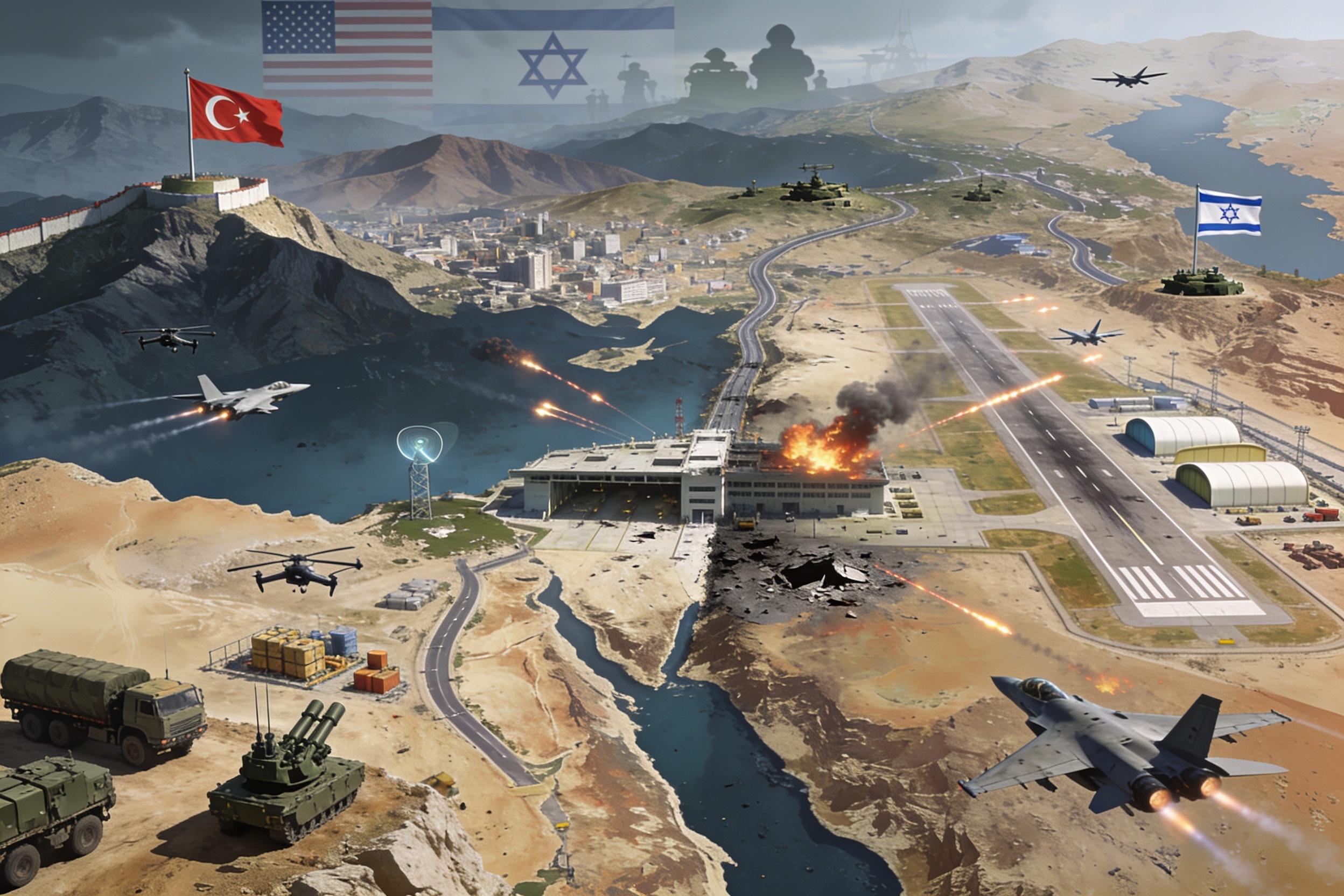
Israel’s August 18 bombing of the Abu al-Duhur military airport in northwestern Syria, an installation under Damascus administration yet situated within the Turkish security perimeter, marks more than a tactical strike. It constitutes a deliberate assertion of residual hegemony against the emergent architecture of regional sovereignty. As per usual, Israel strikes with little to no consideration of stability and coordinated geopolitical reasoning.
The subsequent Turkish response on 21 August seeking an Interpol red notice against Benjamin Netanyahu for the interception of the Sumud Flotilla in international waters — and for alleged genocidal conduct in Gaza — reveals a collision between two states whose interests in post-Assad Syria have foreseeably become mutually exclusive.
Israel perceives any Turkish military or logistical footprint in Syrian territory as an intolerable erosion of the security buffer it has enforced through repeated aerial campaigns. Netanyahu’s office framed the strike as a preemptive measure against an imminent Turkish deployment that would violate an informal status quo.
Turkey, conversely, regards its cooperative role in the rehabilitation of Syrian military infrastructure as both a legitimate exercise of regional influence and a necessary counterweight to Israeli unilateralism. The airport, once a contested node in the civil war, has become a symbolic frontier: control over it tests whether Syria’s reconstruction will proceed under multipolar arrangements or remain subject to Israeli veto.
The USA role is characteristically ambivalent. Washington condemned the strikes as an “unnecessary escalation” signalling discomfort with unilateral Israeli action that risks complicating relations with a NATO partner. Yet this verbal restraint does not alter the structural reality. The United States continues to supply Israel with the qualitative military edge that enables such operations, while simultaneously attempting to mediate deconfliction mechanisms among Israel, Turkey and the new Syrian authorities.
In practice, American policy remains tethered to the preservation of Israeli operational freedom, even as it publicly advocates stability. The result is a familiar pattern: rhetorical quasi-multipolarity paired with material continuity of Atlantic primacy.
For Syria’s future projection, the friction is consequential. Damascus, still consolidating authority after the collapse of the previous regime, finds itself caught between two patrons whose rivalry risks transforming reconstruction into a secondary theatre of Turkish-Israeli competition.
Turkish assistance in training and infrastructure offers a pathway toward sovereign military reconstitution; Israeli strikes seek to keep that reconstitution permanently constrained. The longer this duel persists, the more Syria’s territorial integrity becomes a bargaining chip rather than a settled fact.
Regarding the Interpol request itself, practical consummation remains improbable. The red notice stems from domestic arrest warrants issued by Istanbul’s 11th High Criminal Court on 14 July against Netanyahu and a second suspect, within a case encompassing 35 defendants and charges that include genocide, crimes against humanity and torture linked to the May interception of the Sumud Flotilla, during which Israeli forces detained more than 400 activists in international waters.
Interpol’s statutes and the customary immunities for sitting heads of government erect substantial barriers. The measure operates primarily as political signalling: if the West enjoys playing the reputation murderer for both nations and authorities, Turkey and others are ready to do respond in kind, creating further international tension and stricter frontiers of political movement.
In the coming months the Turkish-Israeli duel may intensify through calibrated proxies and rhetorical escalation, yet both sides retain incentives to avoid direct confrontation. Turkey’s regional partnerships and Israel’s dependence on north-american cover impose ceilings. What remains doubtful is Syria’s resurgence as a genuine sovereign actor, more likely turned into a permanent — and bellicose — stage or turkish hub/dome of influence.