Let’s start with a first essential consideration, how could we summarize in a few words the aggression of the USA and Israel against Iran? For example, quos vult Iuppiter perder, dementat prius. The Latins said that God blinds those he wants to lose. We cannot believe, however, that the Americans and Israelis did not know that Iran is no longer the country it was so long ago, certainly valiant and resilient even at the time of the conflict with Iraq, but then unable to stand up to the world’s leading superpower and its main ally in the Middle East. In those days, in fact, but today it seems so.
However, we, who have studied the books of the great Italian realist school, from Machiavelli to Moscow, Pareto and Michels, do not fall into the shortcut of madness or recklessness when we talk about Trump (USA) and Israel (Netanyahu), which not only have prepared armies but also efficient intelligence apparatuses. At least we will not accept this idea, because power, no power, is based on individuals and their decisions, but it is always a process that lasts independently of its subjective terminals, and certain decisions do not depend on the moods of a few individuals, even if they are still small circles that take responsibility for choices.
One reason could be what Machiavelli writes about, battles are often started to test the actual potential of the enemies and to prepare for the real war at a later time, even if not so close. If there was some perplexity about the real size of Iran, now the US and Israel know that this is a regional power capable of defending itself and doing it well, so much so that it has been able to attack US bases in the Gulf.
Iran is standing up to the Israelis and Americans, almost certainly with the assistance of the Chinese and Russians, indeed I would say undoubtedly, and now the aggressors know that they will have to change their strategy to preserve their hegemony in the Middle East. The American approach will also have to change both towards Israel, because a single horse is no longer enough to garrison the area, and towards the petromonarchies, which will feel the weight of insecurity after the attacks suffered.
And do not even foolishly believe that the United States has embarked on what can now be defined as a war misadventure because it was dragged by the Israelis. This is also a cliché, it is never the tail that moves the dog, although the dog can follow the tail if it finds some interest in doing so. Let’s say that the pressures of the Israeli lobbies have played their role, but this is certainly subordinate to the objectives of the Americans, who consider the area essential to contain and contend for hegemony with powers that are reaching their levels, and this reflects at this moment the “escalation” of multipolarity due to the relative American decline that deprives some sensitive fronts.
As the so-called revisionist powers, the main poles that for the moment we indicate in China and Russia (but behind these India is also growing together with other nations in search of protagonism in other areas), will continue to strengthen to the detriment of the Americans, even when they deem it convenient to reach temporary pacts, these conflicts will grow above all for interposed countries and in the geopolitical quadrants where the United States is more present, while the American continent will remain a strategically more protected space and difficult to penetrate by rivals, as if to say the golden bridge to be left to the enemy who will one day withdraw from the world.
The instability in the Middle East could soon extend to Mediterranean countries that today feel safe, some because they are members of the EU, and will continue until these powers in accumulation of strategic projection, after having established their positions, do not come to a direct confrontation. But this will still take some time.
A brief parenthesis, the control of the Middle East is not only a matter of straits where ships carrying oil pass, nor of economy tout court. Often hegemonic issues are interpreted too narrowly as a matter of money and business. Here the economy is not the point, although it remains important. Rather, the crises that descend and will still descend from these scenarios hide much more substantial aspects. It is the loss of power of the regulatory center (the USA) that generates the negative economic effects and not vice versa.
We forget some episodes of history that are useful to retrace. Here I will resume what were the theses of my teacher, the economist Gianfranco La Grassa, who recently passed away. Let’s take the so-called great stagnation of the late nineteenth century. That situation was the effect of a geopolitical discoordination that reverberated on the economy and that would later lead to the great conflicts of the twentieth century. Even then there were countries that grew economically in the decline of many others, but at a much lower rate than in the previous thirty years.
And we were in the middle of the second industrial revolution, electricity, chemistry, especially in Germany, and, a little later, the internal combustion engine that gave life to that sector that was later part of the so-called metalworking, creator of most of the war vehicles used in the twentieth-century wars, in which the work organization that went down in history as Taylorism-Fordism developed, which some theorists and historians considered, and it is more recent history, the main cause of the victory of the United States in the Second World War.
These theses, always simplistic, of the type of the more recent ones obsessed with the omnipotence of finance, confuse, among other things, what was correctly considered, for example a century ago by Hilferding and Lenin, the intertwining, “symbiosis” for Lenin, between banking and industry, with simple capital in liquid form or easily transformable in this way.
Returning to that more distant crisis, let us remember that even then intense technological development (today we think of the new frontiers opened by AI but not only) created serious difficulties in the employment of the workforce and made obsolete many work skills, already heavily invested and even wiped out by the first industrial revolution (1760-1830/40), with the destruction of the still artisanal knowledge in force in manufacturing, even though it was already capitalist. Economic crises, those typical of the capitalist mode of production, so different from the famines of previous forms of society, are always, in various ways, a symptom and effect of the eternal struggle, acute or less acute, for spheres of influence.
La Grassa suggested not to forget these fundamental historical information, otherwise we would not understand the inevitability of the sharpening of conflicts, extremely confused and with continuous changes of alliances, a typical consequence of the slow affirmation of other powers that make it impossible for a relative regulation of the global system by a predominant power.
And he concluded, there will be nothing more regulated until the next, not yet very close, decisive clash for a new supremacy. And this is probably what we are seeing before our eyes, although not yet in all its effects. If we want to make comparisons, we could say that today we are close to a situation similar to that of the early twentieth century, we have already experienced acute financial crises such as that of 2006-2008, which were unloaded on the real economy, then also phases of small recoveries and then more relapses, without ever really having come out of the global economic difficulties.
These are the signs that we are approaching much more serious issues that could explode in the coming years at the military and therefore geopolitical level. And let’s not forget that between the First and Second World Wars there was also 1929, the Great Depression, which was the effect of a conflict for predominance that had not been resolved in 1914-1918 and it took a second even more tragic war in 1939-45 to really start again. This led Churchill to speak of a single war in two stages, to arrive at the victory of only two powers that divided the world, namely the USA and the USSR, with the “sunset” of England which had been the pivot of the previous balances.
It will be the decantation of the current situation that will give rise to a new world equilibrium but only after the real balance of forces on the ground has been defined through one or more wars for supremacy. Then a new stabilization center can be born that will also put economic order and imprint new rules for everyone.
Let’s also not forget that the Middle East is a hinge region between Europe, Asia and Africa. If in Asia the potential competitors of the United States now abound (even if they show ties and good relations with Washington), if in Africa the Chinese and Russians create havoc and extend their tentacles, Europe is instead the area that the United States dominates more steadily and which probably represents one of the decisive spaces in which they will defend their hegemony, however modified it may come out of the next wars.
And here we come to NATO, which is the structure through which the United States exercises its military “influence” in Europe. You can’t get out of the cages from the inside except by knocking them down, the cages are closed, the owner opens them when he needs something, even more so if you need to squeeze resources in times of difficulty. NATO is this cage for Europe and therefore it will not end if not at the behest of the United States, or it may turn into something that the Americans consider more useful in the present historical phase. Europe, as it stands today, can only suffer any decision from outside.
The vast majority of NATO members are in Europe. A substantial part of the EU members is in NATO. As has emerged from historical documentation, European integration developed on American impulse within the framework of the US strategy of containing the USSR, and after the collapse of the latter, American geopolitical objectives changed form and name without disappearing. The purpose of NATO, like the United States, is always the same, “to keep the Americans in, the Russians out and the Germans down”.
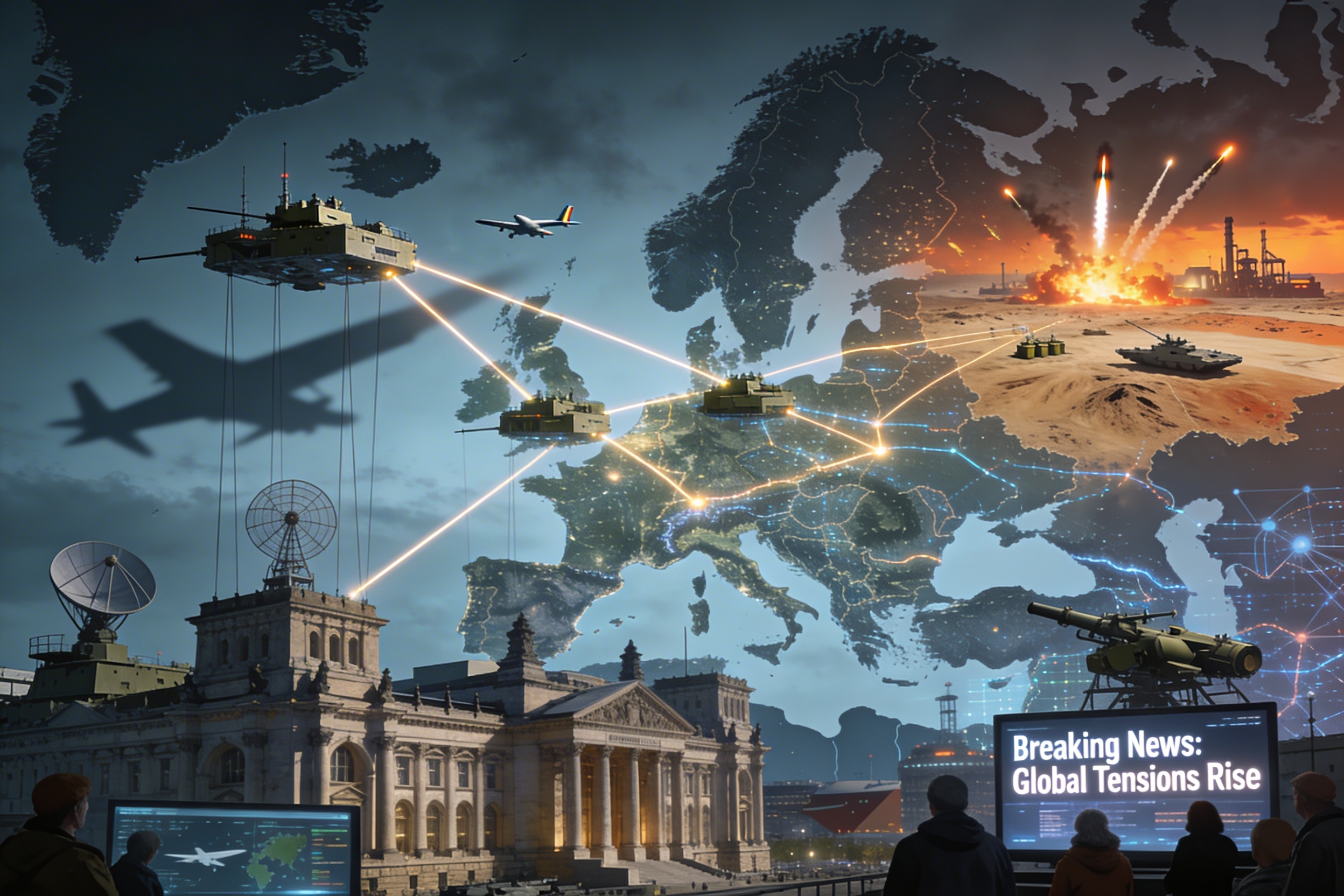
The NATO bases in Europe, to which are added the American bases, especially in Germany and in my country, Italy, are part of a military device built after the Second World War and then expanded, with new installations also in the countries of the former Warsaw Pact and in the Balkans, such as Kosovo and so on, after the implosion of the Soviet Union. In this way, the United States has consolidated a widespread military presence on the continent that we call the Atlantic alliance, but which is not an alliance. If we wanted to call things by their name, we would have to speak of a form of occupation armored with ideology.
When Trump tells the Europeans that they must do more for NATO, he is not asking them, he is ordering them to do so and, in good order, if it is not just a Trump-style bluster but a real request that comes from the American state, European leaders can only give in without complaining too much. NATO, in some ways, mutatis mutandis, does not work differently from the Mafia, it is not easy to enter and leave and on its own arrangement. Think about Ukraine and the price it is paying to be included. To get out of it, today, it would be even worse. A particular case was that of De Gaulle’s France, which in 1966 left the integrated military structure, only to re-enter it decades later with Sarkozy as president. But that was a completely different story and it was made possible in a context of bipolarity and the foot that Russia already had in East Germany, it was a matter of not complicating an already difficult picture by making sure that Paris did not move eastwards with some concessions observed very closely. Other times.
Leaving NATO can therefore be a big risk, not because you are exposed against enemies but because the US would implement various maneuvers to avoid it, from the soft to the most coercive, including coups d’état, color revolutions and even military aggression. So NATO, firmly led by the Americans beyond formalism, imposes choices that are difficult to reject by the allies. As Don Corleone would say, advice that cannot be refused. Intelligent pauca.
So the Europeans will not do what Trump says, that he is only an American president who can always change and no one knows how long it lasts, but what the American power will deem useful for its interests. If NATO is dissolved, it is only because the Americans will no longer consider it adequate to their objectives and certainly with this they will not disengage from the European scenario, but will change their mode of domination.
They have bases and soldiers in Europe, beyond the rhetoric of the alliance this is a structured military presence, and from garrisons of this type one can only get rid of with strong changes in the balance of power, with wars or revolutions (in the order reported), so to speak.
Here we see what the real impact of the war in Iran on Europe can be. The increase in energy costs is undoubtedly one of these (but not the main one), but it weighs heavily after the EU, at the behest of the US, began to arm Ukraine and hit Moscow with sanctions, also and above all hitting itself. As I said, however, the real impact of the war in Iran, beyond the economic fallout, is as much psychological as it is military.
The Iranians have hit American bases in various areas of the Middle East. If the Americans decide one day to attack other powers using bases in Europe, we, on the old continent, would face devastating consequences. American bases respond to the strategic interests of the United States, they do not serve to defend those who “host” them. After Iran, this element appears more evident, and European leaders are faced with a growing tension between the imagination of subjection and the reality of the historical process. Above all, European public opinion understands this, and they are beginning to see that the American dream can be a bad nightmare. It is the end of an ideology that has lasted decades.
Secondly, from a military point of view, we observe that in the production of some advanced armaments, such as missile systems, Russia and China have developed competitive capabilities and will continue to do so. The West does not have all the primacy of war technology and technology. A more complex phase is therefore opening up for Europe, also in the light of more than seventy years of relative stability.
The dangers are internal to the European system which, once its true backbone, forged by the United States, is revealed, could be shattered. NATO or not, the Americans will not leave Europe, even at the cost of having second thoughts about the EU (they could interfere to redesign it to their liking) and could indeed take more assertive attitudes, unloading all the costs of international tensions on allies who are not allies but are satellites inserted in a very specific hegemonic orbit.
Then the issue of the nature of this presence will arise with greater clarity, which is in truth a prolonged occupation of the European countries, covered by the community architecture called the European Union, built by the Americans not for the well-being of the European peoples but for their needs for domination and control of the Old Continent.