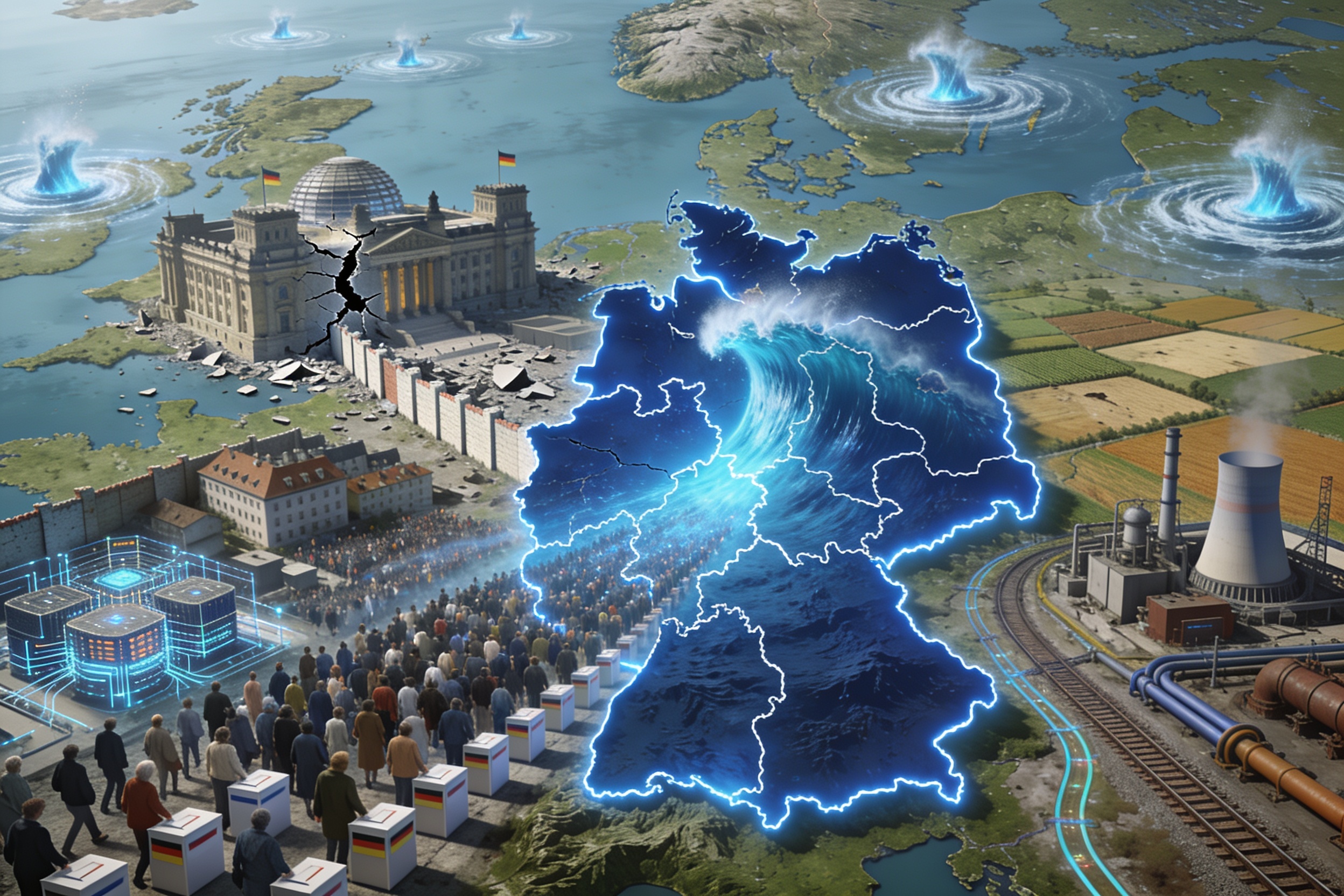
On Sunday, September 6, 2026, 1.7 million eligible voters were called to renew the regional parliament (Landtag) of the state (Land) located in the eastern part of Germany and formerly part of the GDR, the German Democratic Republic. The Alternative for Germany (AfD), a radical right-wing party, beat the other parties and even the polls, which gave it 40%. It reached 44%, a result never achieved before by a far-right movement since the Second World War.
The first interesting figure was that of turnout. Compared to the abstentionist trend of recent years throughout the continent, as many as 80% of Saxon adults went to the polls, demonstrating a strong desire for change compared to the traditional Christian Democrat leadership of the CDU, which is halved with 18%. The socialists of the SPD collect 9.3%, Carola Rachete’s party, Linke 8.6%, the Greens 8.9%, and the left-wing populist party BSW exceeds the threshold with 5%.
The outgoing governor of the CDU, Sven Schulze, is honest, admitting defeat: “They are the strongest party, we have to face the situation – he declared in the heat of the moment on Vatican News – this is democracy, people went to vote en masse, like never before”.
This vote is the tombstone on the credibility of the superiority of traditional parties. Continuing to scream extremism and to brand as unpresentable or irresponsible millions of citizens who simply demand security, border control and social protections is yet another demonstration of a blind and deaf ruling class.
Leader Alice Weidel rejoices: “It is a historic and sensational result. We had a clear mandate to govern.” Ulrich Siegmund, 35, is the presidential candidate who led the AfD to a stunning victory. To Der Spiegel, which had called him “the most dangerous man in Germany”, he responded by distributing autographed copies of the magazine to his supporters. Married, with a daughter, he studied business psychology and administration, and then founded a small company that sells air fresheners.
Siegmund promises radical measures to make Saxony-Anhalt less multicultural, less “woke”, more family-friendly and openly patriotic. He argues that his program could convince German émigrés to return and help revive a stagnant economy.
Like the whole party, he rejects the derogatory label of “Nazi”. He is a former CDU, who left in 2014, who represents a more reassuring and communicative face for the AfD than that of a party known above all for anti-establishment rhetoric.
But behind the smiles and toasts with beer, his critics warn, radical positions remain. Among these, the promise to expel irregular migrants “from the first minute”. One of the main reasons for the massive Saxon vote for the AfD is due to exasperation over the lack of integration by too many immigrants, who, as in the rest of the Old Continent, end up delinquency and terrorizing the population. The Germans are calling for “law and order”, while Prime Minister Merz is unable to be self-critical, despite the fact that half of his voters have chosen the radical right.
It is absolutely false, the result of an offensive disinformation campaign, to dismiss the AfD as the party of the “Nazis”, especially for the political history from the post-war period to today, in Saxony, where the center-left has always obtained excellent results. No! 45% of the Germans in the Land do not have nostalgia for Hitler, nor have they suddenly pulled the moldy uniforms of the SS out of their closets! It has given, en masse, a signal of discontent and anger towards a self-referential ruling class, which has not served the interests of the people, especially on fundamental issues such as work, security and the welfare state.
Laura Ruggeri ha scritto sul suo profilo Facebook: “è certamente positivo che gli elettori della Sassonia-Anhalt abbiano nettamente respinto le disastrose politiche della CDU, il suo appello alle armi e la sua crociata anti russa, ma l’abbraccio all’ Alternative für Deutschland (AfD) non è esattamente motivo di celebrazione”. Va bene il sovranismo, ma non è oro tutto quello che luccica.
“Although the AfD attracts protest votes, i.e. those voters whose real concerns are ignored or minimized by centrist political forces, today the party is being actively co-opted by the same transnational forces that brought the MAGA movement to power in the United States. Within the AfD, two opposing visions of Germany coexist, but it is increasingly clear which faction has the deepest pockets and can make use of powerful allies.
On the one hand, there is co-leader Tino Chrupalla, who advocates a more traditional, nationalist, “Eurasian” and multipolar vision. On the other hand, there is Alice Weidel, who winks at the right of Silicon Valley and capitalist libertarianism. Weidel’s vision is gradually eclipsing the traditional nationalist wing.
This new vision is clearly written into the AfD’s technology and energy agenda. The party explicitly calls for Germany to double the capacity of its data centers and quadruple the computing power of AI by 2030. To achieve this, the AfD calls for an immediate return to nuclear power and the lifting of sanctions against Russia to ensure “cheap energy.”
Let’s be clear about what this means, with a critical analysis, seen from the Right, based on the documented facts: “the AfD’s much-vaunted desire for ‘better relations’ with Moscow is not driven by an ideological affinity or a genuine desire for a multipolar Eurasian security architecture. It is driven by the cold calculation of the tech industry. Russia is seen simply as a supplier of the gas needed to keep the servers of a hyper-digitized Germany running.
Elon Musk, in fact, has openly stated that “only the AfD can save Germany”, using his X platform to host live chats with Weidel and amplify the party’s messages. Peter Thiel, co-founder of Palantir and godfather of the “New Right”, also does not hide his appreciation for the AfD. Ruggeri, therefore, reasonably argues that this alliance aims at a deeply disturbing ideological synthesis, often described by critics as “technofascism”. It is a political model in which a technocratic plutocracy dictates the rules of society, merging the algorithmic logic of Silicon Valley with the nationalist impulses of the far right.
This program, at least in Saxony, could be mitigated because the AfD needs 44 seats to govern but it has obtained 39. The only two solutions are: an alliance between the extremes of right and left, AfD and BSW, which could find certain consonances on immigration, but not on the economy and, above all, on the new technocratic model. Or a pile of all the opponents of the AfD, including BSW, for the sole purpose of excluding the winner Ulrich Siegmund from any administration.
It is unlikely that such an alliance will last long. In fact, the AfD has already made it known that it does not intend to compromise and that, if it fails to form a government, it will ask to return to the polls to obtain 50% of the votes and seats. In reality, BSW is the only party that had not ruled out an alliance with the AfD, rejecting the anti-Alternative “wall”.
But a minority government is not ruled out either: at the third reading for the election of the president of Saxony, to which Siegmund will obviously present himself, a relative majority of deputies will be enough and BSW could be content to abstain to allow the AfD to form its first government in history. Finally, it would be reductive to consider the vote for the AfD as an exclusively local expression.
All of Germany, especially in the suburban centers, shares the same discontent as the Saxons. Even in France, Marine Le Pen is by far ahead in the polls for the presidential elections that will take place in seven months due to the same impatience as the French.
In Spain, Vox is gaining full support, also in light of the oceanic demonstrations against the socialist prime minister Pedro Sanchez on the migration issue, after the events in Ceuta.
Even in Italy, if the quarrels between the parties do not prevail, the 2027 elections could give a historic second term to the right of Giorgia Meloni, due to the failed proposals of the left and their anti-Italian themes of absolute acceptance towards all. Then there will be Greece and all the countries of the former Soviet Union, starting with Poland, which are almost all oriented towards the right. The EU must change or it will be the Europeans who will change it, because the measure is full!